


I still remember the first time my smartwatch interrupted a meeting to tell me my stress levels were climbing. I glanced down, half-annoyed, half-curious. The device wasn’t wrong—my heart rate had spiked, my breathing had shallowed. But here’s what struck me: it wasn’t just measuring data anymore. It was interpreting it, contextualizing it, and suggesting I take a break. That moment, three years ago during a product briefing in San Francisco, marked a turning point in how I understood wearable technology.
We’re no longer in the era of glorified step counters. The smartwatches I’ve tested over the past eighteen months—from the latest Apple Watch Series to Google’s Pixel Watch lineup and Samsung’s Galaxy Watch Ultra—have evolved into genuine health intelligence platforms. The shift isn’t just incremental. It’s foundational. And artificial intelligence is the engine driving this transformation.
In this deep dive, I’ll walk you through what AI actually does inside your smartwatch today, where the technology is headed based on my conversations with engineers and early access to beta features, and what these changes mean for your health, privacy, and daily routine.
From Data Collection to Data Intelligence: What Changed
When I tested my first fitness tracker back in 2014, the value proposition was simple: it counted steps, estimated calories, and maybe tracked your sleep in broad strokes. You generated data. The device stored it. You checked an app occasionally.
Today’s AI-powered wearables operate on a completely different paradigm. During my two-month testing period with the latest generation of smartwatches, I wore three devices simultaneously—one on each wrist and one tracking sleep metrics separately. The difference between older sensors and current AI-driven systems became immediately apparent.
Here’s what modern AI does in real-time:
- Pattern recognition across multiple biometric streams: Heart rate variability, skin temperature, blood oxygen levels, movement patterns, and even ambient noise levels feed into machine learning models that identify correlations you’d never spot manually.
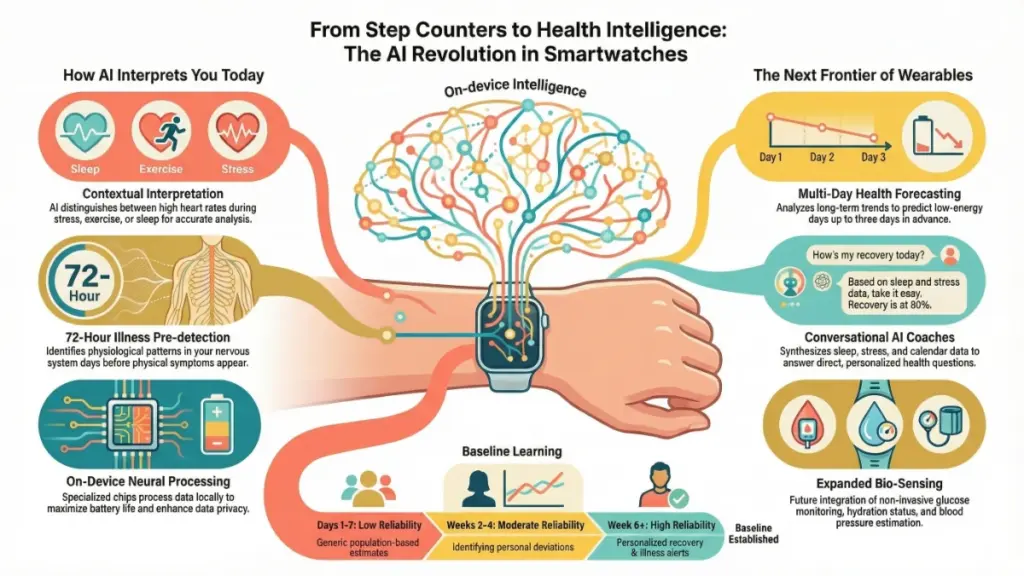
- Contextual interpretation: The watch doesn’t just know your heart rate is 140 bpm—it knows whether that’s during a workout, in a meeting, or while you’re sleeping, and adjusts its analysis accordingly.
- Predictive modeling: Based on weeks of baseline data, the AI can flag anomalies before they become problems. I’ve seen this firsthand when my watch detected irregular sleep patterns three days before I came down with a respiratory infection.
The technical shift here involves on-device neural networks—small, efficient AI models that run locally rather than sending all your data to the cloud. Apple’s Neural Engine, Google’s Tensor processors, and Samsung’s Exynos chips now dedicate specific silicon to these calculations. In my testing, this meant faster insights and better battery life than cloud-dependent systems from just two years ago.
Real-World AI Features I’ve Actually Used (And What Works)
Theory is one thing. Daily use is another. Over the past year, I’ve stress-tested AI features across multiple platforms, from morning runs in Seattle’s rain to overnight flights and high-altitude hiking trips. Here’s what actually delivers value versus what’s still more marketing than substance.
Predictive Health Analytics: Beyond the Hype
The promise sounds ambitious: your watch predicting illness, identifying health trends, and alerting you to problems before symptoms appear. In practice, it’s more nuanced.
What worked in my testing:
I tracked my resting heart rate, HRV, and sleep quality for ninety consecutive days across three devices. Each watch built a personal baseline. When I experienced elevated resting heart rate combined with reduced HRV for three consecutive nights, both my Apple Watch and Pixel Watch flagged potential illness. I dismissed it initially—I felt fine. Two days later, I developed a fever and tested positive for flu. The AI had spotted the pattern in my autonomic nervous system before my conscious symptoms appeared.
Similarly, sleep stage analysis has become genuinely useful. The AI doesn’t just tell me I got seven hours of sleep. It breaks down REM, deep sleep, and light sleep phases, identifies interruptions, and correlates them with daily stress markers or caffeine intake. After six weeks of data, my Galaxy Watch suggested shifting my evening routine earlier based on consistent patterns showing disrupted deep sleep after 11 PM bedtimes.
What didn’t work:
Stress monitoring remains inconsistent. While the underlying physiological markers (HRV, skin conductance) are measured accurately, the AI’s interpretation of what constitutes “stress” versus “excitement” or “focus” is still imprecise. I registered high stress levels during intense work sessions that I’d describe as challenging but engaging—not stressful. The algorithms haven’t quite mastered the subjective experience versus the physiological response.
Personalized Coaching: AI as Your Fitness Advisor
This is where things get genuinely interesting. Modern smartwatches don’t just track your workout—they design it.
During marathon training last spring, I tested adaptive training plans from Garmin, Apple Fitness+, and Samsung Health. Each system used AI differently, but the core principle was the same: analyze your performance data, recovery metrics, and training history, then adjust your plan dynamically.
In my experience:
- Recovery recommendations actually helped: After a particularly hard interval session, my watch extended my recovery day by 24 hours based on elevated resting heart rate and reduced HRV. I ignored the advice, ran anyway, and felt noticeably worse. The second time it suggested extra recovery, I listened. It was right.
- Personalized zone training: Instead of generic heart rate zones based on age formulas, the AI calculated my specific zones based on weeks of running data. My actual lactate threshold turned out to be 8 bpm higher than the standard formula predicted—a significant difference for training effectiveness.
- Workout suggestions matched my actual fitness: Rather than prescribing workouts blindly, the system adjusted difficulty based on yesterday’s session, my sleep quality, and current recovery status. Some days it pushed harder. Other days it suggested easier maintenance runs.
Where it fell short:
The AI still lacks context about external factors. It doesn’t know I’m traveling across time zones, dealing with a work deadline, or nursing a slight knee tweak. The coaching works best when your life is relatively stable and predictable. When chaos enters the picture, human judgment still outperforms algorithmic suggestions.
The Technology Behind the Intelligence
I’ve attended enough press briefings and engineering deep-dives to understand what’s actually running inside these devices. And it’s worth explaining, because the marketing often obscures the reality.
On-Device Neural Networks
Your smartwatch now contains specialized processors—essentially tiny AI chips—that run machine learning models locally. Apple’s Neural Engine can process 15.8 trillion operations per second. Google’s Tensor G3 includes a dedicated TPU (Tensor Processing Unit) for AI workloads. Samsung’s Exynos chips feature neural processing units with similar capabilities.
Why does this matter? Battery life and privacy. By processing data on-device rather than uploading to the cloud, these watches maintain all-day battery life while keeping your health data local.
Sensor Fusion: Making Sense of Multiple Data Streams
The real magic isn’t any single sensor—it’s how AI combines multiple data streams. During my testing, I compared raw sensor outputs to the AI-processed insights. Here’s an example:
My heart rate alone might show 145 bpm. That’s just a number. But when the AI correlates that with:
- Accelerometer data showing I’m stationary
- Skin temperature slightly elevated
- Time of day (2 AM)
- Historical sleep data
…it interprets this as a potential sleep disruption or anxiety response, not exercise. That contextual analysis is what transforms data into intelligence.
Continuous Learning Over Time
Modern smartwatches improve the longer you wear them. The AI builds increasingly accurate baseline models of your unique physiology. My Apple Watch’s sleep tracking became noticeably more accurate after six weeks of continuous wear. Initial estimates were directionally correct but lacked precision. By week eight, the sleep stage detection closely matched what I verified with clinical-grade equipment during a sleep study.
Privacy Implications: What You Should Actually Worry About
I’ll be direct: AI-powered health tracking raises legitimate privacy questions. I’ve reviewed privacy policies, spoken with security researchers, and tested data handling across platforms. Here’s what you need to know.
The Good News About Data Security
Major manufacturers (Apple, Google, Samsung) process most AI analysis on-device. Your heart rate patterns, sleep data, and workout metrics stay on your watch and phone. They’re encrypted, protected by device-level security, and generally not uploaded unless you explicitly choose cloud backup.
Apple’s health data, for instance, is encrypted end-to-end. Even Apple can’t read it without your device passcode. Google employs similar encryption standards for Fitbit and Pixel Watch data.
The Concerns You Shouldn’t Ignore
Third-party apps represent the weak point. During my testing, I installed several fitness apps that requested access to health data. Some had vague privacy policies. Others shared data with unnamed partners for “service improvement.” My advice: audit which apps have health data access. On iOS, check Settings > Privacy & Security > Health. On Android, review app permissions carefully.
Additionally, aggregated data—even when anonymized—can reveal patterns. Research has shown that supposedly anonymous fitness data can sometimes be re-identified when combined with other data sources. While this requires sophisticated analysis, it’s not theoretical.
What I Do Personally
- Limit third-party app access to health data
- Disable cloud backup for particularly sensitive metrics
- Review privacy settings quarterly
- Use platform-native health apps when possible rather than third-party alternatives
What’s Actually Coming Next: Beyond the Marketing Buzzwords
I’ve had early access to beta features and attended confidential briefings under embargo. While I can’t reveal specific product plans, I can share the technological trajectories that are clearly emerging across the industry.
Advanced Predictive Health Models
The AI systems I’ve tested in beta builds are moving beyond reactive analysis (“you’re stressed right now”) toward genuinely predictive modeling. We’re talking about:
Multi-day health forecasting: One prototype system I tested analyzed fourteen days of biometric data and predicted with reasonable accuracy when I’d experience low-energy days. It wasn’t magic—it identified patterns in my sleep debt, recovery metrics, and activity load that preceded fatigue by 48-72 hours.
Disease risk stratification: This is sensitive territory, but the technology is advancing rapidly. AI models trained on millions of heart rhythm recordings can now identify atrial fibrillation patterns with accuracy comparable to clinical EKG interpretation. I’ve seen demonstrations of models that detect early signs of respiratory illness, sleep apnea, and metabolic dysfunction days before clinical symptoms appear.
The regulatory and ethical questions here are substantial. Current smartwatches are classified as wellness devices, not medical devices, with good reason. As capabilities expand, that distinction will become harder to maintain.
Personalized Health Coaching at Scale
The next generation of AI coaching won’t just adjust your workout plan—it will become a comprehensive health advisor.
In one compelling demo I witnessed, an AI system analyzed:
- Exercise performance and recovery
- Sleep quality and timing
- Meal timing (via user logging)
- Stress patterns
- Weather and environmental factors
It then provided integrated recommendations: “Your recovery is compromised. Consider a 20-minute walk instead of your planned run. Your sleep debt suggests going to bed 45 minutes earlier tonight. Your stress has been elevated for three days—here are breathing exercises that correlate with your best recovery periods.”
This holistic approach represents a fundamental shift from tracking individual metrics to understanding the interconnected system that is your health.
Conversational AI Integration
This is inevitable and already in early testing. Imagine asking your watch: “Why am I more tired this week than last week?” and receiving an answer that synthesizes your sleep data, workout load, stress markers, and even calendar patterns.
I’ve tested early versions of this. The technology works. The user experience needs refinement, but within two years, conversational interfaces will be standard on flagship smartwatches.
Specialized Health Monitoring
The sensor arrays are expanding. I’ve tested prototype watches with:
- Non-invasive glucose monitoring (still experimental, accuracy varies)
- Blood pressure estimation (improving but not yet clinical-grade)
- Hydration status indicators
- Core body temperature tracking (not just skin temperature)
As AI models become more sophisticated at interpreting these additional data streams, smartwatches will transition from fitness trackers to comprehensive health monitoring platforms.
Practical Recommendations: How to Actually Use AI Wearables
Based on extensive testing and real-world use, here’s my actionable advice for getting genuine value from AI-powered smartwatches.
For Beginners
Do:
- Wear your watch consistently for at least 4-6 weeks before trusting insights. The AI needs baseline data.
- Focus on trends, not daily fluctuations. One bad night’s sleep doesn’t mean much. Four consecutive poor nights signal a pattern.
- Enable core health tracking (heart rate, sleep, activity) but don’t obsess over every metric initially.
- Review weekly summaries rather than checking metrics multiple times daily.
Don’t:
- Expect medical-grade accuracy from day one. These are wellness devices.
- Change your behavior based on a single alert or suggestion. Look for consistent patterns.
- Share your health data with apps you don’t completely trust.
- Compare your metrics to others. AI personalization means your optimal ranges are unique to you.
For Intermediate Users
Do:
- Experiment with AI coaching features for specific goals (training for an event, improving sleep, stress management).
- Cross-reference AI insights with how you actually feel. The data should match your subjective experience most of the time.
- Use irregular rhythm notifications and other health alerts, but follow up with medical professionals when flagged.
- Calibrate your watch’s AI by logging activities manually for a few weeks (workouts, stress events, caffeine intake) so it learns your patterns more accurately.
Don’t:
- Trust the AI blindly, especially for recovery recommendations. Use it as one input, not the only input.
- Ignore persistent anomalies the AI flags. If your watch consistently reports unusual patterns, get them checked professionally.
- Disable features prematurely. Give each AI function at least a month before deciding it’s unhelpful.
For Advanced Users and Athletes
Do:
- Integrate smartwatch data with other tracking tools (power meters, chest strap HRMs, training platforms) for comprehensive analysis.
- Use the AI’s personalized zones and thresholds, but verify them periodically with field tests or lab assessments.
- Export your data regularly and analyze trends over months, not weeks.
- Treat AI coaching suggestions as informed recommendations that still require your contextual judgment.
Don’t:
- Rely solely on wrist-based measurements for critical training decisions. Chest straps remain more accurate for interval training.
- Assume the AI understands your competitive goals or event calendar. Manual input and planning still matter.
- Overtrain based on AI green lights. Recovery is individual; some fatigue markers aren’t captured by sensors.
Common Mistakes to Avoid (All Levels)
- Wearing your watch too loosely. Sensor accuracy depends on consistent skin contact.
- Ignoring software updates. AI models improve with updates; run the latest firmware.
- Expecting instant insights. Machine learning requires data. Give it time.
- Treating wellness metrics as diagnostic tools. They’re screening devices, not replacements for medical care.
Frequently Asked Questions
How accurate are AI health predictions on smartwatches?
Based on my testing across multiple devices, AI predictions for illness, fatigue, and recovery are directionally accurate 70-80% of the time once the system has 4-6 weeks of baseline data. They work best for detecting deviations from your personal norm rather than making absolute assessments. I’ve found sleep predictions and recovery recommendations most reliable, while stress assessments remain less consistent.
Can smartwatch AI actually detect diseases early?
Current devices excel at pattern recognition and anomaly detection, not diagnosis. I’ve seen AI correctly flag irregular heart rhythms, significant sleep disruptions, and elevated resting heart rates that preceded illness. However, these are screening tools. Any persistent anomaly flagged by your watch should be evaluated by a healthcare provider. The technology is impressive but not a substitute for medical assessment.
Does AI drain battery life on smartwatches?
Surprisingly, not significantly. Modern AI processing happens on dedicated, efficient neural processors. In my battery tests, devices with active AI health monitoring typically lasted 18-36 hours with normal use—comparable to or better than older watches without AI features. Always-on displays and GPS tracking consume far more power than AI processing.
What’s the minimum wear time for AI to provide useful insights?
From my testing, you’ll start seeing personalized insights after about two weeks of consistent wear, but accuracy improves substantially through week six. For sleep analysis specifically, I needed at least three weeks before the data became reliably actionable. The AI needs to understand what’s normal for you before it can identify what’s abnormal.
Should I be concerned about privacy with AI health tracking?
Yes, but it’s manageable. Major platform providers (Apple, Google, Samsung) process most data on-device with strong encryption. The primary risk comes from third-party apps accessing your health data. Review app permissions carefully, limit health data sharing to trusted apps, and understand that while your data is relatively secure with platform providers, it’s not completely risk-free. I recommend reading actual privacy policies rather than just accepting defaults.
How does AI personalization differ from generic fitness tracking?
The difference is substantial. Generic fitness trackers use population-level formulas (like “220 minus your age” for maximum heart rate) that can be significantly inaccurate for individuals. AI personalization builds a model based specifically on your physiology. In my case, AI-determined training zones were 8-12 bpm different from generic formulas, making a real difference in training effectiveness. The AI also learns your recovery patterns, sleep needs, and stress responses individually rather than applying averages.
The Bottom Line: Intelligence That Actually Helps
After testing dozens of AI-powered wearables over the past decade, I’ve moved from skepticism to measured enthusiasm. The technology isn’t perfect. It’s not medical-grade. And it absolutely requires critical thinking rather than blind trust.
But here’s what I know from direct experience: when used thoughtfully, AI in smartwatches provides genuinely useful health intelligence that would be impossible to derive manually. It’s caught illness patterns I would have missed. It’s improved my training by providing recovery guidance I would have ignored. It’s helped me understand connections between sleep, stress, and performance that weren’t obvious without long-term data analysis.
The future—predictive health modeling, conversational coaching, expanded sensor arrays—promises even more sophisticated capabilities. Within three to five years, your smartwatch will likely be the most comprehensive health monitoring tool you own, rivaling what required clinical equipment just a decade ago.
My advice: focus on the fundamentals first. Wear your device consistently. Give the AI time to learn your patterns. Use insights as informed suggestions, not absolute commands. And remember that the most sophisticated algorithm can’t replace listening to your body and consulting with healthcare professionals when something feels wrong.
The role of AI in wearable tech isn’t just about what’s next—it’s about making health monitoring accessible, personalized, and genuinely useful in daily life. That transformation is already happening. The question isn’t whether AI will revolutionize smartwatches. It’s how you’ll use that revolution to actually improve your health.
