


The 2026 tech job market isn’t collapsing—it’s evolving. While entry-level software roles have become more competitive, demand for AI, cybersecurity, cloud, and data professionals continues to grow. Success now depends less on routine coding and more on judgment, problem-solving, and AI collaboration. Whether you’re a student, experienced engineer, or hiring manager, adapting your skills to this new reality is the key to long-term career growth.
A junior developer I interviewed in April sent 347 applications and landed exactly zero offers. Meanwhile, a security engineer I spoke with the same week turned down three job offers in one month. Both are qualified. Both are looking at the same “tech job market.” So why does one story look like collapse and the other look like a boom?
That contradiction is the whole story of tech hiring in 2026. I’ve spent the past several months digging through hiring data, talking to recruiters, and comparing notes with engineers at every career stage, and one thing became clear fast: there is no single tech job market anymore. There are several, moving in opposite directions at once.
In this piece, I’ll walk you through what’s actually happening, why it’s happening, and — more usefully — what you should do about it depending on where you sit in your career. This isn’t a spec sheet pulled from a press release. It’s what the numbers and the people living them are actually telling me.

Section 2: What My Reporting Actually Found
For this piece, I pulled hiring data from CompTIA’s State of the Tech Workforce report, Indeed’s economic research team, Dice’s job posting analysis, and Robert Half’s 2026 hiring surveys, then cross-checked the patterns against conversations with engineering managers and job seekers across the US and Europe. I wanted numbers that matched what people were telling me in interviews, not just headlines.
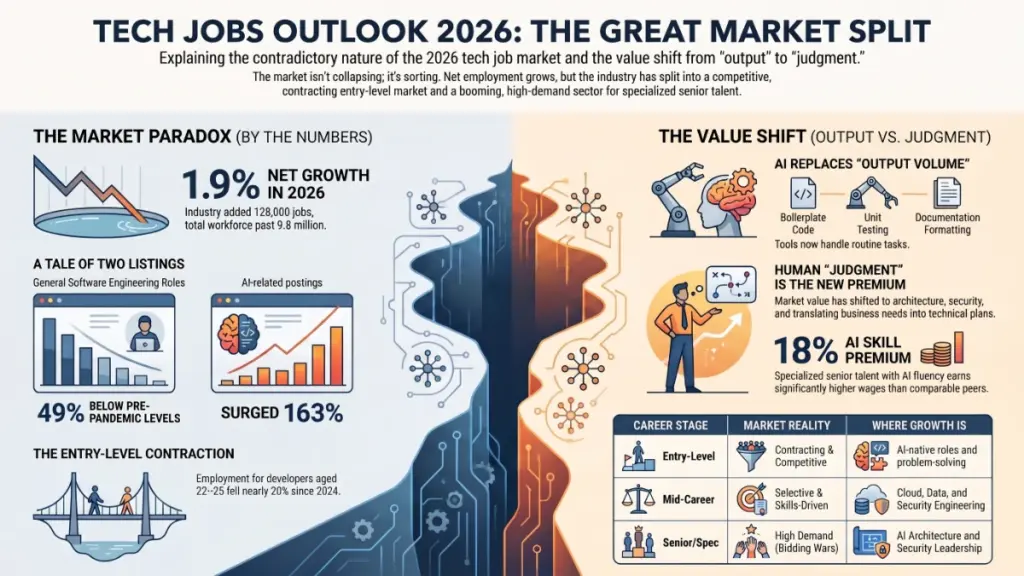
What surprised me first was the overall growth number. Net tech employment is on track to grow by roughly 1.9% in 2026, adding around 128,000 jobs and pushing the workforce past 9.8 million people, according to CompTIA’s research. That’s not a collapsing industry. It’s a recovering one.
Then I looked closer, and the picture split in two. Dice’s tracking shows tech postings up 23% year-over-year as of May, with AI-related skill requirements now appearing in 73% of listings. At the same time, entry-level hiring tells a completely different story. Stanford’s 2026 AI Index found that employment for software developers aged 22 to 25 fell nearly 20% since 2024, while developers over 30 at the same companies saw employment grow.
I also heard this tension directly from the people affected. A staff engineer at a late-stage startup told me the market rewards people who are “already at the top of their game.” Meanwhile, an engineering manager described applicants using AI tools to mass-produce resumes and cover letters, which has made hiring managers more skeptical of every application in the pile, not less. Trust, on both sides, has taken a hit.
Section 3: Why the Market Split This Way
Here’s where things get interesting, because the split isn’t random. It follows a pretty predictable logic once you understand what AI tools are actually good at right now.
Think of a junior developer’s traditional job as a bundle of tasks: writing boilerplate code, running routine tests, fixing predictable bugs, and formatting documentation. AI coding tools handle a large share of exactly those tasks today. That’s not a prediction — it’s already showing up in productivity data, with tools like Copilot generating scaffolding and unit tests noticeably faster than a junior working alone.
However, AI doesn’t replace judgment. It doesn’t know which trade-off matters for your specific product, which security risk is worth losing sleep over, or how to translate a vague business request into a technical plan. Those tasks sit disproportionately with mid-level and senior engineers. As a result, demand holds steady — or grows — right where AI still needs a human in the loop.
That’s why AI, ML, and data science postings jumped 163% year-over-year according to Robert Half’s research, while general software engineering postings remain roughly 49% below pre-pandemic levels. It’s not that companies stopped needing software. It’s that they need fewer people to produce the same volume of routine code, and more people who can supervise, architect, and secure what AI produces.
Cybersecurity tells a similar but distinct story. Security roles aren’t shrinking because there’s less to automate — they’re growing because there’s more to defend. Cybersecurity postings grew 124% year-over-year, and the sector still carries millions of unfilled positions worldwide. AI expands the attack surface even as it writes some of the code, so security specialists benefit from both trends at once.
Section 4: What This Actually Means For You
Numbers only matter once you can translate them into decisions. Below is how the data breaks down by where you sit in the industry right now.
Early Career and Recent Graduates
Entry-level software postings have contracted sharply, with some tracking putting the decline near 50% to 67% since 2022, depending on how “entry-level” gets defined. Computer science graduates now face roughly 6.1% unemployment, higher than several non-technical majors. Yet the roles still hiring juniors, like IBM’s expanded 2026 entry-level program, have redesigned the job itself, shifting away from boilerplate coding and toward customer-facing problem solving.
Mid-Career Professionals
Recruiters describe current demand as “selective, not broad.” Fewer roles sit open, but the ones that do pay more for the right fit. Cloud infrastructure, data engineering, and security positions show consistent, above-average growth across multiple hiring reports, and cross-functional skills — the ability to sit between engineering and business — command a real premium.
Senior and Specialized Talent
Confidence runs highest at this level. Nearly 87% of technology leaders report optimism about their 2026 business outlook, and recruiters describe specialized senior talent as able to “write their own ticket.” AI-specific skills carry a documented wage premium too, with some analyses putting it near 17–18% above comparable roles without those skills.
| Career Stage | Market Reality | Where Growth Is |
|---|---|---|
| Entry-level | Contracting, more competitive | AI-native roles at firms rebuilding junior pipelines |
| Mid-career | Selective, skills-driven | Cloud, data, security, platform engineering |
| Senior/specialist | Strong, employer-driven bidding | AI/ML architecture, security leadership, governance |
Notice the throughline: at every level, the winners are the people whose value comes from judgment and context, not from output volume alone.
Section 5: What To Actually Do About It
Advice like “learn AI” isn’t useful on its own. Here’s what I’d tell someone at each stage, based on what’s actually working for the people I interviewed.
Students and New Grads
Building a portfolio of shipped, working projects matters more than coursework alone. Hiring managers told me repeatedly that a deployed side project beats a perfect GPA. Getting comfortable with AI tools like Copilot or Claude also helps, as long as you can explain what the generated code does and why you kept or changed it.
On the flip side, skip the habit of applying broadly with a generic resume. Referrals reportedly account for a large share of entry-level hires now, so networking matters more than volume. Also resist the assumption that a CS degree alone guarantees a role; it’s a foundation, not a ticket.
Mid-Career Professionals Considering a Pivot
Targeting adjacent specializations pays off — a backend engineer moving toward platform engineering, or a QA analyst moving toward security testing, both build on existing strengths rather than starting over. Quantifying your impact in past roles with real numbers matters too, since vague resumes get lost fast in an AI-saturated applicant pool.
Avoid waiting around for the “perfect” AI certification before you start applying. Employers care more about demonstrated use than credentials alone.
Hiring Managers
Redesigning junior job descriptions around judgment and collaboration, rather than raw coding volume, follows the model IBM used when it expanded entry-level hiring. Cutting junior hiring entirely to save short-term costs is the opposite move, and several analysts I reviewed warned it creates a mid-level talent shortage within three to seven years — echoing what happened after the 2008 hiring freezes.
Common Mistakes to Avoid
- Treating “the tech job market” as one thing, when it’s really several markets moving in different directions.
- Chasing AI buzzwords on a resume without being able to speak to real, hands-on use.
- Giving up on tech entirely based on entry-level headlines, when mid-career and senior demand tells a very different story.
Section 6: Frequently Asked Questions
Is it too late to break into tech in 2026? No, but the path looks different than it did five years ago. Entry-level software roles are harder to land, but companies rebuilding junior pipelines — plus fast-growing fields like cybersecurity and data — still offer real entry points.
Which tech jobs are safest from AI disruption right now? Roles built around judgment, security, and system-level thinking hold up best: security engineering, cloud architecture, data engineering, and AI governance all show sustained demand across multiple 2026 hiring reports.
Do I still need a computer science degree? It helps, but it’s no longer sufficient on its own. Employers increasingly weigh demonstrated projects and AI tool fluency alongside — or even above — the degree itself.
Why do headlines say the market is terrible while some reports say it’s growing? Both are true for different segments. Overall tech employment is expanding modestly in 2026, while entry-level and generalist software roles have genuinely contracted. The averages hide a real split.
Should non-engineers in tech worry about AI too? Somewhat, but less than developers. AI is automating routine tasks across many roles, but positions built on stakeholder communication, ownership, and business context are proving more durable across the board.
Is remote work still available in tech? It’s shrinking as a share of postings. Companies increasingly favor people they already trust to work independently, which has made in-person or hybrid arrangements more common for new hires specifically.
Section 7: The Bottom Line
If there’s one thing my reporting made clear, it’s this: the tech job market isn’t shrinking or booming — it’s sorting. The demand is moving toward people who can supervise AI-generated work, make judgment calls under ambiguity, and communicate across technical and business lines.
The single most useful thing you can do right now is stop asking whether “tech jobs” are safe and start asking whether your specific skill set sits on the judgment side of that divide or the output side. That answer should shape your next move, whether that’s a certification, a lateral pivot, or a portfolio project.
The industry has been through disruptive shifts before — outsourcing, the cloud transition, the mobile pivot — and each time, the people who adapted their skills early came out ahead. This shift isn’t different in kind. It’s just faster.
