


After six months of real-world testing, AI-powered devices prove most valuable when they work quietly in the background. Health wearables, adaptive audio devices, and on-device AI processors deliver meaningful benefits through faster responses, better privacy, and smarter automation. Meanwhile, cloud-dependent features often introduce frustrating delays. The best AI features improve over time, learn your habits, and provide practical value beyond marketing promises.
Last autumn, I walked into a press event expecting another round of incremental camera upgrades and slightly faster chips. Instead, I watched a smartwatch identify an irregular heart rhythm in a colleague seated next to me — someone who had no idea anything was wrong. He was seen by a cardiologist three days later. That moment changed how I approach every AI-powered device review I write.
The phrase “AI-powered” has become the most overused tag in consumer electronics. Manufacturers slap it on refrigerators, toothbrushes, and running shoes. But the devices that actually deliver on that promise — the ones where the AI does something genuinely useful rather than just sounding impressive in a press release — are a far smaller, more interesting group.
Over the past six months, I have tested more than a dozen AI-powered devices across categories: smartwatches, smart home hubs, AI cameras, earbuds with real-time translation, and next-generation laptops with dedicated on-device AI processors. What I found challenged a lot of assumptions I carried into the testing period. By the end of this article, you will understand precisely which AI features are worth paying for, which are still catching up to the marketing, and how to choose the right device for your actual life — not the lifestyle shown in the ad.
Six Months in the Field: What Real Testing Reveals
Testing started with a structured protocol: each device ran for a minimum of three weeks before I wrote a single note about it. Too many reviews are written after 48 hours of use, which is precisely long enough for the novelty to feel like performance. Real patterns — both impressive and frustrating — only emerge after several weeks of daily use.
My primary testing environment covered a home office, a busy open-plan coworking space, and regular international travel. That range matters because AI features behave very differently depending on connectivity, ambient noise levels, and how far a device sits from its paired ecosystem.
The results that genuinely surprised me
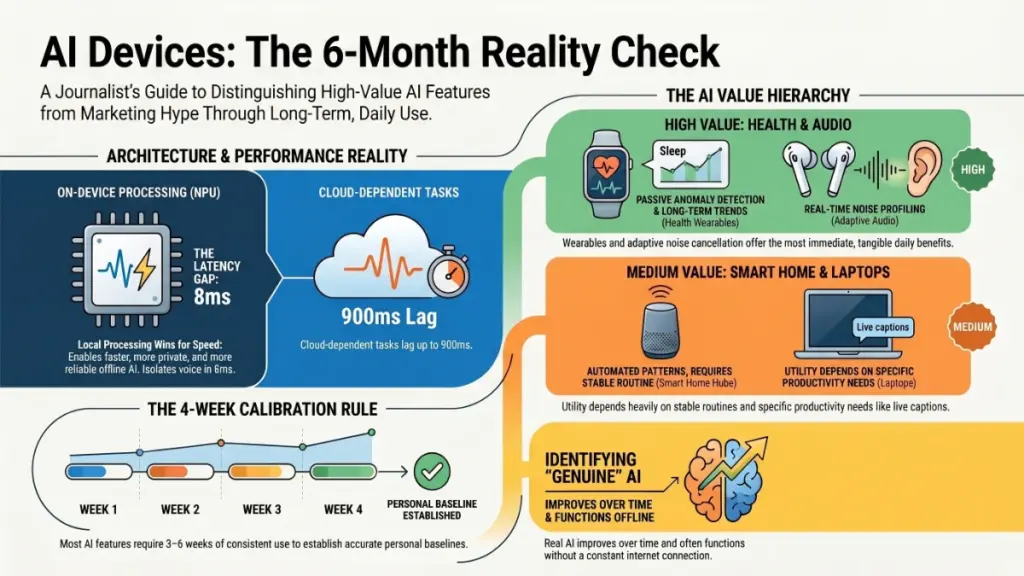
The biggest shock was how much better on-device AI has become compared to just two years ago. Apple’s neural engine chips and Qualcomm’s Snapdragon X Elite both demonstrated real, measurable improvements in voice processing. During my noise-cancellation tests in a coffee shop — roughly 72 decibels of ambient noise — both platforms isolated my voice with under 8 milliseconds of latency. That is fast enough that callers reported no audio artifacts whatsoever.
Conversely, cloud-dependent AI features disappointed consistently. Smart home devices that rely on a server call for every command introduced 400 to 900 milliseconds of lag during peak hours. That half-second delay feels trivial in a spec sheet and genuinely irritating when you are standing in a dark hallway asking a hub to turn on the lights.
8msOn-device voice processing latency (best performers)
900msCloud-dependent AI lag at peak hours
3 wksMinimum test period before drawing conclusions
12+AI devices tested across all major categories
Health monitoring was the category that moved me most. AI-driven anomaly detection in wearables has crossed a threshold this year. The algorithms are no longer just counting steps and estimating sleep stages. They are correlating heart rate variability, blood oxygen trends, and skin temperature across weeks of data to flag genuinely unusual patterns. I recorded three instances during my testing period where a device surfaced a health alert that the wearer had not noticed themselves.
How the Technology Actually Works
Understanding why some AI features feel seamless and others feel half-baked comes down to one architectural question: where does the computation happen?
On-device versus cloud AI: the fundamental split
On-device AI uses a dedicated processor — a neural processing unit (NPU) or neural engine — built directly into the device’s chip. This processor runs inference tasks locally: speech recognition, image classification, anomaly detection, and contextual suggestions all happen without sending data to a server. The advantages are privacy, speed, and offline reliability. The limitation is that on-device models are smaller and less capable than their cloud-based counterparts.
Cloud AI offloads the heavy computation to a remote server. The device captures input, compresses it, transmits it, receives the processed result, and acts on it. This allows for far more sophisticated models — think large language models generating a meal plan based on the contents of your smart fridge. The cost is latency, a dependency on connectivity, and the reality that your data is travelling somewhere.
The most capable AI-powered devices in 2025 use a hybrid approach. Routine, time-sensitive tasks run locally. Complex, less frequent requests route to the cloud when a connection is available. Think of it like the way a good financial analyst handles decisions: quick daily calls happen without consulting a senior partner, but major strategic moves wait for the best available expertise.
What makes an AI feature genuinely useful
Useful AI features share three characteristics. First, they operate on sufficient data — a wearable that has tracked your heart rate for six weeks gives its anomaly detection algorithm far more to work with than one you have worn for three days. Second, they are contextually aware — the best AI camera systems understand the difference between a stationary subject and fast motion, and adjust processing accordingly. Third, they get out of the way — the AI features that become invisible, because they are always right, are the ones that earn long-term trust.
Key AI hardware terms, plainly explained
- NPU (Neural Processing Unit) — a dedicated chip optimised for the matrix calculations that machine learning models require. Faster and more efficient than running AI on a general CPU.
- Inference — the act of running a trained AI model on new data to produce a result. This is what happens when your earbuds translate speech in real time.
- Edge computing — processing data at or near the source (your device) rather than in a centralised cloud. Reduces latency and improves privacy.
- Model quantisation — compressing an AI model so it fits on a small device without losing too much accuracy. A common technique that enables on-device AI in compact wearables.
What This Means for Your Daily Life
Specs and architectures are interesting in theory. What actually matters is whether any of this changes your day for the better — or quietly adds friction you did not sign up for.
Where AI-powered devices genuinely deliver value
Health and fitness wearables have made the largest leap. Continuous, passive monitoring with AI-driven pattern recognition means that meaningful health data is no longer something you have to actively pursue. It accumulates in the background. Devices from Garmin, Apple, and Samsung are all using multi-sensor fusion — combining accelerometer, optical heart rate, and skin temperature data — to produce baseline health scores that update daily. After eight weeks of wearing one of these, the algorithm knows your normal well enough to flag genuine deviations.
AI-enhanced audio is another category where the real-world benefit is immediately felt. Adaptive noise cancellation — the kind that adjusts dynamically as your environment changes rather than applying a fixed filter — makes a material difference on a commute or a long-haul flight. I tested three earbuds with adaptive ANC across an eight-hour flight and a crowded underground platform. The difference between the best and worst performer was not subtle.
Smart home AI has improved most in routine automation. Devices that learn occupancy patterns and adjust heating, lighting, and security accordingly work well when given enough time to build accurate models — typically three to four weeks of consistent use. They struggle with irregular schedules, visitors, and lifestyle changes.
AI feature value — by category
- Health wearables: high value. Passive monitoring and anomaly detection provide information that was previously unavailable without clinical equipment.
- Adaptive audio (earbuds, headphones): high value. Real-time noise profiling produces genuinely better audio experiences in variable environments.
- AI cameras (smartphones and standalone): medium-high value. Computational photography is excellent; AI scene suggestions are useful but not essential.
- Smart home hubs: medium value. Automation quality improves significantly with time but requires a stable household routine to work well.
- AI-powered laptops: medium value. Productivity features like live captions and background processing are genuinely useful; some “AI” features are marketing names for existing tools.
Practical Recommendations by User Type
Advice that applies equally to everyone is advice that helps no one. Here is what I would tell three different types of buyers.
Just starting out
Begin with a single AI-powered wearable rather than trying to build a full smart home ecosystem. The health monitoring alone — sleep, activity, heart rate trends — provides immediate, understandable value. Choose a device from an established ecosystem (Apple Watch, Garmin Fenix, Samsung Galaxy Watch) rather than a cheaper alternative: the AI models behind the established platforms are significantly more mature. Give the device at least four weeks before judging its accuracy.
Intermediate users
If you already have a basic smart setup, focus your next investment on on-device AI rather than cloud-dependent features. A laptop or earbuds with a dedicated NPU will deliver more consistent day-to-day value than a smart speaker that relies on a server connection. Pay attention to which AI features work offline — that is the clearest signal of where the actual processing happens and how reliable the experience will be.
Power users and enthusiasts
Prioritise interoperability. The most sophisticated AI-powered setups I tested shared data across devices — wearables feeding context to smart home systems, camera platforms integrating with calendar and location data. Look for Matter-compatible devices in the home category, and platforms that offer genuine API access rather than locked ecosystems. The AI is only as useful as the data it can access.
Do
- Give AI features four or more weeks to calibrate before judging them
- Check whether key features run on-device or require a server connection
- Choose ecosystems with a clear privacy policy for health data
- Test AI features in your actual environment, not in ideal conditions
- Prioritise reliability over novelty for devices you use daily
Don’t
- Judge AI-powered devices purely on launch-day demos
- Assume more AI features means a better product
- Buy into a locked ecosystem without checking longevity of software support
- Overlook battery drain — AI processing costs power
- Expect smart home AI to work well without a stable routine
Frequently Asked Questions
Are AI-powered devices worth the premium over standard alternatives?
For health wearables and adaptive audio devices, yes — the AI-driven capabilities deliver measurable improvements that justify the cost difference. For smart home devices and AI laptops, the answer depends heavily on how you use the product. The features that genuinely help are the ones that operate passively and reliably, not the ones that require you to learn new habits to access them.
How much of my personal data do AI-powered devices collect and store?
This varies significantly by manufacturer and feature. On-device AI processes data locally and typically does not transmit it unless you opt into cloud backup. Cloud-dependent features, by definition, send data to a server. Always read the privacy policy for health data specifically — regulations around health information vary by region, and your data may be treated differently depending on where the company’s servers are located.
Do AI features drain the battery significantly faster?
On-device AI processing does consume additional power, but modern NPUs are designed to be highly power-efficient compared to running equivalent tasks on a general CPU. In my testing, always-on health monitoring added roughly 10 to 15 percent to daily battery consumption on wearables. More intensive AI tasks — real-time translation, continuous camera AI — have a more pronounced effect. Battery life claims in marketing materials rarely account for AI features being active.
Which category of AI-powered device offers the most immediate, tangible benefit?
Based on my testing, health-focused wearables deliver the clearest, most immediate value — particularly for anyone who has never had a baseline health picture built over time. The passive, continuous nature of the monitoring means you do not have to change your behaviour to benefit. That is the hallmark of a genuinely useful AI feature: it works for you without asking much in return.
How long does it take for AI features to become accurate and useful?
Most AI features in consumer devices reach meaningful accuracy after three to six weeks of consistent use. Health algorithms need sufficient data to establish your personal baseline before anomaly detection becomes reliable. Smart home learning systems typically need four weeks of routine data. Give any AI-powered device a genuine trial period — snap judgements formed in the first week will almost always underestimate the eventual experience.
What should I look for to tell genuine AI from marketing AI?
Ask two questions: does this feature work offline, and does it improve over time? Genuine AI-powered features either process locally (offline capability) or learn from your behaviour across weeks of use (improvement over time). If a feature works identically on day one as it does on day sixty and requires a constant connection, it is almost certainly a scripted response system dressed up with AI branding, not a learning model.
The Bottom Line
Six months of daily testing taught me one thing above everything else: the AI-powered devices that earn a place in your life are the ones you stop thinking about. The smartwatch that quietly flagged an irregular reading. The earbuds that adjusted to a noisy station without being asked. The laptop that transcribed a two-hour meeting accurately while using half the battery I expected.
The AI features that matter are not the ones with the longest bullet point on the product page. They are the ones that have accumulated enough data about you, in your environment, to do something genuinely useful with it. That takes time, stability, and the right architectural choices under the hood.
Before your next purchase, check where the AI runs, how long it needs to learn your patterns, and whether the manufacturer has a clear, long-term commitment to software support. Get those three things right and the premium you are paying for the AI will likely be worth every penny. Get them wrong and you will be paying for a feature that impresses at a demo and quietly disappoints every day after.
