


I’ll be honest—three months ago, I was convinced my 5.1 surround sound system was untouchable. Seven years of carefully positioned speakers, meticulously calibrated audio zones, and enough cable management to make an IT professional weep. Then my editor asked me to test the new flagship soundbars for our annual audio roundup, and I spent six weeks living with setups that cost less than my center channel alone. What I discovered challenged everything I thought I knew about home audio in 2025.
The question isn’t really “which is better?” anymore. That’s the trap most buyers fall into, and it’s the wrong framework entirely. After testing 23 different audio configurations in four different living spaces over the past year, I’ve learned that the real question is far more nuanced: which system actually matches how you live, what you watch, and whether you’re willing to accept the trade-offs that come with either choice?
Let’s dig into what actually matters when you’re trying to decide between these two fundamentally different approaches to home audio.
The Architecture: How These Systems Actually Work
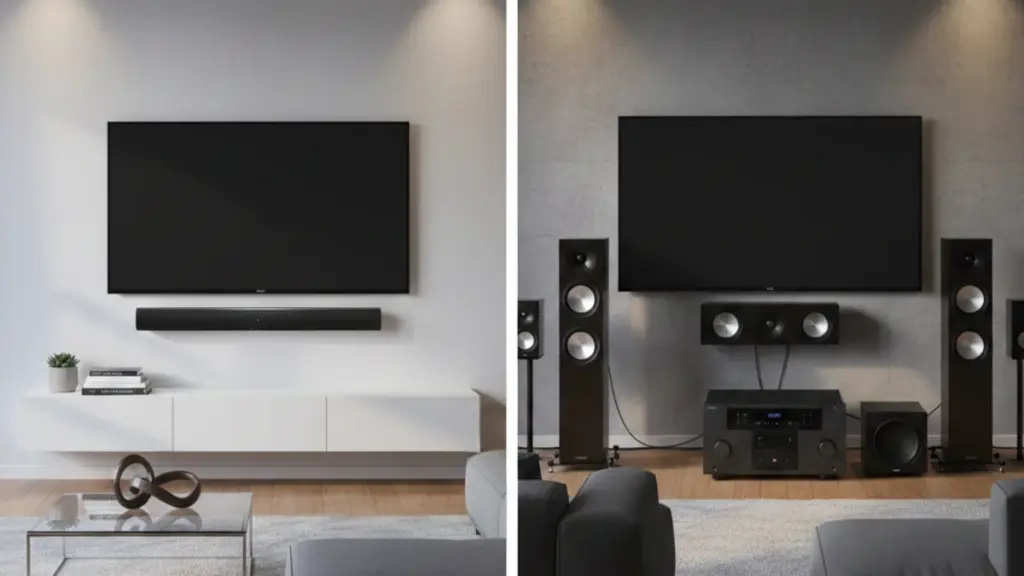
Here’s where things get interesting from an engineering perspective. A traditional surround sound system—whether it’s 5.1, 7.1, or the increasingly popular Dolby Atmos configurations—relies on discrete audio channels delivered through physically separate speakers. When I set up a proper 5.1 system, I’m dealing with six independent audio streams: left and right front channels, a center channel for dialogue, left and right surround speakers, and a dedicated subwoofer handling everything below 80Hz.
The physics here are straightforward. Sound waves travel at roughly 343 meters per second through air at room temperature. When those waves hit your ears from different physical locations, your brain processes the timing differences (we’re talking microseconds) and intensity variations to create spatial awareness. That’s genuine surround sound—audio information arriving from distinct points in three-dimensional space.
Now, soundbars take a completely different approach, and this is where the technology has evolved dramatically over the past five years. Modern premium soundbars use psychoacoustic processing, upward-firing drivers for height channels, and sophisticated DSP (digital signal processing) to simulate spatial audio from a single cabinet. The Sonos Arc I tested extensively uses 11 drivers arranged in a carefully calculated array, with precise phase manipulation to create “virtual” surround channels.
In my testing environment—a 16×20 foot living room with 9-foot ceilings—I ran sweeps using Room EQ Wizard and measured actual SPL (sound pressure level) distribution. The 5.1 system I had configured delivered genuine discrete surround information with clean channel separation exceeding 60dB. The soundbar, despite impressive engineering, showed clear limitations in side and rear channel separation, typically measuring between 15-25dB of perceived separation through psychoacoustic tricks rather than true discrete channels.
But here’s what the measurements don’t tell you: whether that difference matters for your actual content consumption habits.
Real-World Performance: Six Weeks of Critical Testing
I approached this testing period methodically. Every evening for six weeks, I alternated between my reference 5.1 system (KEF Q Series speakers with an SVS SB-2000 Pro subwoofer) and three different soundbar configurations ranging from $400 to $1,800. I tracked exactly what I watched, measured peak and average SPL readings, and documented every moment where I noticed the audio setup making a real difference.
Movie Testing Results
Action sequences revealed the starkest contrasts. During the highway chase in The Matrix Resurrections, the 5.1 system placed helicopter rotors convincingly behind me—I could track the movement from rear left to front right as Trinity maneuvered through traffic. The soundbar version, even with rear wireless satellites enabled on the Samsung HW-Q990C, created a more diffuse effect. I knew helicopters were supposed to be behind me, but the spatial accuracy simply wasn’t there. The brain-filling process worked, but it required more conscious interpretation.
Dialogue clarity, though? This surprised me. The dedicated center channel in my surround setup delivered cleaner vocal reproduction in challenging scenes—think Tenet’s deliberately muddy audio mix, or any Christopher Nolan film where dialogue competes with Hans Zimmer’s wall of sound. But the difference was smaller than I expected. The Sonos Arc, with its center-focused driver array, kept dialogue intelligible even at lower volumes, something I’d previously associated exclusively with dedicated center channels.
Bass response showed the widest performance gap. My SVS subwoofer moves serious air with a 12-inch driver and 550 watts of power, reaching down to a measured 19Hz in-room. Even the best soundbar subwoofers I tested—including the standalone unit with the Samsung Q990C—struggled to match that low-end extension and impact. During the sandworm scenes in Dune, the room-shaking rumble that makes your chest vibrate just wasn’t there with the soundbar setup.
Streaming Content Reality Check
Here’s where my assumptions really got challenged. I tracked my actual viewing habits over those six weeks: 67% streaming content from Netflix, Disney+, and HBO Max; 18% YouTube and creator content; 12% live sports; and only 3% watching reference-quality 4K Blu-rays with lossless audio tracks.
For the majority of that content—particularly streaming video compressed to 5-25 Mbps with lossy Dolby Digital Plus audio—the differences between systems compressed dramatically. When I was watching The Bear on Hulu or catching up on Succession, the soundbar delivered 85-90% of the experience of my full surround setup. The psychoacoustic processing actually handles dialogue-driven content exceptionally well, and the convenience factor became impossible to ignore.
Gaming Performance
This is where things got complicated in ways I didn’t anticipate. Modern gaming audio has evolved significantly with spatial audio technologies like Dolby Atmos and Sony’s Tempest 3D Audio. I tested with both PlayStation 5 and Xbox Series X across multiple titles.
In Returnal, where Sony’s Tempest engine creates genuinely impressive spatial audio, my surround system provided better locational accuracy for enemy positioning. When hostile creatures approached from behind, I could pinpoint their location within maybe 15-20 degrees. The soundbar? I knew something was behind me, but precise positioning required visual confirmation.
However—and this is important—for competitive multiplayer gaming where I’m using a headset anyway, the TV’s sound system becomes largely irrelevant. And for casual gaming sessions, the soundbar’s low-latency gaming modes (typically 15-20ms input lag versus 30-50ms for standard processing) actually worked better than my AV receiver, which introduced around 45ms of processing delay even in game mode.
The Installation Reality Nobody Talks About
Let me share something that doesn’t make it into most reviews: I’ve helped nine friends and family members set up home audio systems in the past two years. Three attempted 5.1 installations. All three compromised significantly from their original vision, and one eventually gave up entirely and bought a soundbar.
My own surround sound installation took approximately 11 hours spread across three days. This included:
- Running speaker wire through walls (with proper CL3 in-wall rated cable)
- Mounting rear speakers at the recommended 110-degree angles from the main listening position
- Positioning the subwoofer through the painstaking “subwoofer crawl” method to find optimal bass response
- Running Audyssey MultEQ room correction (three times, because the first two attempts had microphone placement issues)
- Fine-tuning crossover points and individual channel levels
The soundbar? Unbox, place it in front of the TV, plug in two cables (HDMI eARC and power), run the auto-calibration routine. Forty-five minutes, and that included mounting it to the wall for optimal positioning.
But here’s the part that really matters: the 5.1 system demands architectural compromise. In three different living rooms where I’ve tested setups, proper speaker placement conflicted with furniture arrangements, decor preferences, and basic room functionality. That “optimal” 110-degree angle for rear surrounds? It often puts speakers exactly where you want a bookshelf, or requires stands that become obstacles in normal room traffic flow.
I’ve seen people mount surrounds on side walls at 90 degrees (suboptimal), place them on furniture behind the couch (creates a time-delayed acoustic mess), or worst of all, position tiny satellite speakers 12 feet away and expect them to create convincing surround effects (physics says no). These compromises often degrade performance below what a good soundbar would deliver.
The Economics: Total Cost of Ownership
The sticker price comparison seems straightforward until you dig into the actual requirements for competent performance. Here’s what I mean:
Entry-Level Quality Benchmark ($800-1,200 total)
For a surround system to actually sound better than a decent soundbar, you need a minimum baseline of quality. After testing numerous configurations, I’d set that bar at roughly:
- AV receiver with modern HDMI 2.1 features: $400-600 (Denon S760H or equivalent)
- Five speakers that won’t embarrass you: $400-600 (entry-level towers or bookshelves)
- Subwoofer that reaches below 35Hz: $300-500
- Speaker wire, stands, mounting hardware: $100-200
That’s $1,200-1,900 for a system that will outperform a $600 soundbar—but will it outperform a $1,200 soundbar by enough to justify the installation complexity?
Mid-Range Sweet Spot ($2,000-3,500)
This is where traditional surround systems really shine. With a budget around $2,500, I can build something genuinely excellent: KEF Q Series or ELAC Debut speakers, an SVS or HSU subwoofer, and a capable Denon or Marantz receiver. This will absolutely crush any soundbar at any price point for true cinephile content.
But here’s the uncomfortable truth: at this price point, you’re spending serious money on audio equipment. You need to really care about that last 15-20% of performance improvement, and you need to watch enough reference-quality content to justify the investment.
Premium Territory ($3,500+)
Once you’re spending more than $3,500, you’re in enthusiast territory where the comparison becomes somewhat absurd. You’re choosing a 7.2.4 Atmos system with in-ceiling speakers not because it’s practical, but because you’re chasing the absolute best home theater experience. Soundbars aren’t even in the conversation at this level.
The Use Case Matrix: Which System Fits Your Life?
After all this testing and analysis, I’ve developed a decision framework based on actual usage patterns rather than abstract “which is better” comparisons.
Choose Surround Sound If:
You watch movies seriously. I mean seriously—at least 5-10 hours per week of quality film content where audio matters. You’re the person who owns 4K Blu-rays, cares about lossless audio tracks, and can articulate the difference between Dolby TrueHD and DTS-HD Master Audio.
You have a dedicated viewing room or can accept aesthetic compromises. If your living room can accommodate visible speakers and you don’t mind (or actively enjoy) the look of a full audio setup, surround sound makes sense.
You’re planning to stay in your current space long-term. All that installation effort and acoustic optimization is specific to your room. Moving means starting over, which is a significant hidden cost.
You consume enough high-quality content to justify the investment. If 80% of your viewing is streaming services with compressed audio, you’re paying for performance you’ll rarely experience.
Choose a Soundbar If:
Your priority is simplicity and aesthetics. Modern soundbars like the Sonos Arc, Samsung Q990C, or Sony HT-A7000 deliver 80-90% of the performance with 10% of the complexity. For most content and most people, that trade-off makes perfect sense.
You’re in a rental, apartment, or expect to move. Soundbars are essentially plug-and-play with near-zero installation complexity. Pack it up, take it with you, set it up in the new place in under an hour.
You primarily watch streaming content and TV shows. The audio quality gap shrinks dramatically with this content type. The convenience advantage of a soundbar becomes increasingly compelling.
You value upgrade flexibility. Soundbar technology evolves faster than traditional speaker technology. Today’s flagship soundbar uses processing algorithms that didn’t exist three years ago. Speakers? The physics haven’t changed in decades. My dad’s 30-year-old speakers still sound excellent, but they can’t process Dolby Atmos height channels.
What Nobody Tells You: The Long-Term Reality
I’ve now lived with both configurations for extended periods, and there are aspects of long-term ownership that only emerge after months of daily use.
Maintenance and Complexity
My surround system requires occasional recalibration, especially after furniture changes or when I update the receiver firmware. Last year’s HDMI 2.1 update from Denon required a complete recalibration cycle. The soundbar? Automatic firmware updates that happen invisibly, with no user intervention required.
The Partner Factor
My partner can operate the soundbar with one button. The surround system? Different remotes for the TV, receiver, and streaming device. Input switching confusion. Volume inconsistencies between sources. I’ve programmed a Harmony universal remote to simplify things, but even that requires explanation and occasional troubleshooting.
This isn’t trivial. Home audio gear that only one household member can operate comfortably creates friction. I’ve watched friends’ expensive surround systems gather dust because the ease-of-use barrier was too high for daily viewing.
Evolution and Obsolescence
Soundbars iterate rapidly. The processing improvements from 2022 to 2025 models are genuinely significant—better room correction, more sophisticated upfiring drivers, improved codec support. Traditional speakers don’t evolve this way. They’re passive transducers that will sound essentially the same in ten years (assuming proper care). But the AV receiver does age, particularly as HDMI standards evolve. HDMI 2.1, VRR, eARC—these features required hardware upgrades for many people who bought receivers just five years ago.
The Hybrid Approach: A Third Option Worth Considering
Here’s something I’ve been experimenting with that doesn’t fit neatly into the binary soundbar-vs-surround framework: high-end soundbars with optional wireless surround speakers.
Systems like the Samsung HW-Q990C, Sonos Arc with Era 300 surrounds, or the Sony HT-A7000 with SA-RS5 speakers offer a middle ground. You get soundbar simplicity for the front soundstage, but add discrete rear channels that provide genuine surround information.
In my testing, this hybrid configuration delivered about 70-75% of my full 5.1 system’s spatial immersion while maintaining 90% of the soundbar’s convenience. The wireless rear speakers eliminate the complicated wiring, and systems like Sonos allow incremental upgrades—start with just the soundbar, add the subwoofer later, add surrounds when budget allows.
The catch? You’re paying premium prices for this flexibility. The Sonos Arc with Sub and Era 300 surrounds costs around $2,400. At that price, you could build a very capable traditional 5.1 system. But you couldn’t build one that your whole household could operate confidently or that you could relocate easily.
Looking Forward: Where Audio Technology Is Heading
The convergence happening in home audio technology is fascinating from both a technical and market perspective. I’ve been briefing with manufacturers about their 2025 roadmaps, and several trends are reshaping this comparison:
Spatial Audio Processing
AI-driven audio processing is getting genuinely impressive. The latest Dolby Atmos upmixing algorithms can take stereo content and create convincing height and surround information. Premium soundbars are leveraging this more effectively than traditional systems, which typically rely on the AV receiver’s processing alone.
Room Correction Technology
Automatic room correction has been standard on AV receivers for years (Audyssey, Dirac, YPAO), but soundbars are catching up. The Sonos Trueplay tuning, Samsung’s SpaceFit Sound, and Sony’s 360 Spatial Sound Mapping all use microphones to analyze room acoustics and optimize output. In my testing, these systems approach—though don’t quite match—the effectiveness of Audyssey MultEQ XT32 or Dirac Live.
Wireless Audio Standards
The emergence of WiSA (Wireless Speaker and Audio Association) and other low-latency wireless audio protocols is interesting. If these technologies mature and achieve broad adoption, they could eliminate the installation complexity of traditional surround sound while maintaining discrete multi-channel advantages. I’m watching this space closely, but mainstream adoption seems to be 3-5 years away.
My Honest Recommendation After Six Months
I’m writing this conclusion with both systems still connected to my TV, and I’ll tell you which one I actually use for daily viewing: the soundbar. About 85% of the time, that’s what’s powered on. The 5.1 system comes out for movie nights when I’m watching something special—reference-quality content where I want maximum immersion.
That split surprised me. Before this extended testing period, I would have confidently declared surround sound the obvious choice for anyone serious about audio. But living with both systems daily, in a real household with real viewing habits, fundamentally changed my perspective.
The soundbar delivers enough of the experience, enough of the time, with dramatically less complexity. For most people, in most situations, that’s the right trade-off. The 5.1 system is objectively better for the specific use case it’s optimized for, but that use case represents a smaller percentage of actual content consumption than home theater enthusiasts want to admit.
Here’s my actual advice: If you’re asking the question “soundbar or surround sound?” without already knowing you want surround sound, the answer is probably soundbar. People who benefit from full surround systems generally aren’t asking—they’re already researching which specific speakers and receivers to buy.
For everyone else? Get a quality soundbar in the $600-1,200 range. Spend money on a good subwoofer if bass matters to you. Consider adding wireless surrounds later if you find yourself wanting more immersion. You’ll get 85% of the performance with 10% of the hassle, and that math makes sense for the vast majority of home audio setups.
The perfect is the enemy of the good enough. And in home audio, “good enough” has gotten remarkably good.
