

I’ve been testing audio equipment in my living room for the better part of a decade, and friends still ask me the same question:
“Should I get a soundbar, or go all-in on a home theater system?”
Last month, I spent three weeks switching between a $1,200 premium soundbar and a $2,500 5.1.2 surround system, using the same movies, games, and music.
What I discovered surprised me—because the better choice isn’t always the more expensive one.
The soundbar vs home theater debate has changed dramatically. Modern soundbars with Dolby Atmos and spatial audio have closed the gap in ways that felt impossible five years ago.
At the same time, traditional surround systems still hold advantages no amount of DSP can fully replicate.
After living with both setups daily, I’ve learned this decision is less about raw sound quality—and more about how you actually use your space.
Let’s break it all down.
Understanding What You’re Really Comparing
This isn’t just about speaker count.
You’re comparing two completely different philosophies for delivering immersive sound.
What a Soundbar Actually Is
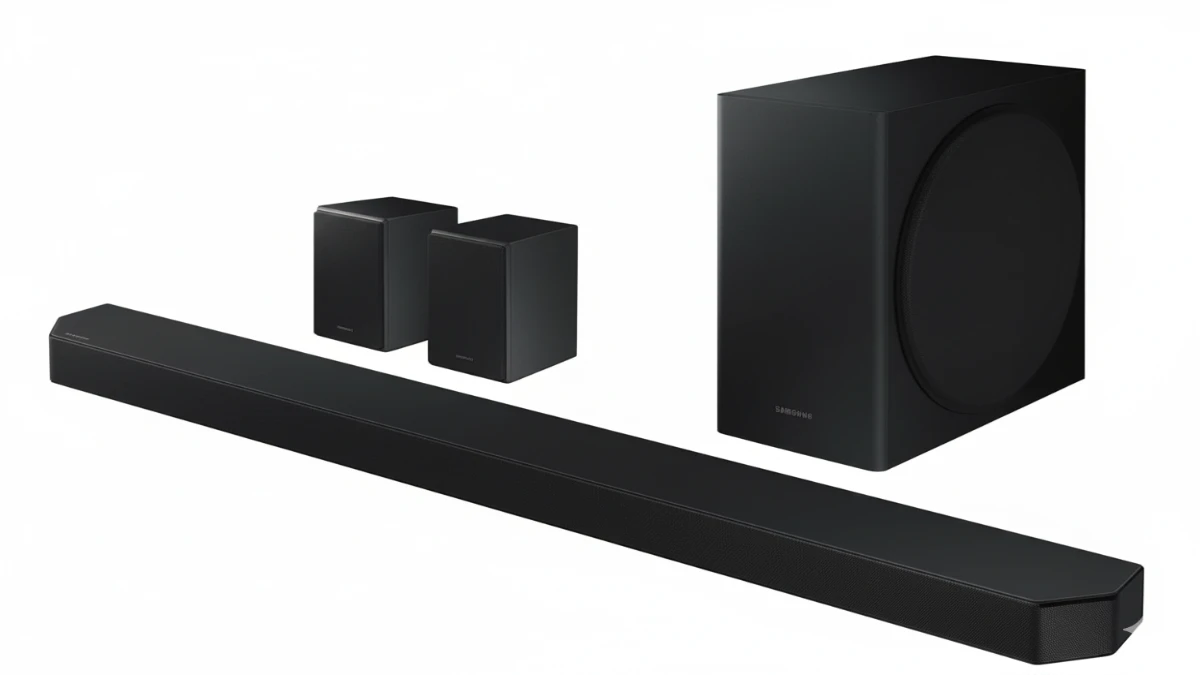
A soundbar is a single speaker enclosure that sits below or above your TV. Inside, it contains multiple drivers arranged horizontally, combined with digital signal processing (DSP) to simulate surround sound.
Most modern soundbars include:
- A wireless subwoofer
- Optional rear satellite speakers
- Support for Dolby Atmos or DTS:X
The numbers you see (like 5.1.2 or 7.1.4) represent:
- Front and surround channels
- A subwoofer
- Height channels for overhead effects
What impressed me most during testing was how convincing some of these virtual surround effects have become.
What a Home Theater System Does Differently
A traditional home theater system uses discrete speakers placed around the room:
- Front left and right
- A dedicated center channel for dialogue
- Surround speakers behind or beside you
- One or more subwoofers
- Optional ceiling or height speakers
Everything runs through an AV receiver, which handles decoding, amplification, and input switching.
The core difference is simple:
- Soundbars simulate direction
- Home theaters place sound where it actually exists
That distinction matters more for some content than others.
The Real-World Sound Quality Difference
Here’s the honest truth:
The gap has narrowed—but it hasn’t disappeared.
Directional Accuracy: Discrete Speakers Still Win
With a real 5.1.2 system, sound moves through physical space.
When something pans from front-left to rear-right, you hear it travel naturally.
Soundbars recreate this effect using timing delays and reflections.
It works well front-to-back, but side-to-side precision suffers.
During Saving Private Ryan, chaotic battlefield movement felt wider and more immersive through discrete surrounds.
The soundbar compressed the soundstage into a narrower bubble.
Bass, Impact, and Dynamic Range
Driver size matters.
Most soundbars use small 2–4 inch drivers.
My tower speakers use 6.5-inch woofers, and there’s no DSP trick that replaces real air movement.
When the T-Rex stomped in Jurassic Park, the home theater delivered chest-thumping impact.
That said, modern subwoofers are impressive.
Samsung’s HW-Q990C sub reached 28Hz in my room—more than enough for most movies.
Dialogue Clarity (This One Surprised Me)
Premium soundbars prioritize dialogue—and it shows.
In quiet scenes, the soundbar actually delivered clearer speech than my dedicated center speaker.
Why?
Soundbars are tuned for typical 8–12 ft TV distances, while home theater speakers often assume larger rooms.
If you watch dialogue-heavy shows, this matters.
Music Playback: Casual vs Critical Listening
For music, discrete speakers still sound better.
Stereo imaging is wider.
Instrument separation is cleaner.
Vocals feel more natural.
The soundbar sounded fine for background music, but it lacked spatial precision.
For casual listening, that’s acceptable.
For focused listening, it isn’t.
Room Acoustics Matter More Than You Expect
Soundbars rely heavily on reflections.
Room layout, flooring, and furniture dramatically affect performance.
My hardwood floors caused harsh reflections until I added rugs.
The home theater system was far more forgiving because each speaker could be aimed directly.
Installation Reality Check
This is where most people decide—whether they realize it or not.
Soundbar Setup: 15 Minutes, No Stress
Unbox.
Plug in HDMI eARC.
Connect the sub.
Run app calibration.
That’s it.
Minimal cables.
No tools.
No drilling.
Home Theater Installation: A Weekend Project
Speaker placement alone took hours.
Then came:
- Running speaker wire
- Mounting surrounds
- Cutting ceiling holes for Atmos
- Hiring a professional ($400)
The AV Receiver Learning Curve
Receivers are powerful—but intimidating.
My Denon has 200+ settings.
Calibration took 45 minutes.
Manual tuning took another hour.
If you enjoy tinkering, it’s fun.
If not, it’s overwhelming.
Cable Management Is a Lifestyle
Receivers introduce:
- Multiple HDMI sources
- Speaker wires everywhere
- Power bricks and adapters
Soundbars avoid all of this.
WAF (Wife Acceptance Factor) Is Real
My tower speakers dominate the room.
The soundbar disappears.
That matters.
Room Size and Layout: The Silent Decider
Small Rooms (Under 150 sq ft)
Soundbars excel here.
Surround systems feel cramped and unnatural.
Medium Rooms (200–300 sq ft)
Both work.
Soundbars are simpler.
Home theaters sound better.
Large Rooms (300+ sq ft)
Home theater wins.
Soundbar virtualization breaks down at distance.
Ceiling Height and Atmos
Up-firing Atmos needs flat, low ceilings.
Vaulted ceilings kill the effect.
In-ceiling speakers don’t care.
Open Floor Plans
Soundbars struggle without boundaries.
Discrete speakers handle open layouts better—with acoustic treatment.
Budget Reality: The True Cost
Soundbars
- Entry-level: $300–400
- Mid-range: $700–1,100
- Premium: $1,200–1,800
No installation costs.
No accessories required.
Home Theater Systems
- Budget 5.1: $1,300–1,700 real cost
- Mid-range 5.1.2: $4,500–5,500
- High-end: $10,000+
Hidden costs add up fast:
- Speaker stands
- Acoustic treatment
- Remotes
- Power conditioning
- Professional installation
Gaming and Sports Performance
Competitive Gaming
Soundbars add latency with Atmos processing.
Receivers in Direct mode don’t.
For shooters, home theater wins.
Cinematic Games
Soundbars shine here.
Atmos height effects are impressive.
Sports Broadcasts
Most sports are stereo.
Soundbars use DSP to fake immersion.
Surprisingly effective.
Smart Home Integration and Daily Use
Soundbars win hard here.
- Voice control works flawlessly
- Multi-room audio is seamless
- One remote controls everything
- Firmware updates add features
Receivers feel like hardware.
Soundbars feel like software.
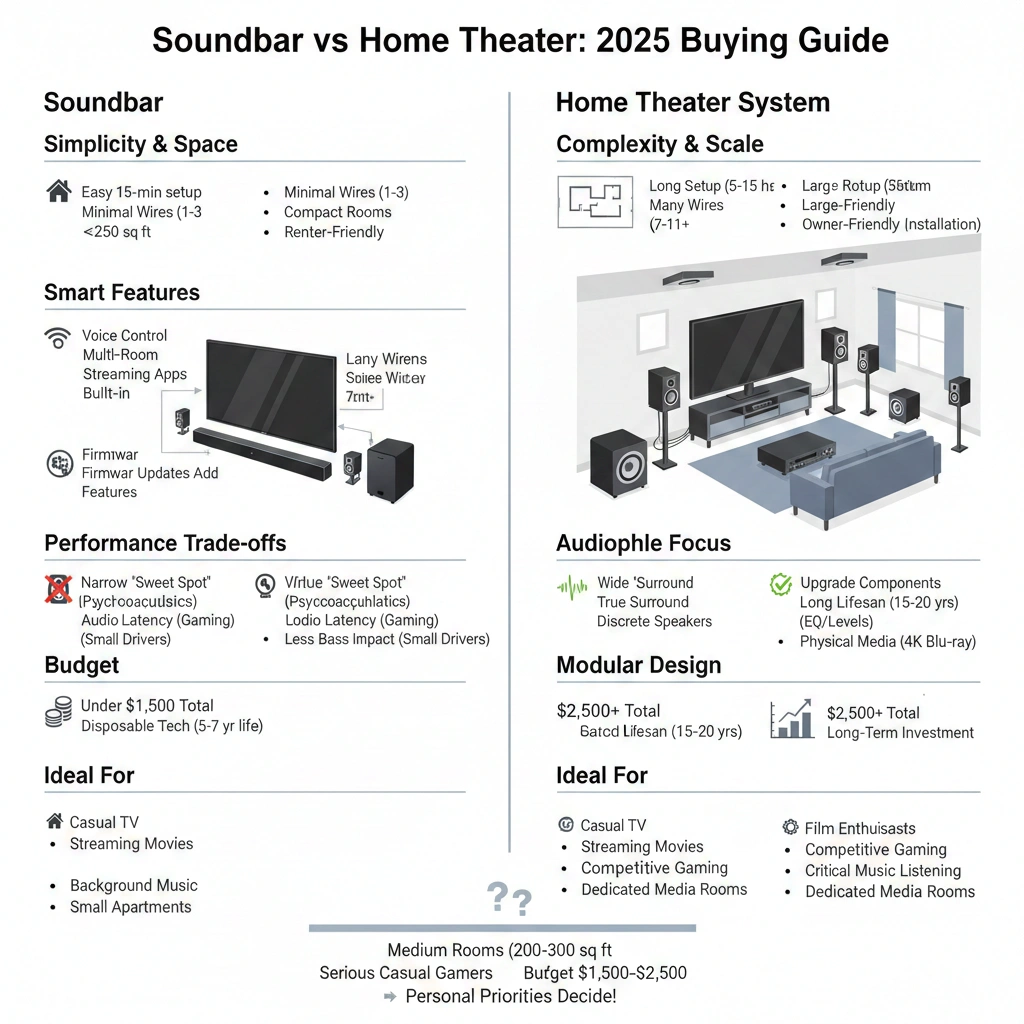
Soundbar vs Home Theater: Quick Comparison
| Feature | Soundbar | Home Theater |
|---|---|---|
| Setup time | 10–20 minutes | Several hours |
| Cable clutter | Minimal | High |
| Room size | Small–medium | Medium–large |
| Audio precision | Good | Excellent |
| Best for | Convenience | Enthusiasts |
Which One Should You Buy?
Choose a Soundbar If You:
- Live in an apartment
- Want clean aesthetics
- Value simplicity
- Have a budget under $1,500
- Watch mostly streaming content
Choose Home Theater If You:
- Have a large or dedicated room
- Enjoy tweaking audio
- Collect Blu-rays
- Game competitively
- Have $2,500+ to spend
My Final Verdict
If I could only keep one system forever, I’d keep the home theater.
But I recommend soundbars to almost everyone.
They sound great.
They’re easy.
They don’t cause stress—or arguments.
A system you enjoy daily beats one you admire occasionally.
Start with a soundbar.
Upgrade later if the bug bites.
Either way, you’ll destroy your TV’s built-in speakers—and that’s already a win.
