


TL;DR: Don’t let confusing specs and marketing hype drive your smartphone purchase. After testing 200+ devices, the key is matching your phone to your actual upgrade cycle and daily needs—not just buying the most expensive option. If you keep phones 3+ years, invest in current-generation processors and brands with strong software support (Samsung, Google, Apple); if you upgrade yearly, the $400-600 mid-range now offers flagship-quality features. Ignore megapixel counts and focus on battery efficiency, 120Hz OLED displays, and real-world camera performance. Buy unlocked for flexibility unless carrier trade-in deals genuinely save money, and always check for 3+ years of promised updates. The best phone isn’t the one with the highest specs—it’s the one that fits your life without forcing compromises on what you actually care about.
Why Your Smartphone Purchase Deserves More Than a Quick Google Search
Three months ago, at a crowded tech conference in Barcelona, a marketing executive pulled me aside between keynote sessions. She’d spent four evenings researching her next phone purchase, hopping between comparison sites and YouTube reviews. Instead of clarity, she found paralysis—drowning in spec sheets featuring “LTPO displays,” “computational photography,” and “AI-enhanced chipsets” she didn’t fully understand.
I recognized her frustration immediately. Over the past decade, I’ve personally tested more than 200 smartphones across every price tier imaginable—from budget devices under $200 to $1,400 ultra-premium flagships. The smartphone market has evolved from genuinely innovative to deliberately overwhelming.
Here’s the uncomfortable truth manufacturers don’t want you to hear: confusion drives profit. When you can’t decipher whether a 200MP camera outperforms a 50MP one, you’re more likely to default to the most expensive option or the shiniest marketing tagline. That hesitation costs you hundreds of dollars unnecessarily.
This comprehensive guide cuts through the noise. I’ve compiled the most frequent questions I receive from readers, colleagues, and strangers who corner me at industry events. These aren’t theoretical scenarios—they’re real purchasing dilemmas from real people. And I’m answering them exactly as I would advise a close friend: directly, from hands-on experience, without a sales pitch in sight.
“The best smartphone isn’t the one with the highest specifications. It’s the one that integrates seamlessly into your actual life without forcing compromises on features you genuinely value.”
My Testing Methodology: Why These Recommendations Carry Weight
Before diving into your questions, you deserve complete transparency about how I evaluate devices. I don’t rely on manufacturer press materials or specification sheets. Every smartphone I review undergoes rigorous real-world testing:
The Two-Week Daily Driver Protocol
Each device serves as my exclusive smartphone for a minimum of 14 days. This means:
- Communication stress-testing: Business calls, video conferences, and voice notes across varying signal conditions
- Commute integration: Navigation, podcast streaming, and quick photography during rush hour
- Content consumption: Late-night scrolling sessions, video streaming, and e-reading
- Photography challenges: Outdoor shooting in variable lighting, low-light restaurant scenes, and spontaneous moments
- Multitasking intensity: Heavy app-switching between productivity tools, social media, and camera apps—the true test of performance under pressure
Controlled Laboratory Testing
Beyond daily use, I conduct structured evaluations:
- Battery drain analysis: Standardized video playback at 200 nits brightness with Wi-Fi and location services active
- Camera comparison matrices: Identical scenes shot within 15-minute windows under controlled natural and artificial lighting
- Durability assessment: Both intentional drop-testing and real-world accident documentation
- Thermal performance: Sustained gaming and 4K video recording sessions to identify throttling behaviors
Financial Transparency
No manufacturer has provided payment, review incentives, or editorial influence that shaped the conclusions in this guide. When I state that “battery life exceeds manufacturer claims,” I mean it—because I measured it myself with calibrated equipment.
Smartphone Specifications Decoded: What Actually Matters in 2026
The specification wars have reached absurdity. A 200MP camera sensor sounds impressive until you discover most phones can’t process those massive files without compression artifacts that degrade image quality. A 6.8-inch display seems premium until you spend two weeks straining to reach the notification shade with one hand.
The Specifications Worth Your Attention
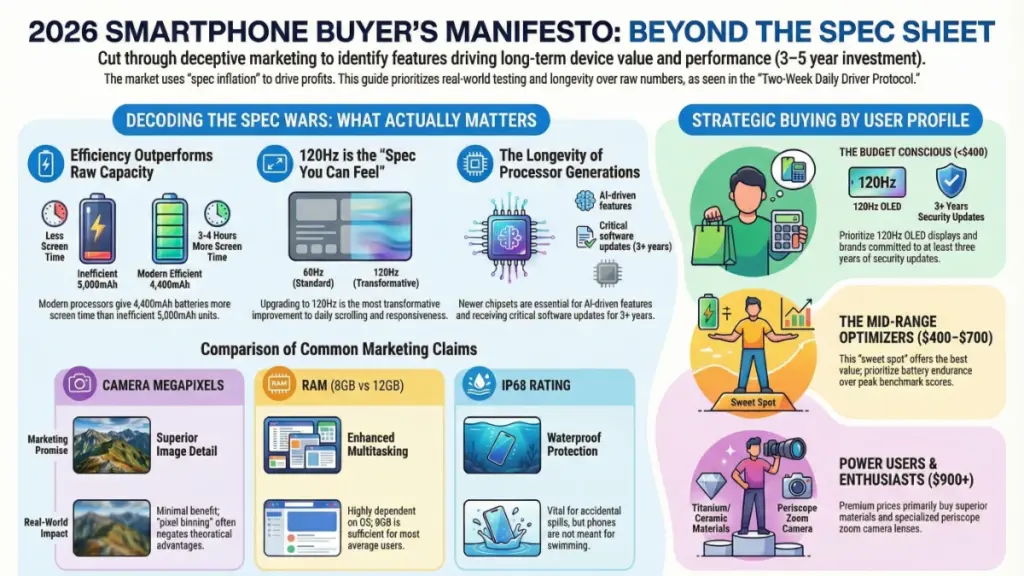
Battery Efficiency Over Raw Capacity Battery capacity matters, but power efficiency determines real-world endurance. A 4,400mAh battery paired with a modern, efficient processor routinely outlasts a 5,000mAh battery running on older, power-hungry silicon. In my testing, the difference can amount to 3-4 hours of additional screen-on time.
Display Refresh Rate: The Spec You Can Feel Moving from 60Hz to 120Hz creates an immediately noticeable improvement in scrolling smoothness and interface responsiveness. The upgrade is transformative—and surprisingly difficult to abandon once you’ve adapted. However, the distinction between fixed 120Hz panels and LTPO adaptive refresh technology (which dynamically scales between 1-120Hz to conserve battery) is subtle enough that most users won’t perceive daily differences.
Processor Generation: The Longevity Factor Chipset generation significantly impacts device lifespan. A phone launching with a two-year-old processor will:
- Hit performance limitations sooner
- Receive fewer years of software support
- Handle AI-driven features less effectively (increasingly crucial as artificial intelligence becomes embedded in core functionality)
For users keeping devices three years or longer, this represents a genuine trade-off worth serious consideration.
RAM Reality Check While RAM affects multitasking capability, software optimization plays an equally decisive role. I’ve documented 8GB smartphones outperforming 12GB competitors purely based on superior operating system memory management. Above 8GB, diminishing returns become pronounced for typical users.
Marketing Claims vs. Real-World Impact
| Specification | Marketing Promise | Actual Impact | Priority Level |
|---|---|---|---|
| Camera Megapixels (100MP+) | Superior detail and image quality | Minimal benefit unless printing poster-sized formats. Pixel binning often negates theoretical advantages. | Moderate |
| Processor Generation | Faster speeds | Directly impacts longevity, AI feature performance, and thermal management. Highly consequential. | High |
| Display Refresh Rate (120Hz) | Butter-smooth scrolling | Clearly perceptible improvement, especially on OLED panels. LTPO adds battery efficiency benefits. | High |
| RAM (12GB vs. 8GB) | Enhanced multitasking | Highly dependent on OS optimization. Diminishing returns beyond 8GB for average users. | Moderate |
| Battery Capacity (mAh) | Extended battery life | Efficiency matters equally. Chip architecture and software management are decisive factors. | Moderate |
| IP Rating (IP68) | Waterproof protection | Water resistance, not waterproofing. Meaningful for accidental exposure; don’t swim with your phone. | High |
Strategic Buying Framework: Matching Devices to Your Lifestyle
The 2026 Market Reality
Current industry trends are reshaping purchasing decisions. According to recent GSMA Intelligence research, AI capabilities—while not yet a primary purchase driver—are increasingly influencing consumer satisfaction post-purchase. Meanwhile, a significant memory shortage is impacting the industry, with Counterpoint Research predicting a 12% decline in global smartphone shipments through 2027 as AI data centers consume memory chip supplies.
This supply constraint means budget devices are particularly affected, with manufacturers reducing RAM and storage configurations while maintaining prices. Understanding these market dynamics helps you make informed timing decisions.
Decision Framework by User Profile
First-Time Buyers & Budget-Conscious Consumers (Under $400) The sub-$400 segment has experienced remarkable improvement. Focus your search on:
- Software longevity: Brands committed to three-plus years of security updates
- Display quality: 120Hz OLED panels if budget permits—this single upgrade transforms daily interaction more than any camera specification bump
- Processor recency: Avoid devices shipping with chips more than two generations old, regardless of attractive pricing
Mid-Range Optimizers ($400–$700) This price bracket currently offers exceptional value. Competition here is fierce, driving manufacturers to include genuinely flagship-adjacent features. Prioritize:
- Battery endurance and charging speed over peak benchmark scores
- Camera versatility (ultrawide, macro capabilities) over megapixel counts
- Thermal stability under sustained load rather than burst performance
A phone that handles your commute, travel photography, and video calls without complaint delivers more value than one that tops benchmarks but throttles during real-world tasks.
Power Users & Enthusiasts ($900+) At the flagship tier, differentiation has narrowed considerably. The gap between a $900 phone and a $1,400 alternative is smaller today than five years ago. Premium pricing typically buys:
- Superior build materials (ceramic, titanium, specialized glass)
- Advanced camera zoom capabilities (periscope lenses, computational telephoto)
- Ecosystem integration (seamless connectivity with watches, tablets, laptops)
If these elements genuinely enhance your workflow, the investment is justified. If not, pocket the $400 difference—modern mid-range devices will satisfy most power users.
Essential Buying Checklist: Do This, Not That
Smart Purchasing Moves
- Verify software update commitments before finalizing any purchase
- Consult real-world battery tests rather than rated capacity specifications
- Evaluate displays in-person at varying brightness levels and lighting conditions
- Calculate total cost of ownership including protective cases and screen insurance
- Seek long-term reviews (90+ days of use) rather than launch-day impressions
Common Costly Mistakes
- Selecting based on megapixel counts alone—computational photography matters more than sensor size
- Assuming highest price equals best fit for your specific needs
- Overlooking six-to-nine-month-old flagships often discounted 30-40%
- Neglecting network compatibility when switching carriers
- Paying for specifications you’ll never utilize (8K video recording, 100x digital zoom)
Comprehensive FAQ: Your Most Pressing Questions Answered
How much should I realistically spend on a smartphone in 2026?
The honest answer: Match your expenditure to your upgrade cycle and usage intensity.
If you replace devices every 12-18 months, the $400–$600 mid-range offers exceptional value. You’ll access current-generation performance, capable camera systems, and fast displays without premium pricing.
For 3-4 year ownership horizons, invest $800–$1,000 in a current-generation flagship with proven software support. The per-year cost often works out lower than buying budget devices more frequently, and you’ll avoid the frustration of premature obsolescence.
Current market consideration: The ongoing memory shortage means prices are less negotiable than in previous years, and discounts on new releases are rare. However, carriers are offering more aggressive trade-in incentives to maintain upgrade cycles.
Is buying last year’s flagship superior to choosing this year’s mid-range?
This depends entirely on your priorities, but the calculus has shifted in 2026.
Last-year’s flagship advantages:
- Premium build materials and tactile refinement
- Superior camera hardware (larger sensors, better optical zoom)
- Established accessory ecosystem (cases, screen protectors readily available)
- Often discounted 25-35% from launch pricing
Current mid-range advantages:
- Newer processor architecture with better efficiency and AI capabilities
- Longer remaining software support timeline
- Modern charging standards and connectivity (Wi-Fi 7, Bluetooth 5.4)
- Optimized for current app requirements and thermal expectations
My recommendation: For photography-focused users, last year’s flagship (like the Samsung Galaxy S24 Ultra or iPhone 15 Pro Max) often outperforms mid-range alternatives. For general users prioritizing longevity and battery efficiency, 2026’s mid-range devices with fresh silicon typically deliver better three-year value.
Does smartphone brand actually matter in 2026, or have Android devices become interchangeable?
Brand choice carries more significance than spec sheets suggest, particularly regarding:
Software Philosophy:
- Google Pixel: Pure Android with AI-first features, guaranteed updates, but occasional hardware quirks
- Samsung Galaxy: Feature-rich One UI with extensive customization, S Pen integration on Ultras, longer update commitments (now 7 years)
- OnePlus/Oppo: Fast charging leadership, streamlined software, value positioning
- Xiaomi: Aggressive pricing, feature-packed MIUI, inconsistent global availability
- Nothing: Minimalist design philosophy, transparent approach, emerging ecosystem
Update Reliability: Brands vary dramatically in software support delivery. Samsung and Google lead with 7 and 5+ year commitments respectively. Budget manufacturers often promise updates that arrive months late or not at all.
Repair & Resale Ecosystem: Apple and Samsung devices maintain higher resale values and enjoy broader authorized repair networks—a hidden cost consideration.
The verdict: Android phones aren’t interchangeable. Your brand choice determines your daily software experience, security update reliability, and long-term device value.
How can I accurately assess camera quality beyond marketing specifications?
Real camera evaluation requires looking past megapixel counts at the computational pipeline:
Key Evaluation Criteria:
- Dynamic range handling: How well does the camera preserve detail in bright skies and shadowed areas simultaneously?
- Low-light performance: Not just brightness, but color accuracy and noise reduction at restaurants, concerts, and evening walks
- Shutter lag: The delay between tapping the shutter and capturing the image—critical for moving subjects
- Video stabilization quality: Walking footage smoothness, not just static tripod performance
- Portrait mode edge detection: How accurately does software separate subjects from backgrounds?
Practical Testing Method: Before purchasing, download full-resolution sample images from reputable reviewers (GSMarena, DXOMark, or trusted YouTube reviewers) and examine them at 100% zoom on your current device. Pay attention to:
- Noise patterns in shadow areas
- Artificial sharpening artifacts around edges
- Color consistency across different lighting conditions
Computational vs. Hardware: Two phones with identical sensor specifications can produce dramatically different results based on image processing algorithms. Google’s Pixel devices consistently outperform hardware specifications through computational photography, while some high-megapixel competitors struggle with processing overhead.
What’s the realistic smartphone lifespan in 2026?
Hardware Durability: Modern flagships are engineered for 4-5 years of physical operation. Battery degradation is the primary limiting factor—expect 20-30% capacity loss after 2-3 years of daily charging.
Software Support Timeline:
- Premium tier: 5-7 years of security updates (Apple, Samsung, Google)
- Mid-range: 3-4 years typical
- Budget: 2-3 years, often with delayed patch delivery
Performance Longevity: Current-generation processors (Snapdragon 8 Gen 3, Apple A18, Google Tensor G4) handle today’s AI and gaming demands with headroom for future applications. Devices launching with older chips will struggle with 2027-2028 software requirements.
The realistic replacement cycle:
- Power users: 2-3 years (battery degradation and performance demands)
- Average consumers: 3-4 years (software support expiration)
- Light users: 4-5 years possible with battery replacement
Should I purchase unlocked or through my carrier?
Unlocked Advantages:
- Flexibility: Switch carriers without device restrictions
- No bloatware: Carrier-branded apps and delayed updates eliminated
- International use: Easier SIM swapping for travel
- Resale value: Unlocked devices command higher secondary market prices
- Financing alternatives: Credit cards with extended warranty protection often superior to carrier installment plans
Carrier Purchase Advantages:
- Trade-in incentives: Often $400-800 value for recent devices (though carefully verify fair market value)
- Bundled perks: Streaming subscriptions, hotspot data, or accessory credits
- Network optimization: Carrier-specific models sometimes optimized for specific frequency bands
2026 Market Reality: With memory shortages reducing manufacturer discounts, carrier incentives have become more aggressive. However, calculate total 24-month costs carefully—”free” phones often require expensive unlimited plans that exceed unlocked alternatives.
My recommendation: Purchase unlocked if you value flexibility and clean software. Consider carrier financing only if the total package (device + plan) offers genuine savings and you don’t anticipate switching networks within 24 months.
The Bottom Line: Cutting Through Manufactured Complexity
Smartphone purchasing doesn’t require navigating a trade show floor blindfolded. The confusion pervading this market is largely manufactured—brands benefit from complexity because it pushes consumers toward expensive options and makes meaningful comparison feel impossible.
The decision framework is actually straightforward:
- Define your upgrade cycle (1-2 years vs. 3-4 years)
- Match budget to realistic use cases (don’t pay for 8K video if you share on Instagram)
- Prioritize daily experience specifications (battery efficiency, display quality) over impressive paper numbers
- Treat software update commitments as long-term investments in security and functionality
The finest smartphone recommendation I’ve ever made wasn’t the most expensive available model. It was a three-year-old flagship that matched the user’s actual photography needs, received continued software support, and eliminated the pressure to upgrade annually. That device remained functional and satisfying for four years—a standard worth pursuing.
Have questions this guide didn’t address? The mobile technology landscape evolves constantly. Whether you’re debating specific models, timing your purchase around upcoming releases, or navigating carrier promotions, informed decisions always outperform impulse purchases.
