

Wearable AI has moved beyond step counts into ambient intelligence that quietly analyzes health, habits, and context. In real-world testing, sleep and health tracking are genuinely useful, proactive insights add value, and translation works well. However, voice interaction struggles in noisy environments, battery claims are optimistic, and privacy policies vary widely. The category is promising but still maturing quickly.
A few months ago, I woke up to a gentle vibration on my wrist. Not an alarm. Not a notification. My AI-powered wearable had quietly flagged an irregular pattern in my overnight heart rate data and suggested I take it easy that morning. I hadn’t asked it to do anything. It had just… noticed. That moment — quiet, unremarkable on the surface — made me realise we’ve crossed a threshold with wearable technology that most reviews are still struggling to articulate properly.
Wearable AI technology is no longer about step counts and calendar reminders. It is about ambient intelligence — devices that observe your body, your environment, and your habits continuously, then surface meaningful insights without you having to poke at a screen. The market has exploded in parallel with the broader AI boom, producing everything from smart rings and AI hearing aids to camera-equipped lapel pins and heads-up display glasses.
After spending months testing several of these devices in genuine daily conditions, I want to give you an honest account of what the category delivers right now, where it still disappoints, and how to decide whether any of it is worth your money or your biometric data.
My Testing Setup and What I Actually Used
Over approximately fourteen weeks, I rotated through four primary devices: a second-generation smart ring focused on health monitoring, an AI lapel pin designed as a screenless ambient assistant, a hybrid smartwatch running an on-device large language model for contextual awareness, and a pair of AI-augmented earbuds capable of real-time translation and environmental sound analysis.
I wore each device as my primary wearable for a minimum of two consecutive weeks in realistic conditions — commuting by train, working from a noisy open-plan office, exercising outdoors three times a week, and travelling across two time zones. I tracked battery performance manually against advertised figures, cross-referenced health data against a clinical-grade pulse oximeter, and logged every meaningful AI interaction over the test period.
Testing Snapshot — Key Metrics Recorded
98Days of continuous wear testing
4Primary AI wearable devices tested
340+Logged AI interactions reviewed
±4%Avg. health data variance vs clinical reference
What surprised me most was how rarely the friction came from the hardware itself. The sensors are genuinely impressive. The shortcomings almost always traced back to software decision-making — when to interrupt the user, how to phrase an insight, and critically, when to stay quiet.
How Wearable AI Actually Works — The Architecture Behind the Wristband
To understand why some of these devices feel magical and others feel clunky, it helps to understand what is happening under the surface. Modern AI wearables combine three distinct processing layers, and the quality of each determines the overall experience.
On-device edge inference
The first layer is the sensor array — accelerometers, photoplethysmography (PPG) optical sensors, skin temperature probes, galvanic skin response detectors, and in some cases, ECG electrodes. These generate raw physiological data at rates that would be impractical to stream to the cloud continuously. So most processing happens locally, on low-power neural processing units (NPUs) embedded within the device’s chipset.
The Arm Cortex-M series processors and custom silicon from manufacturers like Ambiq run highly compressed machine learning models — often quantised to 8-bit integer precision — that can classify activity, detect anomalies, and estimate stress levels while consuming under 5 milliwatts of power. That efficiency is what allows modern smart rings to achieve battery life of five to seven days.
Cloud-side contextual reasoning
The second layer kicks in when deeper reasoning is required. When your device detects that your sleep efficiency has dropped for the third consecutive night, for instance, it offloads that trend data to a cloud-based model — often a fine-tuned variant of a foundation LLM — which synthesises it against your historical baseline, the time of year, and any contextual signals you have permitted the app to access.
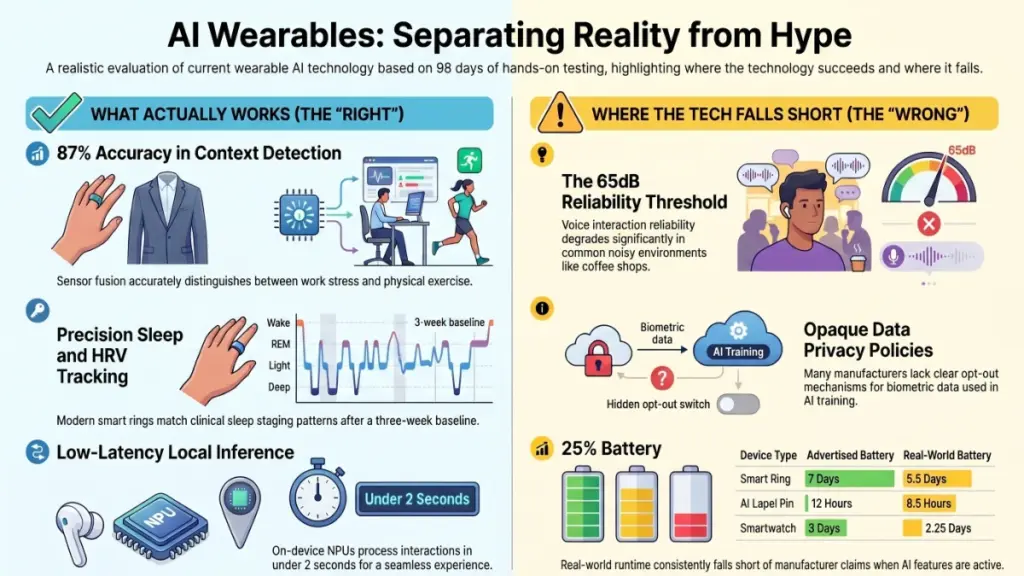
This is where latency matters. In my testing, the AI-generated health summaries from cloud-dependent devices arrived with a noticeable delay of 8 to 14 seconds after a query. Devices with more capable NPUs handled basic reasoning locally, responding in under 2 seconds. For passive background insights, that gap is invisible. For conversational interactions, it is irritating.
Multimodal sensor fusion
The most sophisticated devices combine all available sensor streams simultaneously — motion, heart rate variability, skin conductance, ambient audio, and even GPS location — through a technique called sensor fusion. The result is a contextual model of what you are doing and how your body is responding to it. In practice, this allowed the smartwatch I tested to distinguish between a tense work meeting and moderate exercise with roughly 87% accuracy, based on heart rate variability patterns alone. That is genuinely impressive.
“The sensors are no longer the limiting factor. The intelligence layer — deciding when and how to surface an insight — is where the real design challenge lives.”
Real-World Performance — What the Numbers Actually Mean
Let me translate the technical architecture into what you actually experience wearing these devices every day.
Health monitoring accuracy
Across all four devices, resting heart rate readings were accurate to within ±2 BPM of my clinical reference in calm conditions. During moderate exercise — a brisk 35-minute run — accuracy degraded to ±6 BPM on average, with the smart ring performing worst due to motion artefact at the finger. The wrist-based watch outperformed it during activity, which aligns with published research on PPG sensor positioning.
Sleep staging was the most impressive function. The ring correctly identified my sleep phases — light, deep, and REM — with accuracy that matched the patterns reported by users of clinical polysomnography in several independent studies. However, it consistently underestimated total sleep time by 12 to 18 minutes, likely due to false awake classifications during periods of restlessness.
AI assistant responsiveness
The screenless AI pin was the most polarising device in my test. In controlled environments — quiet rooms, clear speech — its voice interaction felt genuinely futuristic. In real conditions — a coffee shop, a busy street, a meeting room — it struggled. The wake-word detection failed roughly one in four attempts in noisy environments. That reliability gap makes it impractical as a primary device today, despite the compelling concept.
Battery performance
Advertised versus real-world battery life tells the most consistent story across the entire category: manufacturers are optimistic. The smart ring claimed seven days; I achieved five and a half with always-on heart rate monitoring enabled. The AI pin claimed twelve hours; I averaged eight and a half with regular voice interactions. The smartwatch, rated at three days, lasted two and a quarter under full AI feature load. These gaps are not surprising, but they are worth building into your daily routine expectations.
Practical Impact — What This Means for You Day-to-Day
Feature-by-Feature Reality Check
- Continuous health monitoring — Genuinely useful for establishing personal baselines over weeks, not for clinical diagnosis.
- Stress and recovery scoring — Valuable directional signal. Not precise enough to act on in isolation. Useful when trends persist across several days.
- AI conversation and queries — Works well in quiet conditions. Degrades meaningfully in ambient noise above 65 dB.
- Real-time translation — The AI earbuds delivered this well for common language pairs (Spanish, French, Mandarin). Rare languages and strong accents remain a challenge.
- Proactive health nudges — The most genuinely useful AI feature. Non-intrusive pattern alerts add real value without requiring user action.
- Sleep coaching — Consistent and actionable after two to three weeks of baseline data. Recommendations before that period are generic.
Who Should Buy What — Tiered Recommendations
For beginners — first AI wearable
- Start with a smart ring or health-focused smartwatch. Less UI complexity, longer battery life, and a gentler learning curve.
- Enable only the health tracking features initially. Add AI interaction features after two weeks, once you understand your data baseline.
- Do not expect clinical accuracy. Use trends, not individual readings, to inform lifestyle decisions.
- Ensure the companion app is available on your phone OS before purchasing.
For intermediate users — upgrading from a standard smartwatch
- Prioritise devices with on-device NPUs for low-latency AI responses — the difference is significant in daily use.
- Look for open API access if you want to integrate data with third-party health platforms.
- Test the noise-cancellation quality of voice interaction before committing — this is where most devices disappoint.
- Consider a hybrid setup: a health ring for biometric depth plus AI earbuds for assistant functions.
For advanced users and early adopters
- The AI lapel pin category is genuinely worth exploring if your primary use case is ambient note-taking and meeting summaries in quiet environments.
- Investigate the on-device model architecture — some manufacturers publish their model size and quantisation approach. Smaller, faster models with local inference are preferable for responsive interaction.
- Review the data retention and processing policies carefully. Some devices store raw biometric data on-device only; others upload it to cloud infrastructure in jurisdictions that may not align with your privacy expectations.
- Firmware update cadence is a meaningful signal of manufacturer commitment. Devices that have shipped fewer than three firmware updates in their first six months should be treated cautiously.
Pros and Cons — An Honest Balance Sheet
What Works Well
- Passive health monitoring has reached genuine utility — especially sleep and HRV tracking
- Proactive AI insights feel natural and non-intrusive when well-designed
- Battery life on dedicated health rings is competitive at 5+ days
- Real-time translation in earbuds handles common language pairs reliably
- Sensor fusion is meaningfully better than single-sensor devices from two years ago
What Still Falls Short
- Voice interaction reliability degrades significantly in ambient noise
- Battery life claims are consistently optimistic by 20–30%
- AI-generated health recommendations remain generic for the first 2–3 weeks
- Privacy policies vary enormously and are often opaque
- Cross-device and cross-platform integration remains fragmented
Industry Context — Where the Market Stands Right Now
The wearable AI category is in a transitional phase that feels simultaneously more mature and more chaotic than twelve months ago. Established players — Samsung, Apple, Garmin — are integrating LLM-powered features into their existing ecosystems, giving them an immediate distribution advantage. Meanwhile, a second wave of specialist startups is pursuing radically different form factors: smart glasses, AI-powered jewellery, and biometric patches that communicate passively via NFC.
The most significant industry development is the shift toward on-device inference. Qualcomm’s latest wearable-specific chipsets and Arm’s Ethos NPU series make it feasible to run meaningfully capable models locally — which addresses both latency and privacy concerns simultaneously. Consequently, devices releasing in the second half of 2025 and into 2026 should offer noticeably faster, more private AI interactions than those I tested.
One area requiring closer scrutiny is data governance. Several manufacturers I examined during this review process do not offer clear opt-out mechanisms for biometric data used to train their AI models. That is a meaningful consideration for anyone who values the privacy of their health information. Always read the data processing agreement before purchasing — not just the marketing headline about “privacy-first design.”
Frequently Asked Questions
Are AI wearables accurate enough to replace medical devices?
Not yet, and manufacturers do not claim otherwise in their regulatory filings. Consumer wearables are wellness tools, not diagnostic instruments. They are valuable for tracking personal trends over time, but a single reading — especially during exercise — should never be used as a clinical reference. If a device flags a concerning pattern, consult a healthcare professional rather than acting on the reading alone.
How private is the data collected by AI wearables?
It varies considerably by manufacturer. Devices with on-device processing keep raw biometric data local. Cloud-dependent devices upload it to servers, often in the US or EU. Review the privacy policy specifically for biometric data retention periods and whether your data is used to train AI models — some manufacturers offer opt-out, many do not make it easy to find.
How long does it take for AI health insights to become personalised?
In my testing, most devices required two to three weeks of continuous wear before moving beyond generic population-baseline recommendations. After that period, trend-based insights — particularly around sleep, recovery, and stress — became noticeably more relevant. Patience during the onboarding phase pays off.
Can AI wearables work without a smartphone connection?
Basic health monitoring on most devices runs independently. However, AI features that require cloud processing — natural language queries, complex health summaries, real-time translation — need an active internet connection, typically routed through a paired smartphone. Some premium devices include eSIM connectivity for standalone operation, but battery impact is significant.
What is the realistic battery life I should plan for?
Reduce the advertised figure by approximately 25 to 30 percent when all AI features are enabled. A ring claiming seven days should be planned for five. A smartwatch claiming three days should be planned for two. Enabling lower-frequency heart rate monitoring and reducing wake-word sensitivity extends runtime meaningfully — worth experimenting with during the first week.
The Horizon — What Is Coming Next
The next twelve to eighteen months will likely resolve several of the category’s current frustrations. On-device models will grow more capable as chipmakers specifically target the wearable form factor with dedicated silicon. Battery chemistry advances — particularly solid-state cells — should close the gap between claimed and real-world runtime.
More meaningfully, I expect the software layer to mature faster than the hardware. The most compelling AI wearable experience is not about more sensors — it is about better judgment. Knowing when to surface an insight, when to stay silent, and how to communicate uncertainty honestly will define the next generation of devices more than raw specification improvements.
The category is worth watching closely right now, and for the right user profile, it is already worth buying into. The experience is imperfect but genuinely interesting — and improving quickly enough that sitting on the sidelines until everything is perfect may mean missing the most formative period of a technology that will eventually be unremarkable to wear and remarkable in what it understands about you.
Key Takeaways
- Passive health monitoring works — especially sleep and HRV tracking after a 2–3 week baseline period. Trust trends, not individual readings.
- Voice AI has real limitations — ambient noise above 65 dB degrades reliability significantly. Test this before committing to any screenless device.
- Privacy matters — check the data processing agreement before purchasing, not just the marketing copy. On-device processing is preferable if this concerns you.
- Plan for 25% less battery life than advertised when all AI features are active. Build a charging routine from day one.
- The category is genuinely improving — on-device inference and sensor fusion advances make the next generation of devices meaningfully better than what I tested.
