


AI gadgets in 2025-2026 are devices that use machine learning to learn, adapt, and improve over time—unlike old “smart” devices that just followed rules. The best ones combine on-device processing for privacy with cloud AI for power. Top categories include AI wearables (Apple Watch Series 11, Oura Ring), smart home devices with Gemini AI, adaptive audio, and finally-viable smart glasses like Ray-Ban Meta. Avoid standalone AI companions like the Humane AI Pin; they’re still too unrefined.
The Morning That Changed Everything: When My Thermostat Knew Me Better Than I Knew Myself
A few months ago, I woke up to my bedroom feeling unusually cold. My Nest Learning Thermostat had already noticed—not because I touched it, but because it had tracked my sleep patterns for eleven days straight and detected that I tend to wake up restless when the temperature drops below 67°F. It adjusted the heating before my alarm even went off.
That moment stuck with me. Not because it was flashy or futuristic-sounding. But because it was useful in a way that previous “smart” devices never quite were. It solved a problem I hadn’t even consciously articulated yet.
That’s the difference between a smart gadget and an AI gadget. And right now, that difference matters enormously—because we’re in the middle of a genuine shift in how consumer technology works, thinks, and responds to us.
So what are AI gadgets, exactly? That’s a question worth answering carefully, because the term gets thrown around in misleading ways. In this comprehensive guide, I’ll break down what separates AI-powered devices from their connected-but-dumb predecessors, show you the categories that matter in 2025-2026, and help you figure out which ones are actually worth your money.
AI Gadgets vs. Smart Devices: Understanding the Critical Difference
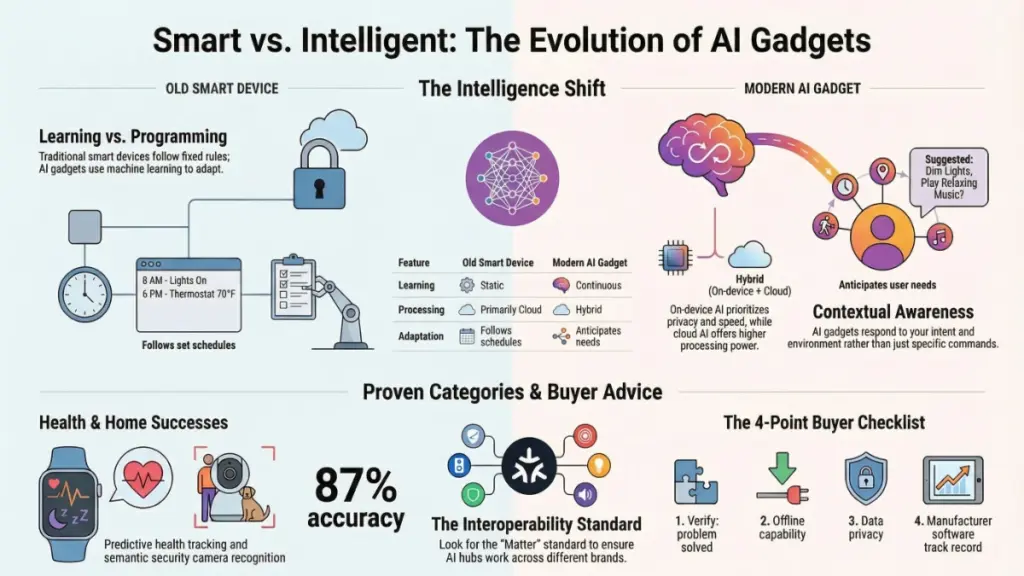
The consumer tech landscape has evolved dramatically. What we called “smart” devices in 2020 were essentially internet-connected appliances following pre-programmed rules. Today’s AI gadgets are fundamentally different—they learn, adapt, and improve based on your behavior.
The Technical Reality: Machine Learning at the Edge
At its core, an AI gadget is a device that uses machine learning models—either on-device or via cloud connection—to make decisions, adapt to user behavior, or interpret complex inputs like voice, images, or biosignals.
This is fundamentally different from a “smart” device that simply connects to the internet and follows rigid if-then rules.
On-Device AI vs. Cloud AI: Architecture Matters
Most AI gadgets fall into one of two processing architectures. Understanding which one your device uses matters for privacy, latency, and performance.
On-device AI means the machine learning model runs entirely on a dedicated chip built into the gadget itself. Apple’s Neural Engine, Qualcomm’s Hexagon NPU, and Google’s Tensor chip are prime examples. When you use Face ID on an iPhone 17 or get real-time translation on a Pixel 9 without opening an app, that’s on-device inference.
The benefit is speed and privacy—your data never leaves the device. The trade-off is that on-device models are typically smaller and less capable than cloud-based ones, constrained by battery life and chip size.
Cloud AI sends data to remote servers where much more powerful models process it and return a result. Most AI assistants work this way. The upside is raw capability. The downside is latency, internet dependency, and external data processing.
The Hybrid Approach (2025-2026 Standard)
Increasingly, the best AI gadgets use both. They run lightweight, fast models on-device for real-time tasks—noise cancellation in earbuds, for instance—and offload complex inference to the cloud when needed. Samsung’s Galaxy AI features use on-device processing for basic language tasks but route complex requests through Google’s cloud infrastructure.
What the Hardware Actually Looks Like in 2025-2026
Modern AI gadgets contain dedicated components that weren’t common two years ago:
- Neural Processing Units (NPUs): Chips specifically designed for matrix multiplications, the core mathematical operation in neural networks. Intel’s Core Ultra processors now deliver up to 48 TOPS (tera-operations per second), while Qualcomm’s Snapdragon X Elite delivers 45 TOPS on the NPU alone .
- Edge TPUs: Google’s Tensor Processing Units scaled down for edge devices, found in Nest cameras and other Google hardware.
- Always-on signal processors: Microphones that listen for wake words locally without sending audio to the cloud until triggered.
- Dedicated vision processors: Found in AI cameras and AR glasses like the Ray-Ban Meta smart glasses, handling computer vision tasks in real time .
The 7 Major Categories of AI Gadgets Dominating 2025-2026
The AI gadget space has expanded far beyond smart speakers. Here are the categories delivering real value right now.
1. AI Wearables and Health Trackers: The Fastest-Moving Category
This is where AI technology has made the most dramatic impact. Devices like the Apple Watch Series 11, Oura Ring Gen 4, and Google Pixel Watch 3 are now performing functions that required clinical visits just years ago.
The Apple Watch Series 11 uses a combination of photoplethysmography (PPG), electrical heart sensors, and on-device neural networks to detect atrial fibrillation—genuine medical-grade functions cleared by the FDA. But 2025-2026 brings even more advanced capabilities.
New for 2026: AI Wearables as Helpful Companions
At CES 2026, the conversation shifted from tracking to interpretation and action. Devices like the Pebble Index O1 smart ring and SwitchBot AI Mindclip work as smart companions rather than simple trackers.
The Index O1 captures notes, ideas, and reminders—and AI automatically sorts them to appropriate locations. Meeting reminders go to your calendar; “buy milk” lands on your shopping list. This represents a fundamental shift from passive tracking to active assistance.
Emerging Options Under $200:
- Omi ($89): A wearable that answers questions, summarizes conversations, creates to-do lists, and schedules meetings. It constantly listens and runs conversations through ChatGPT to remember context and offer personalized advice .
- Plaud NotePin ($159): A wearable voice recorder with AI transcription and summarization, valuable for professionals attending meetings or lectures. The device includes 300 free monthly transcription minutes .
- Rabbit R1 ($199): After crucial software updates in 2025, this retro-styled handheld now features “Creations”—allowing users to build custom tools and games. It performs tasks like booking flights and ordering meals without requiring your phone .
2. AI Smart Home Devices: Finally Functional, Not Frustrating
The smart home category has matured significantly. Google’s Nest Learning Thermostat uses occupancy sensing, weather data, and learned schedules to build heating and cooling models automatically. But 2025-2026 brings deeper integration.
The Matter Standard Revolution
The Matter standard from the Connectivity Standards Alliance now allows AI-powered hubs to make decisions across different brands—something practically impossible two years ago. This interoperability means your AI thermostat can communicate with AI-enabled blinds and occupancy sensors from different manufacturers.
Standout 2025-2026 Smart Home AI:
- Google Nest Doorbell (Wired, 3rd Gen): Integrates Gemini AI to describe and summarize what security cameras see. Users can search recordings with natural-language queries instead of scrubbing timelines .
- Aqara Doorbell Camera Hub G410: Functions as a complete Matter-compatible smart home hub with Thread and Zigbee radios, supporting Apple HomeKit Secure Video .
- AISO Smart Oven ($998): Uses weight sensors and a built-in camera to identify food geometry and deploy ideal cooking times and temperatures automatically .
- Roborock Saros Rover: A robot vacuum with legs that climbs and cleans stairs—featuring sudden stops, turns, and hops .
3. AI Audio: Earbuds and Speakers That Adapt to You
Adaptive noise cancellation is now standard, but the real advancement is personalized sound profiles.
Sony WH-1000XM6 uses AI to analyze your ear shape via 360 Reality Audio assessment and adjusts the equalization curve to your specific anatomy. The difference in perceived soundstage between default and personalized modes is measurable and audible.
Apple AirPods Pro 3 (2025) push further with Conversation Awareness 2.0—detecting when you start speaking and automatically lowering music volume while reducing noise cancellation. This runs entirely on the H2 chip inside the earbuds.
New for 2026: Neural Interface Audio
The Naqi Neural Earbuds represent a breakthrough—allowing control of digital worlds through pure thought via neural signals. While still emerging, this points to the future of human-device interaction.
4. AI Cameras and Computer Vision Devices
AI security cameras have moved beyond motion detection to semantic understanding. Google’s Nest Cam lineup uses on-device processing to differentiate between people, animals, vehicles, and packages.
Advanced setups from Arlo and eufy now recognize familiar faces and send targeted alerts only for unknown persons. The Aqara Camera Hub G5 Pro doubles as a Matter-certified outdoor smart home hub with Thread and Zigbee radios.
Key 2025-2026 Features:
- Natural language search (“Show me when the delivery truck arrived”)
- 2K video resolution as standard
- 360-degree coverage with pan/tilt motors
- AI-powered alerts for specific object categories
5. Smart Glasses 2.0: Breaking Free from Phones
After high-profile failures like Google Glass, smart glasses are finally cracking the mainstream in 2025-2026. What’s changed? Displays have gotten smaller and lighter, batteries improved, and AI has matured enough to make features like real-time translation and AR navigation viable
.
Ray-Ban Meta Smart Glasses represent the focused approach that works—they don’t try to do everything. Instead, they deliver live translation, hands-free photo capture, and voice-activated AI queries reliably.
Solos AirGo V2 (CES 2026) combines lightweight frames with real AI-powered assistant capabilities, object recognition, and hands-free interaction—finally acting as a personal interface that stays with you.
The Competition Heats Up:
Samsung, Apple, and Google are all confirmed or rumored to be launching smart glasses in 2026. The Xreal One Pro AR glasses launched earlier in 2025, and Samsung’s Galaxy TriFold phone is expected to pair with new AR capabilities.
6. Standalone AI Devices: The Experimental Category
This remains the most experimental space with the highest failure rate. The Humane AI Pin and early Rabbit R1 struggled to deliver consistent value, revealing how much infrastructure and refinement is still needed.
However, the Rabbit R1 has improved significantly through 2025 software updates, now offering expanded AI features and “Creations” for custom tool building.
The Lesson: Standalone AI gadgets that try to replace smartphones remain unrefined for mainstream adoption. The focused approach—glasses that do specific tasks well—proves more viable than general-purpose AI companions.
7. AI Laptops and Mobile Devices: The NPU Revolution
Dedicated NPUs are now standard in flagship laptops. Intel Core Ultra processors include NPUs rated at up to 48 TOPS. Qualcomm’s Snapdragon X Elite, used in Surface Pro and Windows on Arm devices, delivers 45 TOPS on the NPU alone.
These enable:
- Real-time background blur in video calls without CPU taxation
- Live captions generated locally
- On-device language translation
- Private Cloud Compute for complex tasks without data sharing
Apple Intelligence (iOS 26, iPadOS 26, macOS Tahoe)
Apple’s 2025-2026 rollout brings significant on-device AI capabilities:
- Workout Buddy: First-of-its-kind fitness experience analyzing workout data and fitness history to deliver personalized, spoken motivation based on heart rate, pace, distance, and Activity rings .
- Live Translation: Automatic translation of texts in Messages with on-device processing .
- Visual Intelligence: Learn about onscreen content across apps using AI analysis .
- Intelligent Shortcuts: Actions that tap into Apple Intelligence models directly for text summarization, image creation, and document analysis .
- Reduce Interruptions Focus Mode: AI-boosted filter that intelligently determines which notifications deserve attention beyond your specified criteria .
What AI Gadgets Actually Mean for You: Practical Impact
Let me translate technical architecture into real-world impact:
| Feature | Old Smart Device (2020-2023) | AI Gadget (2025-2026) |
|---|---|---|
| Responds to | Specific programmed commands | Context and intent |
| Learns from you | No | Yes, continuously |
| Processes data | Mostly cloud | On-device or hybrid |
| Adapts over time | Static functionality | Improves with use |
| Error handling | Fails on edge cases | Recovers and improves |
| Privacy | Data sent to servers | Local processing options |
| Speed | Network-dependent latency | Instant on-device response |
The defining characteristic is compounding improvement. A traditional smart thermostat follows the schedule you set. An AI thermostat builds the schedule itself, refines it over weeks, and adjusts based on outdoor temperature trends and your calendar.
Critical Limitations and Considerations Before Buying
Before investing in AI gadgets, understand these constraints:
1. Cloud Dependency
AI gadgets almost always require ongoing cloud connectivity for powerful features, meaning they’re dependent on manufacturers keeping servers running. Check offline capabilities if internet reliability is a concern.
2. Privacy and Data Usage
Training data often includes your personal behavior. While Apple emphasizes on-device processing with Private Cloud Compute, other manufacturers have varying policies. Always check privacy settings immediately after setup.
3. The “AI” Label is Heavily Overused
Many products claiming AI simply use basic conditional logic. True AI gadgets demonstrate learning and adaptation, not just automation.
4. Software Support Lifespan
If a manufacturer discontinues support, cloud-dependent features may stop working entirely. This is a specific risk with smaller AI hardware companies. Stick with manufacturers who have long-term software support track records.
5. Rising Costs
The worldwide memory shortage caused by AI data centers consuming computing components means laptops and smartphones are getting more expensive in 2026. Samsung has reportedly doubled DDR5 memory prices, with Framework raising component prices by 50%.
Actionable Buying Recommendations for 2025-2026
For Beginners: Start With Proven Categories
Best Entry Points:
- Sleep/Health Tracking: Oura Ring Gen 4 or Fitbit Sense 3 offer AI health tracking without technical setup.
- Smart Home: Google Nest Thermostat or Nest Doorbell with Gemini AI integration.
- Audio: Sony WH-1000XM6 or Apple AirPods Pro 3 for personalized sound.
Avoid: Standalone AI devices like the Humane AI Pin or early-generation Rabbit R1—they remain too unrefined for first-time buyers, though the R1 has improved significantly.
Checklist for First-Time AI Gadget Buyers:
- Does it solve a specific problem you already experience?
- Does it work offline if the cloud is unavailable?
- What data does it collect, and where is it stored?
- Does the manufacturer have a track record of software updates?
- Is there Matter standard compatibility for smart home devices?
For Intermediate Users: Build an Ecosystem
Focus on interoperability. Choose devices supporting the Matter standard for smart home products and compatibility with your existing phone ecosystem (Apple HomeKit, Google Home, or Amazon Alexa).
Recommended Pairings:
- AI thermostat + AI-enabled blinds + occupancy sensors = whole-home adaptation
- AI security cameras with natural language search + smart doorbells with facial recognition
- Wearables with medical-grade sensor validation (look for FDA 510(k) clearance)
Do: Invest in AI wearables with medical-grade sensor validation. Don’t: Buy AI gadgets locked to a single company’s closed ecosystem unless committed long-term.
For Advanced Users: Local AI and Privacy
The next frontier is on-device AI laptops and local inference. Devices running Qualcomm Snapdragon X Elite or Apple M5 chips allow running capable language models entirely locally—no cloud, no data sharing.
Tools to Explore:
- Ollama: Run open-source models locally on capable hardware
- Apple Intelligence on M5 Macs: Private Cloud Compute for complex tasks without external data sharing
- Framework laptops: Modular systems with upgradeable AI components (though prices have increased 50% due to memory shortages)
Frequently Asked Questions (2025-2026 Update)
Are AI gadgets safe for children? Most AI gadgets collect behavioral data. Products for younger users like Amazon Echo Kids are subject to COPPA restrictions and collect significantly less data. Always check privacy policies and configure parental controls before placing AI devices in children’s spaces.
Do AI gadgets work without an internet connection? On-device AI features—Face ID, adaptive noise cancellation, local health tracking—work offline. Cloud-dependent features including most voice assistants and advanced processing do not. Verify offline capabilities before purchasing if internet reliability is a concern.
Will an AI gadget’s performance degrade over time? Performance typically improves as devices learn your patterns. However, software support is critical. If manufacturers discontinue support for older devices, cloud-dependent features may eventually stop working. This risk is higher with smaller AI hardware companies.
What’s the difference between machine learning and traditional programming in gadgets? Traditional programming uses rigid if-then rules written by engineers. Machine learning trains models on data so devices figure out rules themselves—including scenarios engineers never anticipated. That’s why AI cameras recognize new vehicle types they weren’t specifically trained on.
Is my AI gadget’s data used to train AI models? Often yes, but opt-outs are usually available. Apple explicitly states Siri queries aren’t used for training without consent
. Google and Amazon allow data deletion and opt-out from human review. Check privacy settings in companion apps immediately after setup.
Are cheaper AI gadgets worth buying in 2025-2026? Sometimes. The AI camera category has solid options under $100 from TP-Link (Tapo) and eufy using genuine computer vision. In wearables, cheaper devices often use simpler algorithms labeled “AI” without delivering true adaptive performance. Invest in proven platforms rather than unverified AI claims.
What’s new in AI gadgets for 2026? Key trends include: AI wearables evolving into helpful companions rather than just trackers, smart glasses breaking free from phone dependency, home robotics moving toward practical companionship, LiDAR-equipped lawn robots with autonomous car-level sensing, and AI kitchen gadgets that coach rather than just assist.
The Future of AI Gadgets: What’s Coming Next
The next two years will bring AI capabilities to previously mundane categories. Kitchen appliances, car interfaces, medical monitoring patches, and AR glasses are all in active development with on-device AI at their core.
Key 2026 Trends to Watch:
1. Humanoid Robots Entering Homes Companies like 1X have opened pre-orders for NEO, a humanoid household helper bot. Tesla may start selling its Optimus robot in 2026. These leverage large language models and computer vision for more natural human interaction.
2. Physical AI Companions Beyond virtual chatbots, 2026 brings physical companion bots that interact, talk, and provide comfort—distinct from the concerning trend of emotional reliance on AI chatbots.
3. Contextual Awareness Revolution The next generation won’t just respond to commands—they’ll understand where you are, who you’re with, what’s happening in your day, and act accordingly. Anticipating needs rather than waiting to be asked.
4. Digital Detox Tech Counter-trend minimalist devices like e-paper readers and notification-only smartwatches that preserve focus rather than demand attention.
5. Rollable and Tri-Fold Displays Samsung’s Galaxy Z TriFold and rollable laptop screens from Lenovo represent hardware that changes shape to match your needs.
When this contextual awareness works well—as that thermostat moment showed me—it doesn’t feel like technology. It feels like your environment taking care of you.
That’s the promise of AI gadgets. And for the first time, in 2025-2026, it’s a promise that’s starting to be kept.
Key Takeaways: AI Gadgets in 2025-2026
- AI gadgets differ from smart devices by using machine learning to adapt and improve over time, rather than following fixed rules.
- On-device AI offers speed and privacy; cloud AI offers capability. The best devices use hybrid approaches.
- The most proven categories right now are AI health wearables (Apple Watch Series 11, Oura Ring Gen 4), smart home thermostats and cameras with Gemini AI integration, and AI audio devices with personalized sound profiles.
- Smart glasses 2.0 are finally viable with Ray-Ban Meta and Solos AirGo V2 leading the way.
- Standalone AI devices remain experimental—the Rabbit R1 has improved but Humane AI Pin struggled; focused devices outperform general-purpose AI companions.
- Verify before buying: offline functionality, data collection practices, and manufacturer software support history.
- The category is accelerating rapidly—contextual, anticipatory AI is the next frontier, with humanoid robots and physical AI companions emerging in 2026.
