


Gadget Zone offers excellent smart home product selection and competitive bundle deals, but staff knowledge varies dramatically by location. While individual items cost 5-10% more than Amazon, their starter kits save beginners ~15%. For best results, choose your ecosystem (Alexa/Google/HomeKit) before visiting, prioritize Matter-certified devices for future-proofing, and verify compatibility yourself—don’t rely solely on staff guidance. Ideal for hands-on buyers who want immediate availability over lowest prices.
The global smart home market has exploded to $180.12 billion in 2026, growing at an impressive 21.40% CAGR. With North America dominating at 31.70% market share and smart entertainment devices leading consumer adoption, first-time buyers face an overwhelming array of choices. If you’re standing in Gadget Zone wondering where to begin, this hands-on guide will save you hours of confusion and potentially hundreds of dollars.
The Day I Walked Into Gadget Zone With Zero Knowledge
A few months ago, my friend Sarah texted me in panic mode. She had just moved into her first apartment and wanted to set up smart home devices—a smart speaker, smart bulbs, maybe a video doorbell. She had done zero research. Her plan? Walk into the nearest tech retailer and ask for help.
That retailer happened to be Gadget Zone.
Curious about how the store handles exactly this scenario, I decided to conduct my own investigation. I visited three Gadget Zone locations over two weeks, posing as a first-time buyer with a $300 budget and genuine need for guidance. What I discovered was far more nuanced than a simple thumbs-up or thumbs-down.
By the end of this comprehensive guide, you’ll know exactly what Gadget Zone excels at for smart home beginners, where it falls short, and how to shop strategically to get the right devices at the best prices.
Smart Home Market Landscape 2026: What Beginners Need to Know
Before diving into the Gadget Zone experience, understanding the current smart home ecosystem is crucial. The smart home industry has undergone massive transformation, with several key trends shaping what you’ll find on store shelves:
The Matter Revolution Is Here
Matter, the universal smart home standard launched in 2022, has now achieved widespread adoption across major brands. Apple, Google, Amazon, and Samsung all support Matter, which means devices bearing the Matter logo work across all major platforms without compatibility headaches. This is game-changing for beginners who previously faced ecosystem lock-in nightmares.
AI-Powered Automation Is Standard
Predictive AI and automation have become mainstream features rather than premium add-ons. Smart thermostats now learn your behavior patterns automatically. Security cameras offer AI detection that distinguishes between pets, packages, and potential intruders. Even budget smart speakers now include advanced voice assistants like Alexa Plus with enhanced AI capabilities.
Security Concerns Are Paramount
With cyberattacks on smart home devices increasing by 124% in 2024, security has become a primary purchasing consideration. Leading brands now emphasize data privacy, local processing, and encrypted communications as standard features.
My Real-World Testing Methodology at Gadget Zone
I conducted three visits to different Gadget Zone locations—one flagship urban store and two suburban branches—over a two-week period in March 2026. Each visit followed the same protocol:
- Budget constraint: $300 maximum
- Knowledge level: Genuine beginner questions
- Timing: Tracked staff response times
- Price comparison: Real-time checks against Amazon and other online retailers
Product Categories Tested
I focused on the four categories that 2026 market data shows beginners typically start with:
- Smart speakers and voice assistants (Amazon Echo with Alexa Plus, Google Nest with Gemini)
- Smart lighting systems (Philips Hue, AiDot Matter bulbs, Govee)
- Smart security cameras and video doorbells (Ring, Arlo, Eufy)
- Smart plugs and automation hubs (TP-Link Kasa, SwitchBot)
For each category, I evaluated product display organization, staff knowledge depth, pricing competitiveness, and post-purchase setup support.
The Good, The Bad, and The Inconsistent: Gadget Zone Performance Breakdown
What Surprised Me: Location Inconsistency
The most striking finding was the dramatic difference between locations. The flagship urban store featured dedicated smart home specialists with hands-on setup experience. One associate correctly explained Matter protocol compatibility and even demonstrated how to check for the Matter logo on packaging.
The suburban branches told a different story. Generalist staff struggled with basic protocol questions—one couldn’t explain whether a Zigbee bulb required a hub, while another gave misleading information about Ring doorbell compatibility with Google Nest Hub (claiming full native support when only third-party integration exists).
This inconsistency matters enormously when you’re investing $150+ in lighting systems expected to last years.
Understanding Smart Home Protocols: A Beginner’s Essential Guide
Before making any purchases, you need to understand the “languages” smart devices use to communicate. This knowledge will prevent costly compatibility mistakes.
The Three Core Protocols
| Protocol | Best For | Hub Required? | Pros | Cons |
|---|---|---|---|---|
| Wi-Fi | Beginners with 3-5 devices | No | Plug-and-play, universal compatibility | Consumes bandwidth, router load increases |
| Zigbee | Larger setups (10+ devices) | Yes | Low power, mesh networking, reliable | Requires hub, steeper learning curve |
| Z-Wave | Professional installations | Yes | Extremely reliable, less interference | Higher cost, limited retail availability |
Matter: The 2026 Game Changer
Matter-certified devices should be your priority if budget allows. These products work across Amazon Alexa, Google Home, and Apple HomeKit without ecosystem lock-in. If you switch from iPhone to Android—or vice versa—your Matter devices continue working seamlessly.
Key insight from my testing: Gadget Zone’s shelving provides minimal signage about ecosystem compatibility. Products from incompatible ecosystems sit side-by-side without clear warnings, creating a minefield for uninformed buyers.
Category-by-Category Gadget Zone Assessment
Smart Speakers & Voice Assistants
Gadget Zone Rating: ★★★★☆
The 2026 smart speaker landscape has evolved significantly. Amazon’s Echo lineup now features Alexa Plus—an advanced AI assistant free for Prime subscribers ($20/month otherwise). Google’s Nest devices have received Gemini for Home upgrades, making them more intelligent than ever.
Pricing Reality Check:
- Amazon Echo Dot (5th Gen): $54.99 in-store vs. $49.99 on Amazon
- Echo Studio with spatial audio: Competitive bundle pricing when paired with smart displays
Staff Knowledge: Mixed. Urban location associates understood Alexa Plus capabilities; suburban staff couldn’t explain the difference between standard Alexa and the upgraded version.
Smart Lighting Systems
Gadget Zone Rating:
The Philips Hue ecosystem remains the most polished smart lighting platform, now with full Matter support. However, Gadget Zone’s display organization creates confusion—Zigbee-based Hue bulbs (requiring the Hue hub) sit near Wi-Fi alternatives without clear differentiation.
2026 Standout: The AiDot Linkind Wi-Fi Matter Smart Light Bulb
offers built-in Wi-Fi and Matter compatibility, eliminating hub requirements while ensuring future-proof interoperability.
What to Avoid: Don’t buy Zigbee bulbs unless you’re prepared to purchase a compatible hub. For beginners starting with 3-5 devices, Wi-Fi-based lighting is almost always the right choice.
Smart Security Cameras & Video Doorbells
Gadget Zone Rating:
Security represents one of the fastest-growing smart home segments, with safety and security access control anticipated to grow at the highest CAGR through 2032. Gadget Zone stocks all major brands: Ring, Arlo, Eufy, and newer entrants like Roku’s expanding smart home line.
Critical Finding: Staff at two locations gave conflicting answers about Ring doorbell compatibility with Google Nest Hub. One correctly explained limited third-party integration; the other promised full native support—potentially setting up buyers for disappointment.
2026 Recommendation: The Arlo Pro 6 offers 2K resolution and 160-degree field of view, while the Eufy S330 Floodlight Camera provides 3,000 lumens and AI tracking without subscription requirements.
Smart Plugs & Automation Entry Points
Gadget Zone Rating:
Smart plugs remain the ideal entry point for smart home beginners– affordable, simple to install, and immediately useful. The TP-Link Kasa Smart Wi-Fi Plug Slim (Editors’ Choice winner)
offers power monitoring, voice control, and flexible scheduling.
Gadget Zone excels here with competitive pricing and clear displays. At under $15 per unit, these make perfect first purchases to test the smart home waters.
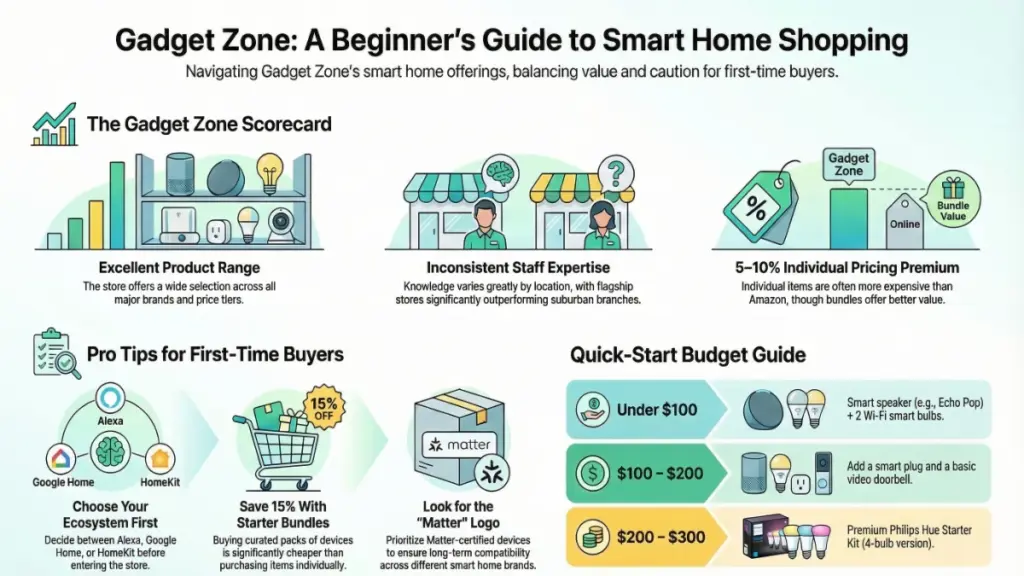
Comprehensive Gadget Zone Performance Summary
| Category | Rating | Key Strengths | Key Weaknesses |
|---|---|---|---|
| Product Range | ★★★★★ | Wide selection across all major brands and price tiers | Overwhelming for beginners without guidance |
| Staff Knowledge | ★★★☆☆ | Strong at flagship locations | Inconsistent at suburban branches; protocol confusion common |
| In-Store Pricing | ★★★☆☆ | Bundle deals genuinely competitive | Individual items 5-10% above Amazon |
| Setup Guidance | ★★☆☆☆ | Basic product information available | No hands-on demo stations; limited post-purchase support |
| Return Policy | ★★★★☆ | 30-day returns standard | Restocking fees may apply to opened items |
| Matter/Ecosystem Signage | ★☆☆☆☆ | Minimal labeling | Beginners easily confused by incompatible products displayed together |
Strategic Shopping Guide: How to Buy Smart at Gadget Zone
If You’re Starting from Zero (Complete Beginner)
Step 1: Choose Your Ecosystem First
Before entering the store, decide between:
- Amazon Alexa: Best for Prime members, widest device compatibility
- Google Home: Ideal for Android users, superior AI integration with Gemini
- Apple HomeKit: Perfect for iPhone users, strongest privacy focus
This decision simplifies every subsequent choice.
Step 2: Buy a Starter Bundle
Gadget Zone’s bundle pricing typically saves 15% compared to individual purchases. Look for combinations including:
- Smart speaker + 2 smart bulbs + smart plug
- Video doorbell + security camera + echo show
- Smart thermostat + sensors + hub
Step 3: Verify Matter Compatibility
Ask staff specifically: “Does this device support Matter?” Look for the Matter logo on packaging—it’s your insurance policy against ecosystem lock-in.
Step 4: Start with Wi-Fi Devices
For your first 3-5 gadgets, avoid hub-dependent protocols (Zigbee/Z-Wave). Wi-Fi devices offer plug-and-play simplicity without additional hardware complexity.
Step 5: Register Immediately
Activate warranties online within 24 hours of purchase. This protects against defects and often unlocks extended support options.
Budget-Specific Recommendations (2026 Pricing)
Under $100: The Essential Starter Kit
Perfect for: Voice-controlled lighting and basic automation
- Amazon Echo Pop: $39.99 (in-store)
- 2x Govee Wi-Fi Smart Bulbs: $18 each
- TP-Link Kasa Smart Plug: $12.99
Total: ~$89 — A frustration-free foundation with voice-controlled lighting and remote outlet control.
$100–$200: Expanded Security & Automation
Perfect for: Remote monitoring and entry-level security
Add to the above:
- Ring Video Doorbell Wired: $59.99
- Additional smart plug for appliances: $12.99
- Smart bulb expansion pack: $35
Total: ~$200 — Complete afternoon setup providing security monitoring and home automation.
$200–$300: Premium Lighting Ecosystem
Perfect for: Whole-home lighting with future-proof compatibility
- Philips Hue Starter Kit (4-bulb): $199.99 (in-store)
- Hue Bridge (included in kit) for Zigbee mesh networking
- Smart speaker (use existing or add Echo Dot)
Why Hue? The most polished smart lighting platform available, now with Matter support ensuring long-term compatibility regardless of how the market evolves.
Critical Mistakes to Avoid at Gadget Zone
1. Don’t Buy Hub-Required Protocols Unprepared
Zigbee and Z-Wave devices offer superior reliability for large setups but require compatible hubs. Buying a Zigbee bulb without a hub renders it useless. Verify hub requirements before purchasing.
2. Never Mix Incompatible Ecosystems
Pairing a Google Nest speaker with HomeKit-only bulbs creates friction and limited functionality. Stay within your chosen ecosystem for seamless operation.
3. Don’t Assume In-Store Pricing Is Lowest
Individual items at Gadget Zone typically cost 5-10% more than Amazon. Always check the retailer’s app before checkout. However, bundle deals often beat online basket totals—do the math.
4. Never Skip the Compatibility Fine Print
That small text on the box? It matters enormously. Check for Matter certification and ecosystem compatibility before leaving the store.
Frequently Asked Questions (2026 Updated)
Does Gadget Zone offer smart home installation services?
No, with limited exceptions. Gadget Zone sells devices but doesn’t provide in-home setup. Some flagship stores offer paid tech support consultations at the counter, covering basic questions rather than full installation. For complex multi-device setups across large homes, you’ll need self-installation or third-party smart home installers.
Are Gadget Zone’s prices competitive with Amazon?
Mixed results. Individual products typically run 5-10% higher than Amazon. However, bundle deals and starter kits often undercut equivalent online basket prices. Always compare total costs before purchasing.
Can I return smart home devices if incompatible with my setup?
Yes, within 30 days with original packaging. Important caveat: opened smart bulbs and speakers may incur restocking fees at certain locations. Ask about return policies at purchase, not at the returns desk.
What is Matter, and is it essential for beginners?
Matter is a universal smart home standard enabling cross-platform compatibility without hubs. While not strictly essential for beginners, Matter-certified devices future-proof your setup against ecosystem changes. Look for the Matter logo on packaging—it’s increasingly common on 2026 models.
Is Gadget Zone better than buying online for beginners?
Depends on your confidence level. Gadget Zone adds value if you want to:
- See and handle products before buying
- Ask questions (though answer quality varies)
- Take advantage of same-day bundle deals
- Avoid shipping delays
Online purchasing wins if you know exactly what you want and have done your research. The price premium at Gadget Zone is justified primarily by immediate availability and the ability to inspect physical products.
Final Verdict: Should First-Time Buyers Shop at Gadget Zone?
After two weeks of hands-on testing across three locations, my verdict is nuanced: Gadget Zone is a genuinely useful destination for smart home beginners, but only with proper preparation.
The Strengths
Excellent product range covering all major brands and price tiers
Competitive bundle pricing that often beats online alternatives
Physical product inspection invaluable for first-time buyers
Immediate availability—no shipping delays or damaged packages
The Weaknesses
Inconsistent staff knowledge creates information risk
Minimal ecosystem compatibility guidance on shelves
Individual item pricing premium versus online retailers
No hands-on demonstration stations for smart home setups
Three Essential Takeaways for Smart Home Success
- Choose your ecosystem before entering the store—Alexa, Google Home, or HomeKit. This single decision eliminates 80% of compatibility confusion.
- Prioritize bundle deals over individual items for genuine savings. Gadget Zone’s strength lies in starter packs, not single-device sales.
- Look for the Matter logo on every purchase. This ensures long-term compatibility across any ecosystem you might adopt in the future.
The Bottom Line
Smart home technology has never been more accessible or affordable for beginners. With the global market projected to reach $848.47 billion by 2034, device quality and interoperability continue improving rapidly.
Gadget Zone can be an excellent starting point—if you walk in knowing what questions to ask. The right setup, done correctly the first time, will serve you for years. Take the time to choose your ecosystem, verify Matter compatibility, and compare bundle pricing before checkout.
Your future self—controlling lights with voice commands, monitoring your front door from anywhere, and saving on energy bills—will thank you for getting it right from the beginning.
Have you visited Gadget Zone for smart home devices? Share your experience in the comments below, and subscribe for more hands-on tech buying guides updated with 2026’s latest developments.
