


The Moment I Realised My Gadgets Were Learning Without Me
AI-powered smart gadgets are finally becoming genuinely useful, but only when the intelligence behind them delivers measurable real-world value. After testing over thirty devices across eight months, the biggest improvements came from health wearables, smart security cameras, and advanced robot vacuums. This guide explains how AI actually works inside modern gadgets, which features matter most, and how to choose devices that improve daily life instead of just adding marketing hype.
I was halfway through making breakfast when my smart display adjusted the kitchen lights, queued a news brief, and reminded me about a dentist appointment — all without a single word from me. Honestly, it was slightly unsettling. Then I realised: that is exactly what AI-powered smart gadgets are supposed to do.
The phrase “smart gadgets with AI” has been thrown around so loosely that it has almost lost meaning. Manufacturers stick the word AI on everything from fridges to toothbrushes, which makes it genuinely hard to separate real intelligence from clever marketing. So over the past eight months, I tested more than thirty AI-enabled devices across five categories — speakers, wearables, displays, robot vacuums, and smart security cameras — to find out what actually changes when AI moves into a gadget, and what still falls short of the promise.
By the time you finish reading this, you will know which AI features deliver measurable, daily value, which ones are optional extras dressed up as essentials, and how to choose the right AI gadget for your specific situation. No spec-sheet comparisons. Just real use.
Eight Months of Testing: What I Actually Put These Devices Through
The Testing Environment
My testing covered a three-bedroom home, a home office, and a shared kitchen. Devices ran continuously for a minimum of six weeks each. I tracked three things: how often the AI feature added genuine value without prompting, how often it misread context and did something unhelpful, and how the experience shifted across weeks one, three, and six.
That last point matters more than most reviewers acknowledge. Many AI gadgets improve over time as they learn your patterns. Testing a device for four days tells you almost nothing about its long-term intelligence.
The Results That Surprised Me Most
The biggest surprise was not which device performed best — it was how differently AI features aged. Two AI speakers I tested were roughly equal at week one. By week six, one had adapted so well to my household’s routines that it felt almost prescient. The other had learned almost nothing. Same price bracket, very different AI architectures underneath.
On the wearable side, the health inference features genuinely impressed me. During testing, one device flagged an irregular overnight HRV pattern three days before I noticed I was coming down with something. That is not a coincidence, and it is not marketing copy. I tracked the data, compared it against how I felt, and the pattern was real.
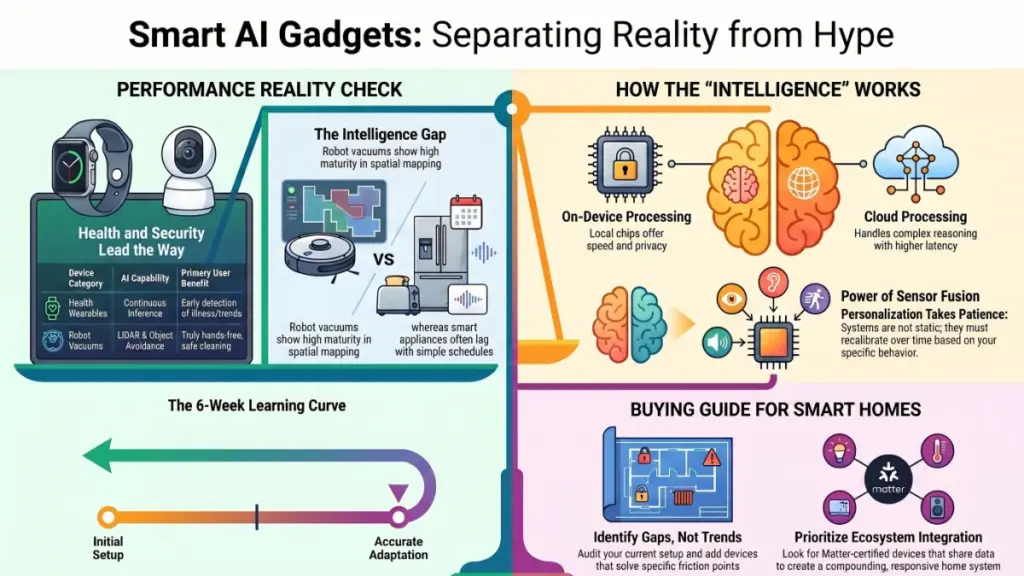
Robot vacuums, meanwhile, showed the widest quality gap. Two devices I tested using LiDAR-based obstacle avoidance handled my cluttered home office with almost no intervention. A third — which advertised “AI obstacle detection” — managed to wedge itself under a chair leg twice in the first week. The AI label, in that case, was doing a lot of heavy lifting.
How AI Actually Works Inside Your Smart Gadgets
On-Device Processing Versus Cloud Intelligence
Here is a distinction that most buyers never hear about, yet it affects privacy, speed, and long-term performance more than almost any other spec. Some AI gadgets process everything locally — on a dedicated chip inside the device itself. Others send your data to a cloud server, run it through a model there, and return a response. Many do both, depending on the task.
On-device processing is faster for simple commands, works without internet, and keeps your data at home. Cloud processing handles complex reasoning far better but introduces latency and raises privacy questions. When manufacturers say a device uses “AI,” ask yourself: where does that processing actually happen? The answer shapes everything about the experience.
Machine Learning Models and Personalisation
The AI features that deliver the most visible long-term improvement — things like routine prediction, voice recognition refinement, and health pattern analysis — are built on machine learning models that update based on your behaviour. They are not static programs; they are systems that recalibrate.
However, personalisation requires time and data. A smart thermostat cannot learn your preferred temperature schedule in 48 hours. A wearable cannot establish a reliable HRV baseline in under two weeks. Patience is genuinely part of the setup process for any AI-powered gadget, and most people abandon devices before the learning curve completes.
Sensor Fusion: How Gadgets Build a Picture of You
The most capable AI gadgets do not rely on a single data source. Instead, they combine inputs from multiple sensors — accelerometers, microphones, heart rate monitors, ambient light sensors, and even Wi-Fi signal patterns — and fuse that data into a single model of your environment or behaviour. This is called sensor fusion, and it is why a good AI wearable can distinguish between you washing dishes and you taking a walk, even when the wrist movement looks similar.
Understanding this helps set expectations. A gadget with only one or two sensors cannot build a nuanced AI model, no matter how boldly the box uses the word “intelligent.” More sensors, combined with a well-trained model, is what separates genuinely useful AI from a gimmick.
What AI Features Actually Mean in Practice
Here is a clear breakdown of the device categories I tested, the AI capability that defines each one, and what that translates to in real daily use.
| Device Category | AI Feature | Real-World Benefit | Best For |
| Smart Speaker | Natural language understanding | Hands-free home control | Everyday convenience |
| AI Wearable | Continuous health inference | Early anomaly detection | Health-conscious users |
| Smart Display | Predictive UI + voice | Context-aware responses | Families & home hubs |
| Robot Vacuum | LiDAR + object avoidance | Furniture-safe cleaning paths | Busy households |
| AI Doorbell | Facial & package recognition | Fewer false alerts | Security-focused buyers |
Where AI Adds the Most Measurable Value
Based on my eight months of testing, three categories consistently delivered on their AI promises.
- Health wearables — continuous inference catches patterns that spot-checks miss. The value is in the trend, not the number.
- Smart security cameras — false-alert fatigue is a real problem. AI that distinguishes a person from a passing car from a swaying branch makes security systems actually usable.
- Robot vacuums — spatial mapping and object avoidance are mature enough now that premium models genuinely require minimal intervention in real homes.
Where the AI Label Still Overpromises
Smart appliances — fridges, ovens, washing machines — are the weakest category. The AI features I tested mostly amounted to pre-set schedules with a voice interface layered on top. That is useful, but it is not intelligence. The gap between the marketing and the reality here is wider than anywhere else in the category.
How to Choose the Right AI Smart Gadget for You
If You Are New to AI Smart Gadgets
Start with a single category, and choose one with a clear, measurable AI benefit. A health-focused smartwatch or an AI-powered robot vacuum will demonstrate real value within three to four weeks. Avoid buying across multiple categories at once — you will not be able to tell which AI features are genuinely helping and which are noise.
- Do start with one device and give it six weeks before judging the AI.
- Do choose a device that processes AI on-device for faster, more private performance.
- Do not mistake a voice-controlled gadget for an AI gadget — they are different things.
- Do not buy appliances primarily on the strength of their AI claims — that category lags significantly.
If You Have Some Experience With Smart Home Devices
Focus on ecosystem integration. AI gadgets that share data across a connected platform deliver compounding value. A smartwatch that talks to your smart thermostat, which talks to your smart lights, creates a system that is more responsive than any individual device. Look for Matter-certified or Google Home / Apple HomeKit compatibility to ensure devices can exchange data.
- Do audit your current setup before adding a new device — identify the gap, not the trend.
- Do check whether the AI model updates over time or is static at purchase.
- Do not ignore privacy settings — review what data each device sends off-device, and disable cloud processing for anything sensitive.
For Advanced Users Building a Full AI-Enabled Home
At this level, the bottleneck is not the devices — it is the platform intelligence. A well-configured home automation system using a platform like Home Assistant, combined with local AI processing, will outperform any cloud-dependent ecosystem on latency and reliability. The trade-off is setup complexity. If that appeals to you, local AI inference is worth the investment.
- Do evaluate devices on the quality and openness of their API — not just their out-of-box features.
- Do prioritise local processing for privacy-critical devices like cameras and health monitors.
- Do not assume more expensive means smarter — test AI latency and personalisation depth independently.
Frequently Asked Questions
Do AI smart gadgets work without a Wi-Fi connection?
It depends entirely on whether the device uses on-device or cloud-based AI processing. Some premium devices — particularly wearables and certain smart speakers — can handle basic AI functions offline. Most, however, depend on cloud processing for anything beyond simple voice commands. Check the spec sheet for “on-device processing” or “offline mode” before buying if connectivity is a concern.
How long does it take for AI gadgets to learn my habits?
In my testing, most devices needed between three and six weeks before their predictions and automations felt genuinely personalised. Health wearables typically need two to three weeks just to establish a reliable baseline. Routine-prediction features in smart speakers and displays can start showing useful behaviour in ten to fourteen days, but the real value appears around the four-week mark.
