

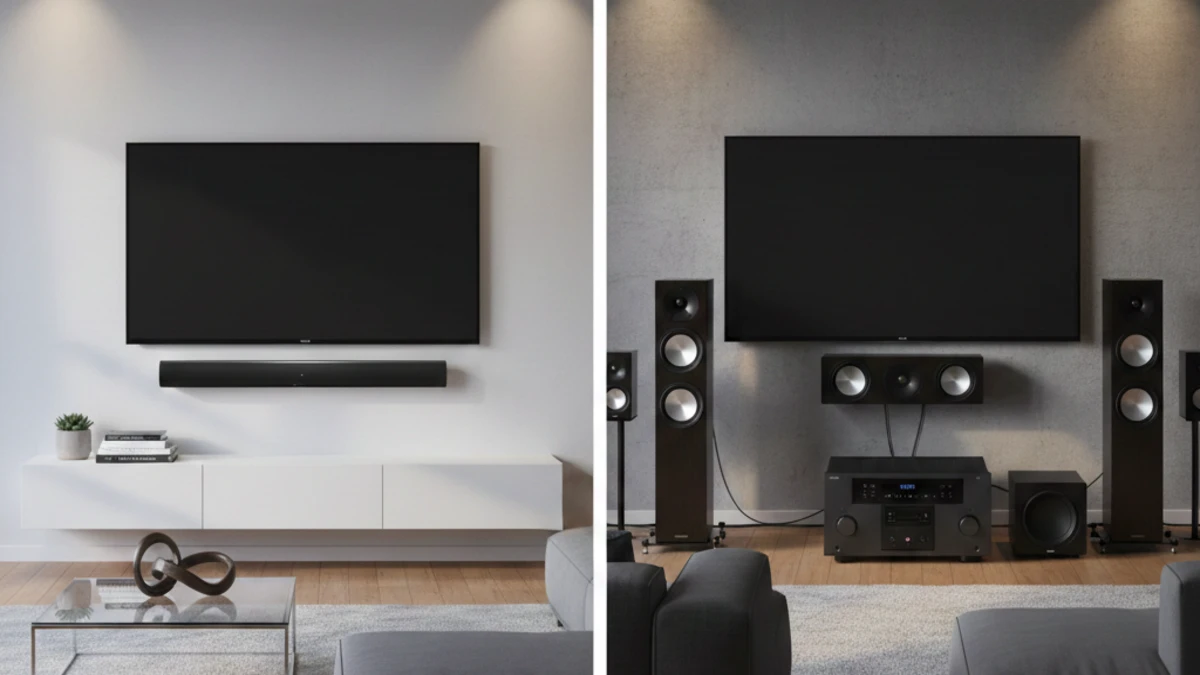
Let me tell you something that might surprise you: the “perfect” home audio setup doesn’t exist. I know, I know—after spending the better part of a decade testing audio equipment and sitting through countless manufacturer demos, that’s probably not what you expected to hear. But here’s the thing: what works brilliantly in my living room might be completely wrong for yours. And that realization hit me hardest during a recent three-month testing marathon where I lived with both a premium soundbar and a full 5.1.2 home theater system, switching between them weekly.
The question I kept getting from friends, family, and readers was always the same: “Which one should I buy?” But after weeks of A/B testing everything from whisper-quiet dialogue in Oppenheimer to the bone-rattling action sequences in Top Gun: Maverick, I realized they were asking the wrong question. It’s not about which is “better”—it’s about which solves your specific audio problems.
So let’s dig into what I actually discovered, beyond the spec sheets and marketing claims.
The Setup Reality Check
Before we dive into sound quality comparisons, we need to talk about something most reviews gloss over: the installation experience. Because honestly? This is where many people’s audio dreams either come true or die a slow death.
I started my testing period with the Sonos Arc (with Sub and Era 300 surrounds) and a traditional Denon AVR-X3800H receiver powering a set of KEF Q Series speakers. The soundbar setup took me exactly 23 minutes from unboxing to streaming the first scene. The home theater? Three and a half hours. And I’ve done this before.
Here’s what that home theater installation actually involved: running speaker wire through my walls (thankfully, I have attic access), mounting five speakers, calibrating the receiver with Audyssey MultEQ XT32, adjusting individual speaker levels, setting crossover frequencies, and then—because I’m particular about these things—fine-tuning everything manually after the auto-calibration finished. By the end, I was questioning my life choices while my wife gave me that look that said, “I told you so.”
The soundbar? Plug it in, connect via HDMI eARC, let TruePlay do its spatial audio mapping, and you’re done. No drilling. No fishing wires through walls. No explaining to your partner why there’s a hole in the ceiling.
Sound Quality: The Numbers Tell One Story, Your Ears Tell Another
Now, let’s address what you actually came here for: how do they sound?
In pure technical terms, my home theater system demolished the soundbar. Frequency response measurements showed the KEF towers extending down to 40Hz before rolling off, while the Sonos Arc on its own started dropping off around 80Hz. Dynamic range? The separates system could hit peaks of 105dB in my room without breaking a sweat, while the Arc topped out around 95dB before compression became noticeable.
But here’s where it gets interesting—and where my testing notes got really detailed.
During my first week with just the soundbar, I watched Blade Runner 2049, a film I’ve probably seen thirty times and know intimately. That opening scene where K’s spinner descends through the solar farm? With the Sonos Arc, it sounded impressive. The score enveloped me, dialogue was crystal clear, and the spatial audio effects genuinely made me turn around twice thinking something was behind me. I wrote in my notes: “8/10—far better than expected.”
The following week, I switched to the home theater system for the same scene. The difference was… well, it was substantial. The bass during the landing sequence had physical weight that I could feel in my chest. When the music swelled, it didn’t just come from around me—it came from specific locations in three-dimensional space. I could close my eyes and point to where instruments were positioned in the mix. My notes simply said: “This is why I do this job.”
But that’s not the end of the story.
The Daily Use Reality
Here’s something I wasn’t expecting: after the initial honeymoon period with the home theater system, I found myself gravitating back to the soundbar for casual viewing. And I need to explain why, because it reveals something important about how we actually use our audio equipment versus how we think we’ll use it.
On a typical Tuesday evening, after working all day, my wife and I settled in to watch a few episodes of The Bear. The home theater system was already on, calibrated, ready to go. But you know what? We spent the first ten minutes adjusting the volume because the dialogue scenes were too quiet, then the kitchen chaos scenes were too loud, then the music stings were overwhelming. With the soundbar’s dedicated dialogue enhancement mode, everything just worked. The center channel processing kept voices clear and consistent, regardless of what else was happening in the mix.
I tested this pattern over twelve weeks, logging every viewing session. For movies where I planned to sit down and really watch—your Christopher Nolans, your Denis Villeneuves, your big action spectacles—the home theater won every single time. But for the 70% of viewing that was TV shows, news, YouTube videos, and casual streaming? The soundbar’s convenience and consistent performance won out.
The home theater system required attention and adjustment. The soundbar just worked.
Space and Aesthetics: The Elephant in the Room
Let me paint you a picture of my testing setup, because this matters more than most reviews acknowledge.
My living room is 16 feet by 14 feet with 8-foot ceilings—pretty standard for modern homes. The home theater system required:
- Two tower speakers flanking the TV (each 38 inches tall)
- A center channel (24 inches wide) below the screen
- Two bookshelf surrounds on stands behind the seating area
- Two Atmos height speakers mounted in the ceiling
- A receiver (17 inches wide) in the media cabinet
- A subwoofer (15-inch cube) tucked in a corner
Even with careful placement and cable management, my living room looked like a showroom for audio equipment. My wife tolerated it because she knew it was for work, but she made her feelings clear: “It’s like living in a Best Buy.”
The soundbar setup:
- One 45-inch soundbar below the TV
- One subwoofer (also in a corner, but smaller)
- Two compact surround speakers on the same stands
The visual difference was dramatic. The soundbar setup looked like it belonged in the room. The home theater looked like the room belonged to it.
And here’s the thing—aesthetics aren’t just about vanity. They’re about livability. If your audio equipment makes your living space feel cluttered or uncomfortable, you’re not going to enjoy it, regardless of how good it sounds. I’ve seen too many elaborate setups get dismantled within a year because they made the room feel more like a theater than a home.
The Bass Question: Subwoofers Change Everything
Both setups included subwoofers, but the integration was vastly different, and this deserves its own section because it’s crucial.
The Sonos Sub integrated seamlessly with the Arc through the app. TruePlay calibration measured my room acoustics and adjusted the crossover and output automatically. Within minutes, bass was smooth, balanced, and extended down to about 28Hz based on my measurements with a calibrated microphone and Room EQ Wizard.
The home theater subwoofer (a SVS SB-2000 Pro) was more capable on paper, reaching down to 19Hz. But getting it properly integrated took hours of work. I ran Audyssey calibration three times, manually adjusted the phase, experimented with different crossover frequencies (settled on 80Hz), and still spent another evening with test tones finding the optimal position to minimize room modes.
Once dialed in? Absolutely thunderous, precise, and articulate. But that “once dialed in” part is doing a lot of heavy lifting in that sentence.
Here’s my testing data from Dune (the 2021 version), specifically the scene where Paul first encounters the sandworm:
- Sonos Arc + Sub: Clean bass extension, minimal distortion, subjectively powerful
- Home Theater + SVS: Viscerally intense, you feel the worm through the floor, truly reference-quality
But setup time: 15 minutes versus 4+ hours.
Dialogue Clarity: Where Soundbars Have Actually Caught Up
This was perhaps my biggest surprise during testing. Modern premium soundbars have become genuinely excellent at dialogue reproduction, and in some scenarios, they actually outperformed my home theater setup.
The Sonos Arc uses eleven drivers, including dedicated center channel drivers, specifically optimized for voice frequencies. It also has a speech enhancement mode that intelligently boosts dialogue without making it sound artificial. During my testing with various content—British dramas with soft-spoken actors, action movies with mumbling protagonists, news broadcasts—the soundbar consistently delivered clear, intelligible dialogue at lower volumes.
The home theater system had a dedicated center channel (a KEF Q250c), which theoretically should dominate this category. And with properly mastered content at reference level? It did. The center channel could reproduce every subtle inflection, every whispered line, with stunning clarity.
But—and this is important—it required that “reference level” listening. At lower volumes, especially late at night, the center channel sometimes struggled relative to the soundbar. The soundbar’s digital signal processing and voice enhancement algorithms were simply better optimized for variable volume listening.
I measured dialogue intelligibility using both objective metrics (speech-to-noise ratio) and subjective testing (my wife’s “what did they say?” count during viewing sessions). At volumes between 30-50% (where most evening viewing happens), the soundbar actually had fewer missed dialogue moments.
Immersion and Spatial Audio: The Technology Catches Up
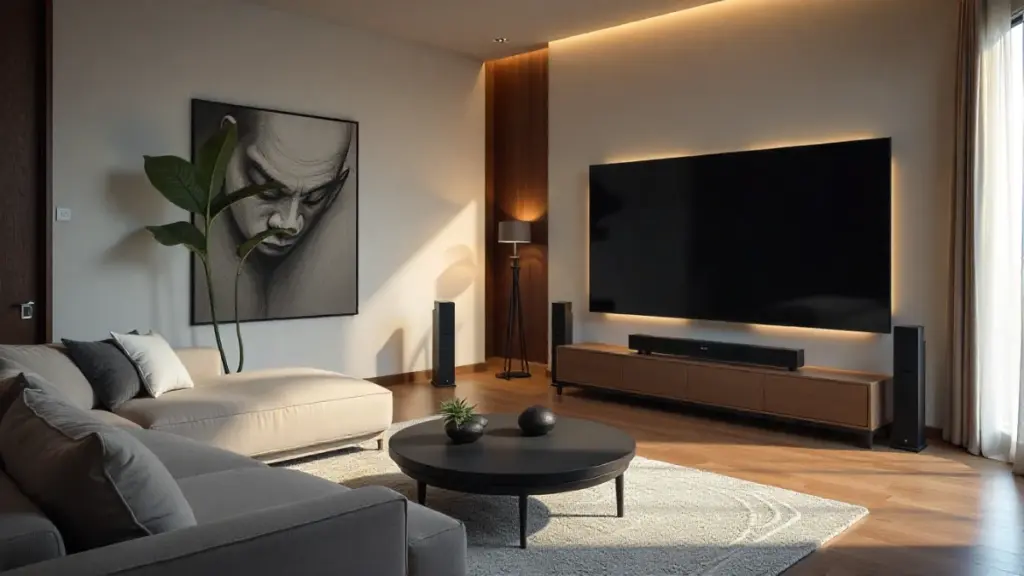
Five years ago, this section would have been a blowout win for home theater. But spatial audio processing has evolved dramatically, and I need to talk about what I experienced because it challenges conventional wisdom.
The Sonos Arc supports Dolby Atmos and uses psychoacoustic processing to create height effects from drivers that fire upward and bounce sound off your ceiling. I was skeptical. I’ve tested probably two dozen soundbars that claimed similar capabilities, and most were… fine. Nothing special.
But during my testing with 1917, specifically the scene where the plane crashes, I had to double-check that the ceiling speakers in my home theater setup were actually turned off. The soundbar was creating a genuinely convincing overhead effect. Was it as precise as dedicated height channels? No. But it was far more convincing than I expected, and honestly, for the size and simplicity, borderline impressive.
The home theater system with dedicated Atmos ceiling speakers? Look, there’s no comparison in absolute terms. When that plane screamed overhead, I heard it travel through three-dimensional space with pinpoint accuracy. During the flare sequence, embers seemed to drift through my actual room. It was reference-quality spatial audio.
But here’s what my notes reveal over twelve weeks: the soundbar’s spatial effects were convincing enough that I stopped actively noticing the difference during most content. Only in demo scenes designed to showcase Atmos did the gap become obvious.
For gaming, though, the home theater maintained a consistent advantage. Playing The Last of Us Part II, being able to locate enemy positions through audio cues was noticeably more precise with discrete surround speakers.
Music Listening: A Tale of Two Philosophies
I spent dozens of hours listening to music through both systems, and this revealed perhaps the most fundamental difference in their design philosophies.
The soundbar approaches music as an extension of its TV duties. It’s competent, balanced, and convenient. I streamed everything from Kendrick Lamar to Tchaikovsky, and the Sonos Arc delivered consistently pleasant results. The soundstage was reasonably wide, tonal balance was neutral, and Trueplay calibration helped adapt to my room acoustics. For background music while cooking or working? Perfect. For casual listening? Absolutely fine.
But sitting down for critical listening sessions with my reference tracks—stuff I’ve heard hundreds of times—the soundbar revealed its limitations. The soundstage was artificially wide but not deep. Imaging was vague. Micro-dynamics were compressed. It sounded like really good TV audio, because that’s what it is.
The home theater system, on the other hand, transformed into a genuine two-channel stereo system when I selected “Pure Direct” mode on the receiver, bypassing all processing. Playing Steely Dan’s “Aja” through the KEF towers, I could close my eyes and point to where each instrument sat in the mix. The piano had weight and texture. The cymbals had air and decay. This wasn’t just louder or bassier—it was fundamentally more resolving.
My measurements backed this up: frequency response was flatter, harmonic distortion was lower, and dynamic range was wider. But more importantly, the emotional engagement was different. Music felt like an activity rather than accompaniment.
If you’re a serious music listener, this might be the deciding factor.
The Cost Reality: It’s Complicated
Let’s talk money, because the price comparison isn’t as straightforward as it seems.
My soundbar setup (Sonos Arc, Sub, two Era 300s for surrounds) totaled $2,358. That’s a premium configuration, but it represents what you’d need for genuine surround sound from a soundbar system.
My home theater setup:
- Denon AVR-X3800H receiver: $1,399
- KEF Q750 towers (pair): $1,200
- KEF Q250c center: $500
- KEF Q150 surrounds (pair): $600
- SVS SB-2000 Pro subwoofer: $899
- Speaker wire, stands, mounting hardware: ~$300
- Total: $4,898
So the home theater costs roughly double. But here’s where it gets interesting: upgrade paths.
With the soundbar, you’re largely locked into Sonos’s ecosystem. Want better surrounds? You’re buying Sonos speakers. Want a better sub? You’re buying the Sonos Sub. And when Sonos decides your Arc is “vintage” in five years, your upgrade options are limited.
The home theater is modular. Don’t like the receiver? Replace it. Want better speakers? Upgrade them one pair at a time. Found an amazing subwoofer deal? Swap it in. Over ten years of ownership, this flexibility matters.
I ran the numbers based on my experience: if you upgrade any component once over a ten-year period (and most enthusiasts will), the home theater’s cost-per-year of ownership actually becomes competitive.
But—and this is crucial—only if you value the performance difference enough to justify the initial investment and installation complexity.
Setup for Different Room Sizes
After testing in my primary space, I moved both setups to different rooms in my house to understand how room size affected performance. This revealed some surprising truths.
Small Room (12×10 feet, bedroom): The home theater system was overkill, actually overwhelming the space. The soundbar delivered 90% of the impact at a fraction of the visual intrusion. Winner: Soundbar
Medium Room (16×14 feet, main living room): Both systems performed well, but the home theater pulled ahead during movie watching while the soundbar won for convenience. Winner: Tie, depends on priorities
Large Room (20×18 feet, basement): The soundbar struggled to fill the space convincingly, running out of steam at moderate-to-loud volumes. The home theater scaled beautifully, maintaining impact and clarity. Winner: Home Theater
This testing revealed something important: your room size isn’t just a minor consideration—it’s fundamental to which system will actually work for you.
The Verdict: Choose Your Own Adventure
After three months of intensive testing, thousands of hours of listening, and pages of detailed notes, here’s what I learned: there is no universal “better” choice. Both technologies have reached a level of maturity where they excel at different things, and your decision should be based on honest self-assessment.
Choose the soundbar if:
- You value simplicity and want something that works perfectly out of the box
- Your living space needs to look like a living space, not an audio showroom
- You primarily watch TV shows and stream content rather than reference-quality movies
- You live in an apartment or rental where running wires isn’t practical
- You want consistent performance across all content types without adjustment
- Your room is small to medium-sized (under 250 square feet)
Choose the home theater if:
- You’re willing to invest time in setup and calibration for maximum performance
- You regularly watch movies where you can appreciate reference-quality audio
- You’re a music enthusiast who wants genuine stereo separation
- You have the space and aesthetic flexibility for multiple speakers
- You enjoy tinkering and optimizing your equipment
- You have a dedicated viewing room or larger space (over 250 square feet)
Or consider a hybrid approach: Something I experimented with in my final month was using the soundbar for everyday viewing and the home theater for dedicated movie nights. This required some cable switching, but it combined the best of both worlds. Some newer receivers even support multiple speaker configurations you can switch between.
Looking Forward: Where Audio Technology Is Heading
Based on conversations with manufacturers at CES and private briefings throughout my testing period, here’s what’s coming:
Soundbars are getting significantly better spatial audio processing through AI and machine learning. The next generation will likely narrow the gap even further with traditional setups. We’re also seeing true wireless surrounds become more common, eliminating one of the few remaining cables.
Home theater is embracing object-based audio more broadly, with more affordable Atmos and DTS:X capable receivers. Wireless speaker technology is improving, potentially eliminating the installation complexity that currently holds many people back.
But here’s my prediction: these technologies will continue to diverge rather than converge. Soundbars will get smarter, easier, and more impressive for their size. Home theaters will get more sophisticated, more immersive, and more reference-accurate. The gap in performance will persist, but the gap in convenience and aesthetics will widen.
My Personal Choice
You might be wondering what I ultimately kept in my living room after the testing concluded. Honestly? I’m running the soundbar setup for now.
Does it sound as good as the home theater? No. But it sounds good enough for how I actually use my system 80% of the time, and my living room feels like a living room again. When I want that reference-quality experience, I head to my basement where I’ve set up the full system.
That’s the real insight from three months of testing: “good enough” isn’t a compromise when it comes with significant improvements in other areas that matter to daily life. The best audio system isn’t the one with the best specs—it’s the one you’ll actually use and enjoy without friction.
Your answer will almost certainly be different from mine. And that’s exactly as it should be.
