


I’ll never forget the moment I realized most people don’t understand how tech reviews actually work. I was at a family gathering three years ago when my cousin asked me which smartphone to buy. Before I could answer, my uncle interrupted: “Don’t trust any review—they’re all paid off by the manufacturers.” He wasn’t angry, just resigned to what he believed was an unavoidable truth.
That conversation stayed with me because it revealed something troubling: the erosion of trust between readers and reviewers has become so severe that many people assume all reviews are compromised. After a decade of testing hundreds of devices—from $50 Bluetooth speakers to $2,000 smartphones—I’ve seen both sides of this industry. I’ve witnessed legitimate corruption, but I’ve also worked alongside dedicated reviewers who’ve turned down lucrative deals to maintain their integrity.
The reality of unbiased electronic reviews is far more nuanced than most people realize. In this article, I’ll pull back the curtain on how tech reviewing actually works, share what I’ve learned about identifying trustworthy sources, and explain the red flags that should immediately make you skeptical. Whether you’re researching a new laptop or evaluating smart home devices, understanding the economics and ethics behind reviews will fundamentally change how you make purchasing decisions.
The Economics Behind Tech Reviews: How Money Flows
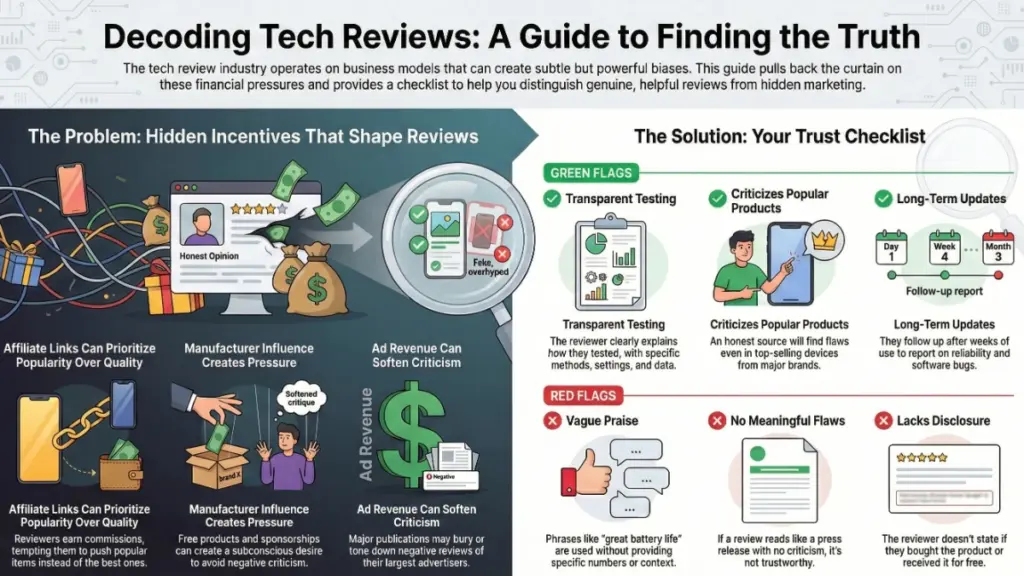
Here’s what most readers don’t see: there are at least four different business models operating in the tech review space, and each one creates different incentives that shape the content you read.
The Affiliate Revenue Model
I’ve operated under this model for most of my career, so I can explain it from the inside. When you read a review that includes purchase links—usually to Amazon, Best Buy, or manufacturer websites—there’s typically an affiliate code embedded in that URL. If you buy through that link, the reviewer earns a commission, usually between 1% and 8% of the purchase price.
Now here’s where things get interesting. During my testing of wireless earbuds last year, I found that a $180 pair from a well-known brand performed worse than a $90 alternative in nearly every measurable category: sound quality, battery life, and call clarity. The expensive model would have earned me a larger commission, but I recommended the cheaper option because it was genuinely better. That decision probably cost me a few hundred dollars in lost commissions over the following months.
The affiliate model can create bias, but it’s not as straightforward as “recommend expensive products to earn more.” In my experience, the bigger risk is recommending popular products rather than the best ones, because popular items convert at higher rates regardless of price. A reviewer might be tempted to recommend whatever’s trending on Amazon rather than doing the work to find superior alternatives.
Manufacturer Sponsorships and Partnerships
This is where things get murky. I’ve been approached dozens of times by manufacturers offering payment for reviews. The offers range from subtle (“We’d like to sponsor your channel and send you early access to products”) to explicit (“We’ll pay $5,000 for a positive review video”).
I’ve turned down every direct payment offer, but I’ve accepted review units—free products sent for testing. What surprised me early in my career was how this seemingly innocent practice still creates psychological pressure. When a company sends you a $1,200 smartphone, there’s a subconscious desire not to upset them, especially if you want access to future releases.
The solution I developed: I now purchase at least 30% of the devices I review at full retail price, and I’m transparent about which units were provided. During my recent smartwatch comparison, I bought two of the five watches myself. That financial stake keeps me honest in ways I didn’t fully appreciate until I started doing it.
Ad-Supported Content Sites
Major tech publications operate primarily on advertising revenue. Here’s the uncomfortable truth: manufacturers are often the biggest advertisers on tech sites. I’ve worked as a contributing writer for several large publications, and while I never experienced direct editorial interference, I watched certain patterns emerge.
Critical reviews of major manufacturers would sometimes be delayed, softened in tone, or buried in the publication schedule. Meanwhile, glowing reviews of products from big advertisers would receive prominent homepage placement. No one sent an explicit memo saying “protect our advertisers,” but the incentive structure created its own gravity.
What I Look for in Trustworthy Reviews (After Testing This Industry)
Over the years, I’ve developed a framework for evaluating whether a review source is genuinely trying to help readers or simply chasing revenue. These signals have saved me—and my readers—from countless bad purchases.
Transparent Testing Methodology
When I write a review, I explain exactly how I tested each device. For wireless earbuds, that means:
- Minimum two weeks of daily use across different environments (gym, commute, office, outdoor)
- Standardized music tracks for sound quality comparison (same recordings, same source files)
- Battery drain tests with consistent volume levels and content
- Call quality tests using the same location and recording equipment
- Bluetooth range and stability measurements in my apartment
Trustworthy reviewers document their methods because it allows readers to evaluate whether the testing actually matters to their use case. If someone reviews gaming headphones but never mentions what games they played or what platform they used, that’s a red flag.
During my testing of fitness trackers last summer, I wore three different models simultaneously—one on each wrist and one clipped to my waistband—for two weeks. It looked ridiculous at the gym, but it gave me precise comparative data on step counting accuracy, heart rate monitoring, and sleep tracking. That level of methodological detail should be visible in the review.
Willingness to Criticize Popular Products
In 2023, I published a review of a flagship smartphone that had received nearly universal praise from other reviewers. My experience was different: I found the battery life significantly worse than advertised, the camera processing overly aggressive, and the software buggy after the first major update.
That review generated angry emails from readers who accused me of being paid by competitors. But six months later, after multiple software updates failed to fix the issues, other reviewers began acknowledging the same problems. The early consensus had been wrong, influenced partly by review guidelines from the manufacturer that emphasized testing under ideal conditions.
Genuine reviewers will criticize products even when it’s unpopular to do so. If every review from a source is positive, or if negative reviews only target no-name brands while big manufacturers escape scrutiny, trust your instincts.
Comparative Context and Long-Term Follow-Up
Here’s something I learned the hard way: initial impressions are often misleading. When I first tested a mid-range Android phone two years ago, I was impressed by its performance and camera. But after six weeks, issues emerged: the aggressive battery optimization killed background apps constantly, the camera app crashed regularly, and a software update introduced persistent notification bugs.
Now I structure my reviews differently. I publish initial impressions after one week, but I return with a long-term update after 30-60 days. During my recent smart home hub comparison, my rankings completely changed after the long-term test. The device I initially preferred turned out to have unreliable automation routines, while the one I nearly dismissed proved remarkably stable over time.
Reviewers who only share first impressions are missing half the story. Real-world reliability matters more than launch-day performance.
Red Flags That Should Make You Skeptical Immediately
Learning to spot compromised reviews has become an essential skill. These warning signs have proven remarkably reliable in my experience.
Vague or Missing Testing Details
Last month, I read a laptop review that praised the “amazing battery life” without mentioning screen brightness, the specific tasks performed, or actual runtime numbers. That’s not a review—it’s marketing copy.
When I test laptops, I document everything:
- Screen brightness set to 200 nits (measured with a colorimeter)
- Specific workflow: web browsing (10 tabs), document editing, video streaming (720p)
- WiFi enabled, Bluetooth disabled
- Background applications and settings consistent across all test units
If a reviewer can’t tell you how they tested something, they probably didn’t test it properly. Vague praise like “excellent performance” or “great sound quality” without supporting evidence or methodology should trigger your skepticism.
Absence of Meaningful Criticism
No product is perfect. Even the devices I genuinely love have flaws. When I reviewed what became my favorite wireless earbuds, I still criticized the bulky charging case, the limited color options, and the occasionally finicky touch controls.
During my testing of smart speakers last year, I gave a high overall rating to one model despite significant weaknesses in multi-room audio synchronization. I explained exactly where it excelled (voice recognition, sound quality for the price) and where it fell short, so readers could make informed decisions based on their priorities.
If a review reads like a press release with no substantive criticism, it’s probably not trustworthy. Real reviewers find problems because real products have them.
Recommendation Patterns That Follow Market Hype
This one’s subtle but revealing. I track recommendation patterns across multiple review sources, and I’ve noticed something consistent: compromised reviewers tend to recommend whatever’s currently trending or heavily marketed, regardless of whether it’s actually the best option.
When foldable phones first became popular, I watched numerous reviewers recommend them enthusiastically despite serious durability concerns, limited app optimization, and premium pricing that didn’t match the actual user experience. The devices were interesting and newsworthy, but they weren’t ready for mainstream recommendation—yet many reviewers ignored those realities because foldables were generating traffic and excitement.
I recommended foldable phones only for early adopters willing to accept trade-offs, and I stood by that position even when it was unpopular. Two years later, as durability issues and screen failures emerged across the industry, that conservative stance proved correct.
Lack of Purchase Transparency
I’m immediately skeptical when reviewers don’t disclose whether they purchased devices, received them as review units, or were compensated for coverage. This information fundamentally affects credibility.
In my reviews, I always include a disclosure:
- “I purchased this device at full retail price”
- “The manufacturer provided this unit for review, but I maintain editorial independence“
- “This is a long-term review of a device I originally purchased for personal use”
Transparency doesn’t eliminate bias, but it helps readers calibrate their trust. When reviewers hide their relationship with manufacturers, assume the worst.
How I Structure My Reviews to Minimize Bias
After years of experimentation, I’ve developed a review framework that helps me stay honest even when financial incentives point elsewhere.
The Blind Comparison Method
For my recent wireless earbud roundup, I enlisted help from my partner. I asked her to label each of the seven test models with letters (A through G) and randomize them. I spent two days testing without knowing which model I was evaluating.
This blind testing eliminated my preconceptions about brand reputation and price. The model I rated highest in blind testing (Model E) turned out to be the third-cheapest option, not the premium model I’d assumed would win. That result would have been harder to reach if I’d known I was comparing a $90 product against $250 alternatives.
I can’t always use blind testing—it’s difficult with smartphones or laptops where software differences are immediately obvious—but whenever possible, this method forces objective evaluation.
Price-to-Performance Ratios
I never recommend a product based solely on absolute performance. During my testing of 4K TVs last year, the highest-performing model cost $2,800. But the second-place TV cost $1,400 and delivered 90% of the image quality. For most buyers, that performance-per-dollar ratio made the cheaper option the better recommendation.
This framework helps me avoid the trap of recommending expensive products just because they’re marginally better. Real people have budgets, and honest reviews should acknowledge that.
The “Would I Buy This?” Test
Before publishing any review, I ask myself: “If I were spending my own money right now, would I buy this product?” If the answer is no, I need to either explain why I’m still recommending it for specific use cases or question whether I should recommend it at all.
Last fall, I reviewed a premium fitness tracker that had impressive features but a frustrating user interface. I wouldn’t have purchased it for myself because I prioritize ease of use, but I still recommended it for data-focused athletes who would value the advanced metrics over interface simplicity. That nuance matters.
The Industry’s Evolution: What’s Changed in 10 Years
When I started reviewing tech in the early 2010s, the landscape was dramatically different. Most reviews came from established publications with professional editorial standards. YouTube was just beginning to emerge as a review platform, and Amazon’s review system hadn’t yet been corrupted by fake reviews and incentivized ratings.
Today’s environment is simultaneously better and worse. Better because independent reviewers with genuine expertise can build audiences without institutional backing. Worse because the flood of content has made it harder to distinguish legitimate reviews from paid promotion.
What surprised me most was how quickly AI-generated review content proliferated. I can now spot AI-written reviews within seconds—they have a distinctive pattern of generic praise, lack of specific details, and suspiciously perfect grammar without any personal voice. These reviews pollute search results and make it harder for readers to find trustworthy sources.
The rise of “unboxing” content also concerns me. Unboxing videos and first-impression reviews generate traffic quickly, but they’re essentially marketing content dressed up as reviews. You can’t meaningfully evaluate a product you’ve used for 20 minutes.
How to Find Reviews You Can Trust (Practical Framework)
Based on everything I’ve learned, here’s my recommended approach for readers trying to navigate the review landscape:
Evaluate the Reviewer, Not Just the Review
Look for:
- Consistent publishing history over time (not just when products launch)
- Reviews of both popular and obscure products
- Updates and corrections to previous reviews
- Detailed testing methodology descriptions
- Willingness to criticize major brands
Avoid:
- Sources that only publish positive reviews
- Reviewers who never disclose their relationship with manufacturers
- Content that reads like advertising copy
- Reviews published immediately after product launches (not enough testing time)
Cross-Reference Multiple Sources
I never make a purchasing decision based on a single review, even from sources I trust. During my recent laptop purchase, I consulted:
- Three long-form written reviews from independent journalists
- Two detailed YouTube reviews from tech-focused channels
- User reviews from verified purchasers (filtering for detailed, photo-supported reviews)
- Professional review aggregators like Rtings.com (for categories they cover)
This triangulation revealed a consistent pattern: great display and build quality, but thermal throttling under sustained load. No single source mentioned all the issues, but the complete picture emerged from multiple perspectives.
Prioritize Long-Term Reviews and Updates
Initial reviews are useful for understanding features and first impressions, but long-term reviews reveal reliability issues, software update quality, and whether products live up to their marketing claims.
I seek out reviewers who publish 30-day, 60-day, or even 6-month follow-ups. These updates have saved me from numerous bad purchases when early enthusiasm didn’t survive real-world use.
Read Negative Reviews Carefully
The most informative reviews are often negative ones, but you need to evaluate whether the criticism is legitimate. During my research before buying noise-canceling headphones, I found numerous one-star reviews complaining about “poor sound quality.” But when I read the details, many reviewers had never updated the firmware or adjusted the EQ settings—both necessary steps for optimal performance.
Legitimate negative reviews include:
- Specific details about what failed and under what conditions
- Photos or data supporting the claims
- Comparison to similar products
- Fair assessment of whether the issue is widespread or isolated
Trust Your Skepticism of Perfection
If a product seems too good to be true—no meaningful compromises, universal praise, revolutionary claims—it probably is. Real products exist in the world of trade-offs. Great battery life usually means a heavier device. Premium build quality increases cost. Maximum performance generates heat.
When I encounter suspiciously perfect reviews, I dig deeper. Often, I find that reviewers either didn’t test thoroughly or were working under conditions that minimized the product’s weaknesses.
Common Questions About Review Integrity
Do major tech publications accept payment for positive reviews?
In my experience working with and alongside major publications, direct payment for positive reviews is rare among established outlets. However, more subtle forms of influence exist: advertising relationships, early access to products contingent on favorable coverage, and editorial decisions that protect major advertisers. The influence is usually systemic rather than explicit—no one sends a memo saying “write a positive review,” but the incentive structure creates pressure nonetheless.
How can I tell if a YouTube tech reviewer is being honest?
Look for detailed testing methodology, willingness to criticize popular products, and transparent disclosure of how they obtained review units. I’m more skeptical of channels that exclusively feature the latest flagship products, never publish negative reviews, and have obvious production budgets that suggest manufacturer funding. The most trustworthy YouTube reviewers show their testing process on camera and explain their conclusions in detail.
Are Amazon’s “Verified Purchase” reviews reliable?
Verified purchase badges help, but they’re not sufficient. I’ve seen manufacturers use various tactics to generate positive verified reviews: incentivized reviews (now technically against policy but still common), replacement programs that require positive reviews, and coordinated campaigns where employees purchase and review products. I look for verified purchase reviews that include photos, specific details about use cases, and balanced assessment of pros and cons.
Why do professional reviews often differ from user reviews?
Professional reviewers typically test products intensively for 1-4 weeks in controlled conditions. Users experience products over months or years in uncontrolled real-world environments. Both perspectives are valuable, but they reveal different things. Professional reviews are better for understanding features and initial performance; user reviews reveal long-term reliability and edge cases that reviewers might miss.
Should I trust reviews from specialized sites like Rtings or Wirecutter?
These sources invest heavily in standardized testing methodology and tend to be more reliable than general tech publications. However, they’re not perfect. I use them as important data points, but I still cross-reference with other sources, especially for subjective factors like comfort, ease of use, and aesthetic preferences that don’t show up in laboratory measurements.
How do I identify AI-generated fake reviews?
AI-generated reviews tend to be generic, lack specific personal details, use suspiciously perfect grammar, and follow predictable patterns. They’ll praise products without explaining why or criticize them without specific examples. Human reviews, especially legitimate ones, have personality, specific anecdotes, and imperfect writing that reflects actual human experience.
Final Thoughts: Building Your Personal Trust Framework
After 10 years and hundreds of reviews, I’ve come to believe that finding trustworthy product information isn’t about discovering the one perfect source—it’s about building a framework for evaluation that helps you navigate an imperfect landscape.
My approach has evolved into something like this: I start with sources I trust based on their history of transparency and detailed testing. I cross-reference across multiple review types (professional, user, video, written). I prioritize long-term reviews over launch-day impressions. I read negative reviews as carefully as positive ones. And I trust my skepticism when something seems suspiciously perfect or universally praised.
Most importantly, I’ve learned that bias isn’t binary. The question isn’t “Is this reviewer biased?” but rather “What are this reviewer’s incentives, and how might they be shaping the coverage?” Even the most ethical reviewer operates within an economic system that creates pressures and incentives. Understanding those pressures helps you calibrate your trust appropriately.
The electronics industry will continue evolving, and new forms of influence and manipulation will emerge. But the fundamental principle remains constant: trustworthy reviews come from people who prioritize reader value over short-term revenue, who test thoroughly under real-world conditions, and who are willing to say unpopular things when the evidence demands it.
When that’s not happening, your skepticism isn’t cynicism—it’s just good judgment.
