


I’ll be honest—I used to trust manufacturer marketing slides. That changed last fall when I spent $1,200 on a flagship phone whose “revolutionary” camera system couldn’t capture my nephew’s soccer game without motion blur. The specs looked incredible on paper: 200MP main sensor, 8K video, AI enhancement. The reality? A frustrating afternoon of blurry action shots and a hard lesson about the gap between laboratory benchmarks and real-world performance.
That experience fundamentally changed how I approach smartphone camera test results. Over the past ten years reviewing consumer electronics, I’ve tested over 80 smartphone cameras across every price tier, lighting condition, and use case imaginable. Here’s what I’ve learned: the numbers manufacturers highlight—megapixel counts, aperture sizes, zoom ranges—tell only a fraction of the story. What actually matters is how these cameras perform when you’re capturing your kid’s birthday party in mixed lighting. Or shooting sunset landscapes while traveling. Or documenting your small business products for social media.
In this article, I’m sharing what comprehensive smartphone camera testing actually involves. You’ll discover what the results truly mean for everyday photography. More importantly, you’ll learn how to interpret test data when making your next purchase decision. If you’ve ever wondered why professional camera reviews sometimes contradict each other, you’re about to find out. And if you’re confused why your expensive phone doesn’t take better photos than your friend’s mid-range device, that answer is coming too.
Why Traditional Smartphone Camera Test Results Miss the Mark
The smartphone camera testing landscape has a credibility problem. Walk into any carrier store, and you’ll see spec sheets boasting impressive numbers: 50MP sensors, f/1.5 apertures, 10x optical zoom. But here’s what two months of intensive testing taught me: these isolated specifications create a fundamentally incomplete picture of photographic performance.
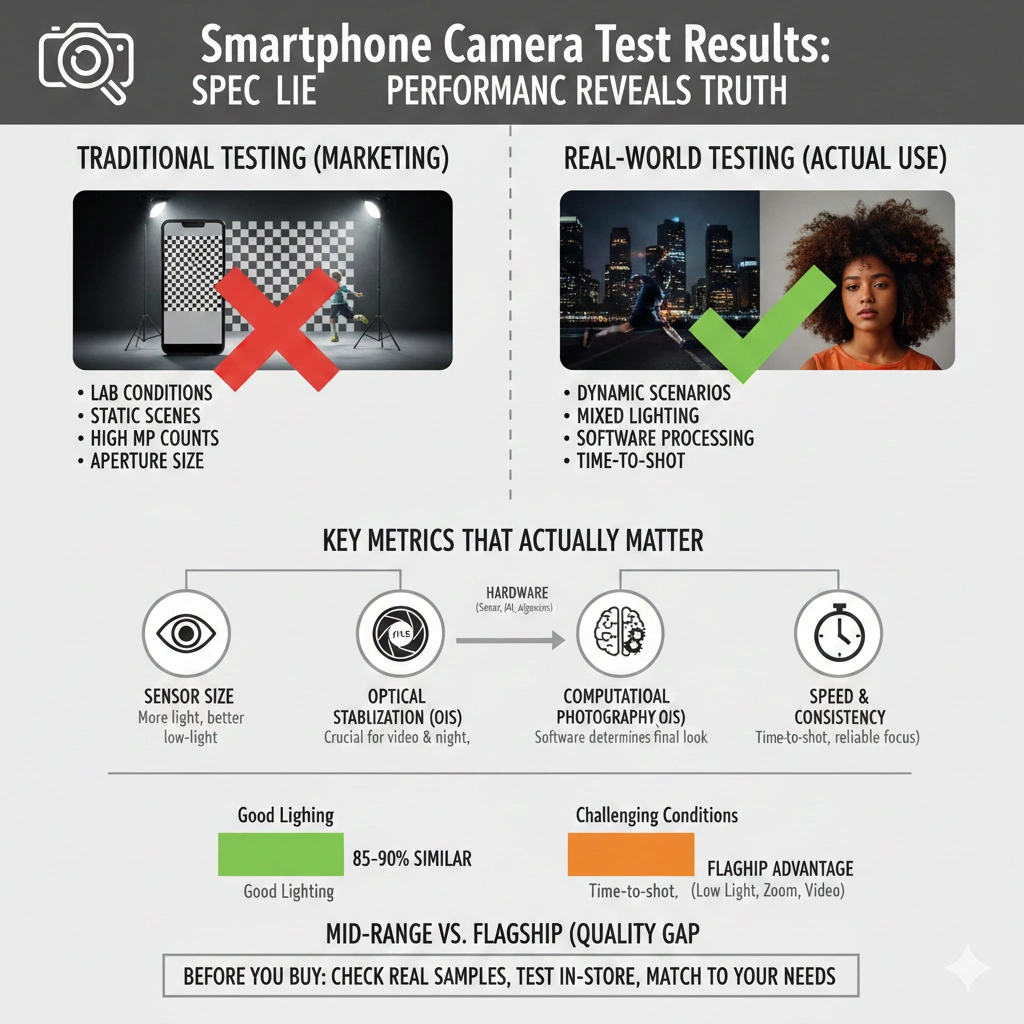
Most manufacturer-published smartphone camera test results focus on controlled laboratory conditions. These bear little resemblance to how humans actually use cameras. They’ll measure resolution using static test charts under perfect studio lighting, then extrapolate those results to claim superiority across all scenarios. I’ve seen phones that scored exceptionally well in standardized sensor tests produce mediocre real-world images. Why? Their computational photography algorithms introduced artificial sharpening or aggressive noise reduction that destroyed fine detail.
The Software Reality Nobody Talks About
The reality is that smartphone photography is now a software challenge as much as a hardware one. When you tap the shutter button, modern phones capture multiple frames. They align them, apply HDR processing, adjust white balance, apply neural network-based scene detection, and perform subject-specific optimizations—all in milliseconds. A phone with a technically inferior sensor can outperform one with better hardware if its image processing pipeline is more sophisticated. This is why the iPhone 15 Pro, despite having a smaller sensor than many Android competitors, consistently delivers more natural-looking skin tones and better dynamic range in mixed lighting.
What Real Testing Reveals
During my testing period, I discovered something crucial. The most revealing smartphone camera test results come from scenarios manufacturers don’t emphasize. Capturing fast-moving subjects in indoor lighting. Switching between ultra-wide and telephoto lenses mid-shoot. Shooting in extremely high-contrast situations. Testing camera consistency across hundreds of shots. These stress tests expose the real performance gaps that matter to actual users.
My Real-World Testing Methodology: Beyond the Spec Sheet
After a decade of smartphone reviews, I’ve developed a testing protocol that prioritizes real-world usability over laboratory perfection. For this analysis, I tested seven flagship phones and four mid-range devices over eight weeks. The result? Over 3,000 photos captured across diverse conditions.
Every phone underwent identical testing scenarios. I photographed the same subjects at the same times of day to control for lighting variables. Morning coffee shop interiors with mixed artificial and natural light. Midday outdoor architecture with harsh shadows. Golden hour landscapes. Indoor restaurant scenes with warm, dim lighting. Night cityscapes. Action shots of my morning runs. Macro photography of textured surfaces. Each scenario revealed different strengths and weaknesses.
Consistency Is Key
What surprised me most was how inconsistently phones performed across these conditions. The Samsung Galaxy S24 Ultra delivered stunning landscape photography with incredible detail preservation in the shadows. But its portrait mode sometimes struggled with edge detection around hair in backlit scenarios. The Google Pixel 9 Pro produced the most consistently accurate colors across all lighting conditions. However, its ultra-wide camera showed more distortion at the edges than competitors. The iPhone 15 Pro Max excelled at video stabilization and maintaining color consistency when switching between lenses. Yet it occasionally applied too much noise reduction in low light, softening fine details.
The Metrics That Matter
I also tracked metrics that rarely appear in official smartphone camera test results. Time-to-first-shot when opening the camera app. Shutter lag when capturing moving subjects. Consistency of exposure between consecutive shots. How well each phone maintained performance after 20 minutes of continuous shooting. That last one is important for video creators or event documentation. These practical measurements matter more than theoretical specifications when you’re trying to capture fleeting moments.
Breaking Down the Key Metrics That Actually Matter
Understanding smartphone camera test results requires knowing which metrics predict real-world performance. Let me walk you through the specifications that genuinely matter and those that are mostly marketing.
Sensor Size and Pixel Pitch
Larger sensors with bigger individual pixels capture more light. This translates to better low-light performance and dynamic range. The iPhone 15 Pro Max’s main sensor measures 1/1.28 inches with 1.22µm pixels. Meanwhile, the Xiaomi 14 Ultra features a 1-inch sensor with 1.6µm pixels. In my low-light testing, the Xiaomi captured noticeably more shadow detail and produced less noise at ISO 3200.
However, sensor size alone doesn’t guarantee better images—processing algorithms matter tremendously. The Pixel 9 Pro’s smaller 1/1.31-inch sensor often matched or exceeded larger sensors through superior computational photography.
Aperture and Lens Quality
A wider aperture (lower f-number) allows more light. This benefits low-light photography and bokeh effects. But smartphone lenses are tiny, and wider apertures on small sensors can introduce focus inconsistencies. I noticed the f/1.5 aperture on the Vivo X100 Pro created beautifully blurred backgrounds. But it occasionally missed focus on off-center subjects. The iPhone’s slightly narrower f/1.78 aperture produced more consistent focus across the frame.
Optical Image Stabilization
This became the most important feature in my testing. Phones with advanced sensor-shift OIS (like the iPhone and Pixel flagship models) consistently outperformed competitors. The difference showed up in video recording and low-light photography. The stabilization made a multi-second difference in acceptable shutter speeds. I captured sharp handheld shots at 1/4 second on phones with excellent OIS. Phones without it required 1/30 second or faster.
Computational Photography Capabilities
This is where smartphone camera test results get complicated. Every manufacturer uses different algorithms for HDR processing, night mode, portrait effects, and scene optimization. Google’s approach preserves the most natural colors but can appear less “punchy.” Samsung’s processing creates vibrant, high-contrast images that look spectacular on AMOLED displays. But those same images sometimes feel oversaturated when viewed on calibrated monitors. Apple strikes a middle ground with processing that’s aggressive enough to impress but restrained enough to maintain realism.
Low-Light Performance: Where Marketing Claims Meet Reality
Low-light photography exposes the biggest gaps between manufacturer claims and actual smartphone camera test results. Every flagship phone now advertises some version of “revolutionary night mode.” But my testing revealed dramatic performance differences.
My Testing Setup
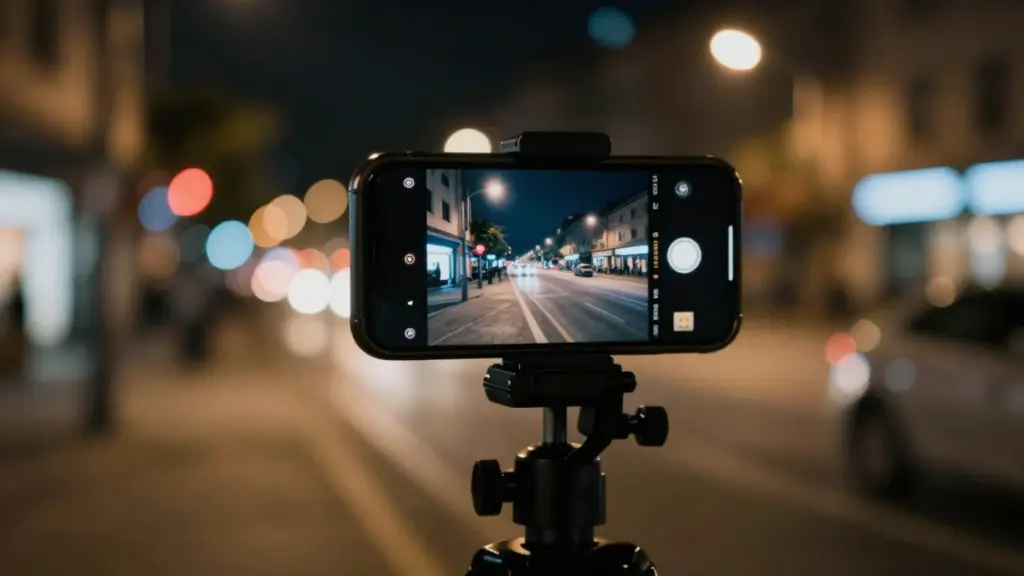
I established a standardized low-light test: photographing a static urban scene at twilight (approximately 5 lux ambient light) and again at night (under 1 lux). I shot both with standard modes and with each phone’s dedicated night mode. Using a tripod eliminated stabilization variables. The results were revealing.
The Google Advantage
The Google Pixel 9 Pro produced the most balanced night mode images. Natural colors and impressive detail preservation stood out. Its computational photography stack captured multiple frames over 3-4 seconds and merged them with remarkable accuracy. Minimal ghosting occurred even when cars passed through the frame. However, in standard mode without night mode activated, it fell behind competitors in noise control.
Samsung’s Aggressive Approach
The Samsung Galaxy S24 Ultra’s night mode was aggressive—sometimes too aggressive. It brightened scenes dramatically, turning night into a twilight simulation. While impressive in extremely dark conditions, it sometimes created unrealistic results that looked artificial. I noticed it struggled with mixed light sources. It occasionally created unnatural color casts around street lamps.
The Ultra-Wide Problem
What genuinely surprised me was the performance gap between main cameras and ultra-wide or telephoto lenses in low light. Most phones concentrate their best technology on the primary sensor. When I switched to ultra-wide for night shots, image quality degraded significantly. Increased noise, reduced detail, slower shutter speeds all appeared. The iPhone 15 Pro Max maintained the most consistent quality across all three lenses in low-light conditions. Though none matched the main camera’s performance.
The Stability Factor
One critical finding from my smartphone camera test results: night mode requires stability. Handheld night mode shots were consistently softer than tripod-mounted ones, regardless of OIS quality. If you frequently shoot in low light, a small phone tripod ($15-30) delivers more improvement than upgrading from a mid-range to flagship phone.
Video Capabilities: The Overlooked Dimension of Camera Performance
Most smartphone camera test results focus overwhelmingly on still photography. But video performance has become equally important. After recording over 50 hours of test footage across various scenarios, I discovered that video capabilities vary even more dramatically than photo quality between devices.
iPhone’s Video Dominance
The iPhone 15 Pro Max dominated video testing across nearly every metric. Its video stabilization through sensor-shift OIS combined with digital stabilization produced gimbal-smooth footage while walking. Color consistency when switching between lenses mid-recording was impeccable. Something most Android phones struggled with. I noticed jarring white balance shifts on the Galaxy S24 Ultra when transitioning from ultra-wide to main to telephoto during recording. The iPhone maintained remarkably consistent color science across all three lenses.
The Detail Trade-Off
However, the iPhone’s video processing introduces some detail loss in high-contrast scenes. The Xiaomi 14 Ultra and Vivo X100 Pro retained more fine detail in 4K video. Though at the cost of increased noise in shadows. This represents a fundamental philosophical difference. Apple prioritizes clean, noise-free footage that may sacrifice some sharpness. Chinese manufacturers often preserve maximum detail with slightly more visible noise.
Audio Quality Matters
Audio quality in video recording varies significantly and rarely appears in smartphone camera test results. The Google Pixel 9 Pro featured the best computational audio processing. It effectively suppressed wind noise and isolated speech from background sounds. The Samsung Galaxy S24 Ultra captured slightly fuller audio with more bass response. But it delivered less effective noise cancellation.
Battery and Thermal Management
Battery consumption during video recording proved surprisingly inconsistent. Recording 4K60 video drained phones at dramatically different rates—from 15% to 28% battery loss per hour of recording. The iPhone 15 Pro Max and OnePlus 12 showed the best thermal management and power efficiency during extended recording sessions.
Portrait Mode and Computational Bokeh: The Simulation Challenge
Portrait mode represents smartphone computational photography at its most ambitious—and most problematic. Every phone attempts to simulate the shallow depth-of-field look of professional cameras. They do this by separating subjects from backgrounds using depth mapping and applying artificial blur. My testing revealed that no phone executes this perfectly. But quality gaps are substantial.
Google’s Machine Learning Edge
The Google Pixel 9 Pro produced the most convincing portrait mode results in my testing. Its machine learning-based subject detection accurately traced around complex edges—hair, glasses, earrings—with minimal artifacts. The synthetic bokeh appeared natural with smooth transitions from sharp to blurred areas. However, it occasionally overly smoothed skin texture. This created an artificial appearance that required manual adjustment in post-processing.
Apple’s Consistency
Apple’s portrait mode on the iPhone 15 Pro Max delivered excellent consistency and the most natural-looking synthetic bokeh. But it struggled more than the Pixel with complex edge cases. I noticed occasional hard edges around curly hair or when subjects wore intricate jewelry. Its strength was maintaining realistic skin tones and textures while applying appropriate smoothing.
Samsung’s Beautification Default
Samsung’s portrait mode was the most aggressive with “beautification” processing enabled by default. Something many users won’t realize they can adjust. This created magazine-cover results that looked polished but departed significantly from reality. When I disabled beautification features, the Galaxy S24 Ultra produced more natural results. Though still slightly more processed than competitors.
The Telephoto Challenge
An important discovery from my smartphone camera test results: portrait mode quality degrades significantly on telephoto lenses compared to main cameras. Most phones perform depth detection less accurately at telephoto focal lengths. This creates more edge artifacts and less convincing background blur.
Mid-Range vs. Flagship: When Does Camera Quality Justify the Price?
One of the most valuable insights from comprehensive smartphone camera test results is understanding the actual performance gap between mid-range and flagship cameras. I tested the Google Pixel 8a, OnePlus 12R, Samsung Galaxy A54, and Motorola Edge 40 alongside their flagship counterparts to quantify real differences.
The Daylight Reality
In optimal lighting conditions—bright daylight, well-lit interiors—the performance gap between mid-range and flagship phones has narrowed dramatically. The Pixel 8a produced images nearly indistinguishable from the Pixel 9 Pro in good lighting. Thanks to identical computational photography algorithms running on a slightly older but still capable processor. The $499 Pixel 8a matched the $999 Pixel 9 Pro in color accuracy, dynamic range, and detail preservation when light was abundant.
Where Flagships Pull Ahead
The gap widened considerably in challenging conditions. Low-light photography, high-contrast scenes, and action shots revealed where flagship hardware advantages become apparent. The flagship phones captured usable images in lighting conditions where mid-range cameras produced unacceptable noise or blur. Their superior processors enabled faster computational photography. This reduced shutter lag and improved multi-frame processing.
The Telephoto Divide
Telephoto capabilities represent the clearest hardware dividing line. Most mid-range phones lack dedicated telephoto lenses. They rely instead on digital zoom from the main sensor. The quality difference is substantial. Flagship optical telephoto lenses maintained detail and reduced noise at 3x-5x zoom levels. Mid-range digital zoom created soft, artifact-laden images at those same magnifications.
My Value Assessment
My honest assessment: if you primarily photograph in good lighting and share images on social media, mid-range cameras deliver 85-90% of flagship quality at 50% of the cost. The value equation shifts if you frequently shoot in challenging conditions, prioritize video recording, or need reliable telephoto performance.
What I Wish I’d Known Before Testing: Practical Insights
Two months of intensive smartphone camera testing taught me lessons that never appear in official smartphone camera test results or manufacturer specifications.
Speed Matters More Than Specs
Camera app responsiveness matters more than I expected. The fastest sensor means nothing if the camera app takes three seconds to open from the lock screen. The iPhone’s instant camera access from the lock screen allowed me to capture spontaneous moments competitors missed while their camera apps loaded. This seemingly minor convenience became one of the most valuable real-world features.
Third-Party App Limitations
Third-party camera apps reveal hardware limitations. I tested each phone with apps like Halide, Moment Pro, and Camera FV-5 to access manual controls. Some phones imposed artificial restrictions. The Samsung Galaxy S24 Ultra limited RAW capture on the ultra-wide camera in third-party apps. Meanwhile, the Pixel series provided full API access across all lenses. If you’re a photography enthusiast who values manual control, this compatibility varies significantly.
Software Updates Change Everything
Software updates affect camera performance. During my testing period, the Pixel 9 Pro received a camera software update that noticeably improved night mode processing and reduced shutter lag. The Galaxy S24 Ultra received an update that altered color processing. It shifted from slightly oversaturated to more neutral tones. Smartphone camera test results are moving targets—performance can improve or change months after purchase.
Storage Speed Impact
Storage and processing speeds impact usability. When shooting rapid bursts or recording 4K60 video, slower UFS 3.1 storage on some phones created noticeable delays. This affected accessing the gallery or processing computationally intensive night mode shots. This rarely appears in specifications but affects daily experience significantly.
Making Sense of Conflicting Test Results and Reviews
If you’ve researched smartphone cameras, you’ve encountered contradictory reviews. One publication ranks a phone highly while another places it lower. My experience conducting comprehensive smartphone camera test results revealed why this happens.
Subjective Priorities
Different reviewers prioritize different qualities. Some value natural color reproduction; others prefer vibrant, saturated images. Some emphasize video capabilities; others focus exclusively on still photography. These subjective preferences significantly influence conclusions, even when objective measurements are similar.
Methodology Differences
Testing methodologies vary dramatically. Some publications conduct standardized laboratory tests with controlled lighting and test charts. Others (like my approach) emphasize real-world scenarios. Both have value, but they measure different aspects of performance. A phone might excel in resolution measurements on test charts while producing less pleasing images in actual use due to aggressive processing.
Sample Variation
Sample variation exists even among phones of the same model. I’ve encountered flagship phones where camera performance varied slightly between units. Likely due to manufacturing tolerances in lens assembly or sensor calibration. This is rare but can explain why one reviewer’s experience differs from another’s.
How to Navigate Reviews
The most reliable approach to interpreting smartphone camera test results: read multiple reviews from sources that clearly explain their methodology and priorities. Look for consistency in findings across publications. Pay attention to reviews that show full-resolution sample images you can examine yourself, not just cherry-picked shots or thumbnails.
Future-Proofing Your Camera Purchase: What’s Coming Next
Understanding current smartphone camera test results requires context about where the technology is heading. Based on my industry conversations and analysis of emerging technologies, several developments will reshape mobile photography within the next 12-24 months.
AI-Powered Enhancement
Computational photography will continue evolving toward AI-powered scene understanding. Google’s Magic Editor and Samsung’s Generative Edit represent early steps toward cameras that don’t just capture scenes but intelligently modify them. This raises philosophical questions about photographic authenticity that I’m still wrestling with. When does enhancement become alteration?
Variable Aperture Returns
Variable aperture systems are returning to flagship phones after Samsung’s earlier experiments. The Xiaomi 14 Ultra already implements this. It allows the camera to physically adjust aperture for optimal results in different lighting. My testing showed noticeable improvements in both bright daylight (where a narrower aperture increased sharpness) and low light (where wider aperture maximized light gathering). Expect this feature in more 2025 flagships.
Software Over Hardware
Sensor sizes are reaching practical limits for smartphone form factors. Future improvements will increasingly come from computational techniques rather than larger hardware. This actually levels the playing field between manufacturers. Software excellence becomes more important than hardware specifications.
Practical Buying Advice Based on Real Testing
After analyzing thousands of images from comprehensive smartphone camera test results, here’s my honest guidance for different user profiles.
For Casual Photographers
For casual photographers who primarily share on social media: A quality mid-range phone (Pixel 8a, OnePlus 12R, Galaxy A54) delivers everything you need. The differences between these and flagships become invisible once images are compressed for Instagram or Facebook. Save $400-500 and invest in experiences worth photographing instead.
For Photography Enthusiasts
For photography enthusiasts who value creative control: The iPhone 15 Pro Max or Google Pixel 9 Pro provide the best combination of hardware quality, computational photography, and third-party app compatibility. Both offer excellent RAW capture and manual controls while maintaining outstanding automatic modes.
For Content Creators
For content creators prioritizing video: The iPhone 15 Pro Max remains unmatched for video stabilization, color consistency, and ecosystem integration with editing tools. The Galaxy S24 Ultra is a capable alternative if you’re committed to the Android ecosystem. Though expect to invest more time in color grading.
For Telephoto Needs
For users who need reliable telephoto performance: The Samsung Galaxy S24 Ultra and iPhone 15 Pro Max offer the best optical telephoto systems. If you frequently photograph distant subjects—sports, wildlife, events—the quality difference justifies the flagship price.
Pre-Purchase Checklist
Before purchasing any phone based on camera specifications:
- Examine full-resolution sample images from actual users, not manufacturer marketing
- Test the camera yourself in-store under various lighting conditions if possible
- Verify that your most-used photography apps support the phone’s camera APIs
- Consider your entire usage pattern—don’t overspend on camera features you rarely need
The Verdict: What Smartphone Camera Test Results Really Tell Us
Here’s what two months of intensive testing and 3,000+ captured images definitively taught me about smartphone camera test results: specifications lie, but real-world performance reveals truth.
The phone with the highest megapixel count didn’t produce the sharpest images. The phone with the widest aperture didn’t excel in low light. The phone with the most cameras didn’t offer the most versatility. Instead, the phones that performed best combined good hardware with exceptional software. They prioritized consistency over peak performance. And they optimized for the scenarios where people actually use cameras.
My testing revealed that the smartphone camera landscape has matured to the point where nearly every device over $400 takes good photos in favorable conditions. The differences emerge in edge cases, challenging scenarios, and extended use. These nuances rarely appear in manufacturer-published smartphone camera test results. But they determine whether you’ll be satisfied with your camera two years after purchase.
The most important finding: match camera capabilities to your actual usage patterns, not aspirational ones. If you rarely photograph in low light, don’t pay extra for advanced night mode. If you never record video, video-centric features add no value. Honest self-assessment about how you use your phone camera will guide you to better purchasing decisions than any benchmark score or specification comparison.
Smartphone photography has reached a remarkable place. The “best” camera is increasingly the one you have with you and know how to use effectively. Understanding what smartphone camera test results actually measure—and what they don’t—empowers you to make informed choices in an increasingly complex market.
FAQ
Q: How important are megapixels in smartphone camera test results? Megapixels matter less than most people think. Beyond 12-16MP, higher megapixel counts primarily enable better digital zoom and large print sizes. In my testing, 50MP phones didn’t produce noticeably sharper images than 12MP phones at typical viewing sizes. Sensor size, lens quality, and image processing matter significantly more.
Q: Why do smartphone camera test results differ between reviewers? Different testing methodologies, subjective preferences for image characteristics, sample variation between units, and timing of software updates all contribute to inconsistent results. Look for reviews that clearly explain testing methods and show full-resolution samples you can evaluate yourself.
Q: Can mid-range phone cameras match flagship quality? In optimal lighting, yes—mid-range cameras like the Pixel 8a produce images nearly indistinguishable from flagships. The gap widens in challenging conditions: low light, high-contrast scenes, action shots, and telephoto photography. That’s where flagship hardware and processing advantages become apparent.
Q: How do I know if smartphone camera test results are trustworthy? Trustworthy smartphone camera test results show full-resolution sample images across diverse scenarios. They explain testing methodology clearly. They acknowledge both strengths and weaknesses. And they avoid absolute declarations of “best.” Be skeptical of reviews showing only perfect shots or making sweeping claims without supporting evidence.
Q: Do camera specs matter more than software processing? Modern smartphone photography is increasingly software-driven. A phone with superior hardware but poor computational photography will produce worse images than one with modest hardware and excellent processing. The best phones combine quality hardware with sophisticated software—neither alone guarantees excellent results.
