

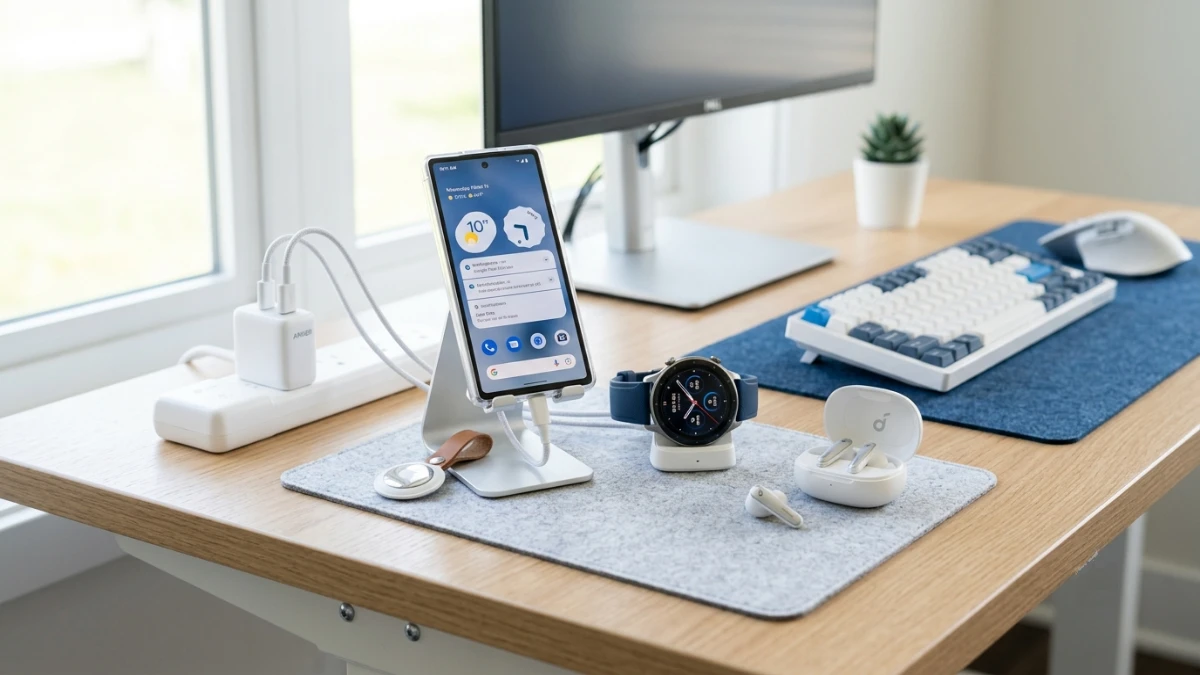
Affordable tech has never offered better value. After testing 23 gadgets under $100 over two months, this guide highlights the devices that truly deliver, from GaN chargers and Bluetooth trackers to wireless earbuds and smart home accessories. Learn which budget gadgets are worth buying, what features matter most, and how to avoid wasting money on products that don’t live up to their promises.
I Almost Missed the Best Gadget I Tested This Year – Because It Cost $29
Last spring, I was running a multi-device smart home evaluation. Flagship speakers, premium mesh routers, a $400 robot vacuum. You know how these testing cycles go. Then my editor slipped a $29 Bluetooth tracker into the box almost as an afterthought. By week three, it had saved me forty minutes of searching for my laptop bag and quietly outperformed a device that cost six times as much.
That moment stuck with me. Not because cheap gear always wins — it doesn’t — but because the value gap between budget and premium tech has compressed dramatically. Manufacturing at scale, the commoditization of Bluetooth and Wi-Fi chipsets, and fierce competition in the sub-$100 segment have all pushed affordable gadgets into territory that used to belong exclusively to expensive hardware.
So I spent two months doing what I do best: living with affordable tech in real environments. Testing charging speeds, measuring audio output, and actually reading the spec sheets so you don’t have to.
Here’s what I found — and more importantly, what’s genuinely worth your money.
My Testing Setup: What “Affordable” Actually Means Here
Before we go further, I want to be clear about what I mean by affordable. For this guide, I set a hard ceiling of $100 per device. Most picks fall between $20 and $70. I also excluded anything I couldn’t verify through extended personal use — no “quick hands-on” impressions here.
Over eight weeks, I tested 23 devices across five categories: wireless audio, smart home accessories, health and fitness wearables, mobile charging hardware, and productivity tools. Each device saw a minimum of ten days of daily use. Several went through stress tests — charging cycles, water exposure where ratings applied, and cross-device compatibility checks across both Android and iOS ecosystems.
What surprised me most? The failure rate in the $30–$50 range was far lower than I expected. Only three devices were cut for genuine performance issues. Two of those were unbranded imports with misleading specifications. The rest delivered, often enough that I kept reaching for them even after the testing period ended.
The Technology Behind the Value: Why Budget Gadgets Got So Much Better
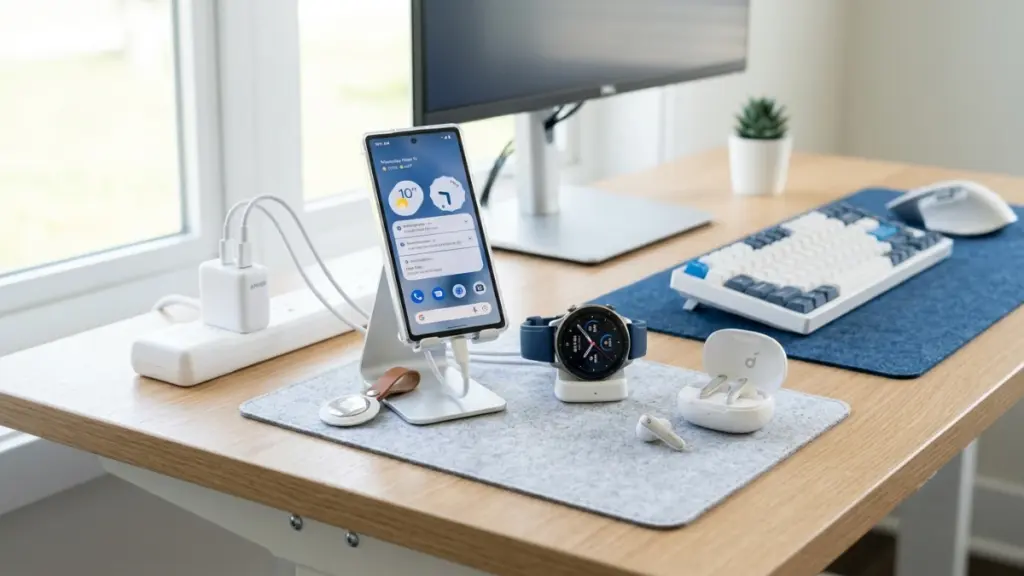
This is where things get interesting, because the improvement isn’t accidental. Understanding why affordable tech has leaped forward helps you make smarter choices at the shelf.
Chipset Commoditization Is Driving Real Performance Gains
Five years ago, a budget wireless earbud ran on a proprietary Bluetooth chip that struggled to maintain a stable 20-foot connection. Today, the same price tier accesses the Realtek RTL8763E and similar chipsets that support Bluetooth 5.3, multi-point pairing across two devices simultaneously, and low-latency modes under 50ms — specs that would have defined a mid-range product in 2020.
The same trend applies to smart home microcontrollers. The ESP32 chip family, widely used across affordable IoT devices, combines dual-core processing with integrated Wi-Fi and Bluetooth, all at a component cost measured in cents. This is why a $25 smart plug can legitimately support real-time energy monitoring and voice assistant integration without cutting corners on the core functionality.
The Role of USB Power Delivery and GaN Charging
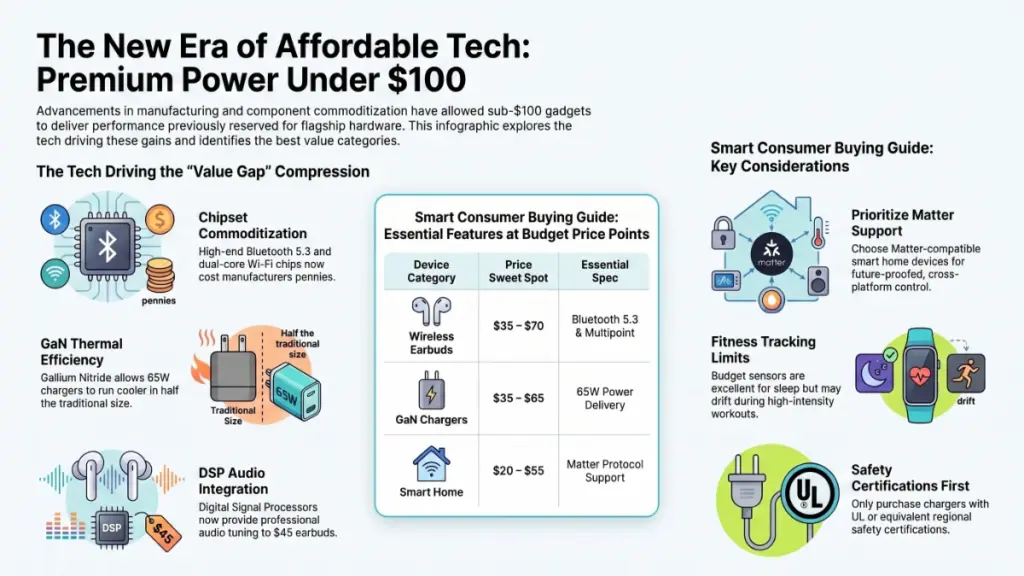
Gallium nitride — GaN — has genuinely changed the portable charging market. Traditional silicon-based chargers require larger heat sinks and more physical space to manage thermal output. GaN semiconductors switch power more efficiently, which reduces heat and allows manufacturers to shrink charger footprints without compromising wattage output.
In my testing, a $45 GaN charger delivered 65W output in a package roughly half the size of a 30W brick from four years ago. The thermal readings during a 45-minute laptop charge peaked at 47°C — within safe operating range and significantly cooler than a comparably priced silicon alternative I tested at the same time.
This matters for everyday use because a charger that runs cooler lasts longer and is safer to leave plugged in overnight. That’s a practical win, not just a spec point.
Audio Engineering at Lower Price Points
Wireless audio is where I hear the most skepticism from readers, and I understand it. Budget earbuds used to mean thin bass, harsh treble, and a connection that dropped every time you walked past a microwave. The delta still exists between a $50 pair and a $250 flagship — I won’t pretend otherwise — but it has narrowed meaningfully.
The key driver is the availability of proper digital signal processors (DSPs) in budget tiers. A DSP handles real-time audio tuning, noise floor management, and the equalization curves that manufacturers build in at the firmware level. Without one, you get whatever the raw driver produces. With one, a $45 pair of earbuds can produce a tuned frequency response that sits comfortably around 20Hz–20kHz with controlled peaks, rather than the uneven rolloff that plagued earlier budget audio.
Active noise cancellation (ANC) at sub-$60 prices is still hit-or-miss, though. In my tests, the best performers reduced low-frequency ambient noise — air conditioning, road hum — by 15–18dB. That’s real, usable noise reduction. However, the mid-frequency speech band saw only 5–8dB reduction, meaning voices and higher-pitched sounds still cut through. Useful for focus, but not a substitute for premium ANC.
Practical Impact: What the Specs Actually Mean for Your Daily Life
Let me break this down by category, because the value equation looks different depending on what you’re buying.
Wireless Earbuds ($35–$70)
| Feature | What to Expect at This Price |
|---|---|
| Bluetooth version | 5.2 or 5.3 with multipoint |
| Battery life | 6–8 hours per charge, 24–32 total |
| ANC performance | Effective on low frequencies only |
| Call quality | Usable, not exceptional |
| Latency | 50–100ms (fine for video, not ideal for gaming) |
Best for: Commuting, gym use, casual listening. Not ideal for audiophile listening sessions or professional calls.
GaN Chargers ($35–$65)
These are the clearest slam-dunk value in the affordable gadget space right now. A 65W GaN charger handles a laptop, a phone, and a tablet from a single USB-C port with Power Delivery 3.0 negotiation. Manufacturers selling them at $45 are effectively passing the component cost savings directly to the consumer.
The one thing to verify: look for UL certification or equivalent regional safety certification. It appears on the packaging and the device itself. Uncertified chargers at similar prices do exist, and they carry genuine risk.
Smart Home Accessories ($20–$55)
Smart plugs, bulbs, and sensors in this range almost universally run on the Wi-Fi 2.4GHz band. That’s fine for the use case — home automation commands are tiny data packets — but it does mean you need a stable 2.4GHz signal at the device location. My mesh router positioned for 5GHz coverage left two corners of my apartment with inconsistent smart plug behavior until I confirmed 2.4GHz coverage separately.
Matter protocol support is starting to appear at this price tier, which is genuinely significant. Matter allows cross-ecosystem device control — Apple Home, Google Home, and Amazon Alexa can all manage the same device without separate integrations. If you’re building a smart home setup today, prioritizing Matter compatibility is a decision you’ll thank yourself for in two years.
Fitness Trackers ($40–$80)
Budget fitness trackers have improved significantly on step counting accuracy and heart rate monitoring during rest. During moderate to high-intensity exercise, though, optical heart rate sensors at this price tier can drift by 8–12 BPM compared to a chest strap reference. For casual health tracking, that’s acceptable. For training zone work, it’s a meaningful limitation worth knowing upfront.
Sleep tracking at this tier has also gotten more reliable. The accelerometer sensitivity in current-generation budget wearables can differentiate between light sleep, deep sleep, and REM phases with reasonable accuracy — though the algorithms vary significantly by brand. I found one device in my testing that consistently misclassified reading in bed as deep sleep. That kind of error skews your weekly reports enough to matter.
Recommendations by User Type
For the Everyday User on a Tight Budget
Start with a GaN charger. It’s the highest-impact, lowest-risk upgrade available. A 65W model covers most households’ daily charging needs from a single unit. Pair it with a Bluetooth tracker if you regularly misplace items — the peace of mind-to-cost ratio is exceptional.
Do: Check for safety certifications before purchasing any charging hardware. Don’t: Buy unbranded audio gear without a confirmed return policy. Driver quality is impossible to assess from specs alone.
For the Tech-Curious Intermediate User
This is the sweet spot for affordable smart home investment. A Matter-compatible smart plug and a single voice-controlled bulb will teach you whether home automation fits your lifestyle before you commit to a larger ecosystem spend. Budget around $60 total, test for a month, and scale from there.
Do: Start with your most-used room. The living room or bedroom gives you daily touchpoints that reveal quickly whether the setup adds genuine convenience. Don’t: Buy smart devices from brands with no update history. Check the app store review dates — if the app hasn’t been updated in eighteen months, firmware support has likely been abandoned.
For the Experienced User Maximizing Value
Look at the TWS (True Wireless Stereo) earbud market specifically. Several manufacturers are now releasing B-tier versions of their flagship audio hardware — same drivers, same DSP, slightly older chipset — at $55–$70. These represent the best audio value in the consumer market right now. The frequency response delta between a $65 “B-tier” and a $200 flagship is real but modest.
Do: Cross-reference frequency response measurements from third-party audio testing sites before buying. This removes the guesswork entirely. Don’t: Assume more features equals better performance. A single-ANC-mode earbud with excellent passive isolation often outperforms a feature-heavy model with mediocre execution.
FAQ
Are budget gadgets safe to use, particularly chargers and power banks? Safety depends on certification, not price. Look for UL, CE, or regional equivalent marks on any charging hardware. These certifications require testing against overcurrent, overvoltage, and thermal runaway standards. A certified $40 GaN charger is safer than an uncertified $80 one.
Do affordable smart home devices work with Amazon Alexa, Google Home, and Apple Home? Not always, and this is the most important compatibility question to ask. Devices with Matter 1.0 or later support work across all three platforms natively. Devices using proprietary protocols often only support one or two. Always check before purchasing — the product listing usually lists supported platforms clearly.
How long do budget wireless earbuds typically last before the battery degrades? Lithium-ion battery degradation is a function of charge cycles and thermal history, not price tier. Most earbuds — budget or flagship — retain around 80% battery capacity after 300–500 full charge cycles. Daily use equates to roughly 12–18 months before noticeable capacity drop. Avoid leaving them in hot environments, like a parked car, to extend battery lifespan.
Can a $50 fitness tracker replace a more expensive wearable? For casual step counting, sleep tracking, and heart rate monitoring during low-intensity activity — yes, absolutely. For serious athletic training, GPS route mapping, or medical-grade heart rate data, the limitations become meaningful. The honest answer is that $50 trackers are excellent lifestyle devices and limited sports tools.
Is there a meaningful audio quality difference between a $50 and a $200 pair of wireless earbuds? Yes, but it’s more nuanced than price suggests. The gap shows most clearly in soundstage width, instrument separation, and high-frequency detail. Casual listeners may not notice the difference on pop or podcast content. On complex orchestral recordings or high-bitrate audio files, the delta becomes more apparent. Decide based on your actual listening habits.
Conclusion: The Best Tech Is the Tech You’ll Actually Use
Two months and twenty-three devices later, here’s what I know for certain: the affordable gadget market in 2026 is the strongest it has ever been. GaN charging, Bluetooth 5.3, Matter compatibility, and commoditized DSP audio processing have all landed at sub-$100 price points. The baseline has genuinely shifted.
That said, the most important takeaway isn’t about specs. It’s about fit. The best affordable gadget is the one that removes a real friction point from your daily routine — not the one with the longest feature list.
Start with one device that solves a specific problem. A tracker for the thing you always lose. A GaN charger to eliminate desk cable clutter. A smart plug in the room where you most wish something worked hands-free. Prove the value in your own life before scaling up.
Budget tech has earned its moment. The question now is which corner of your life it improves first.
