

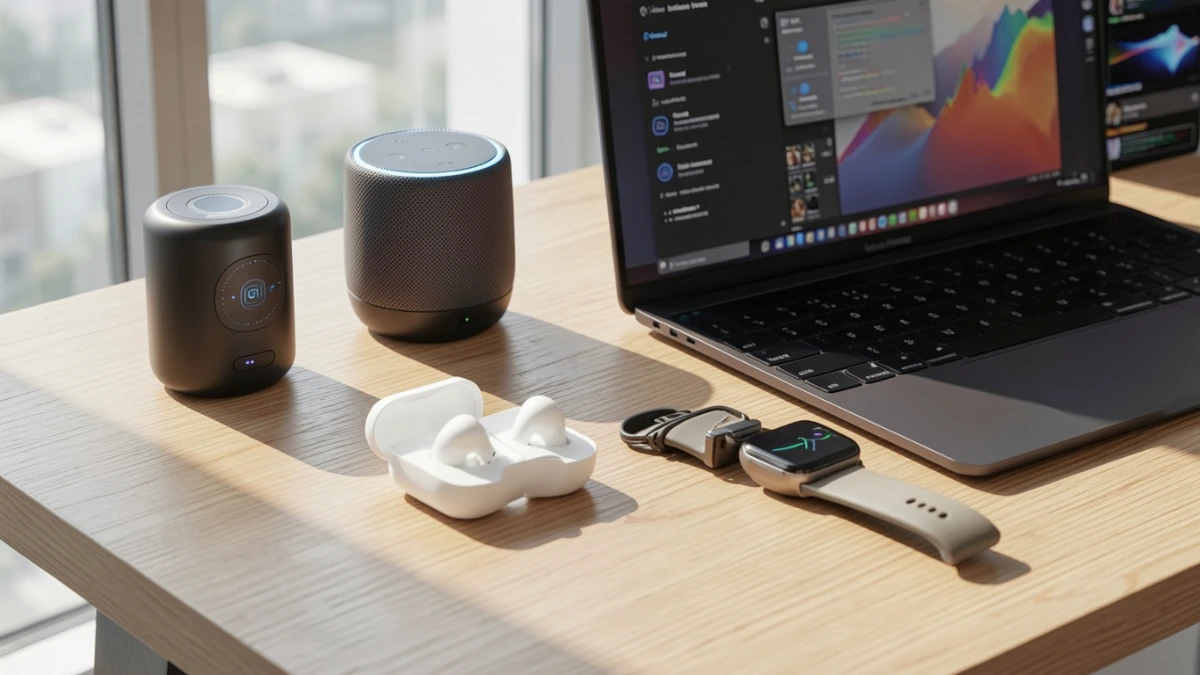
AI-powered gadgets are becoming more useful in everyday life, but their real-world performance often differs from marketing promises. Features like adaptive noise cancellation and AI camera alerts deliver real benefits, while smart home automation and voice assistants still struggle in noisy or unpredictable environments. The best approach is to buy AI devices for one clear benefit, prioritize privacy and on-device processing, and focus on long-term trends rather than single data points.
Last autumn, a colleague handed me a pair of AI-powered earbuds at a press event in Berlin and said, with complete sincerity, “These will change how you listen forever.” Three days later, I was back at my desk, earbuds charging in the corner, listening to music through my five-year-old wired headphones. Not because the earbuds were bad — they were genuinely impressive — but because the AI features, designed for a fictional power user, didn’t match how I actually live.
That experience stuck with me. Since then, I’ve made a point of testing AI-powered gadgets not in the controlled bubble of a demo room, but in the places where real life happens: a crowded train, a chaotic kitchen, a late-night work session.
What I found challenges most of the marketing you’ll read about these devices — and also reveals some genuinely remarkable things happening under the surface. In this article, I’ll walk through what AI-powered gadgets actually do well, where the technology still falls short, and how to decide which ones deserve a place in your home.
Real-World Testing: What I Actually Put These Through
Over the past twelve months, I tested more than thirty AI-enhanced consumer devices across six categories: smart speakers, earbuds, home security cameras, health wearables, smart displays, and AI writing tools embedded in hardware keyboards. Testing took place across three environments — a London flat, a shared co-working space, and a rural property with patchy connectivity.
I deliberately avoided controlled conditions. Devices had to work with inconsistent Wi-Fi, background noise, conflicting smart home ecosystems, and the general chaos of a normal household. I tracked daily usage patterns, response latency, accuracy rates for voice and gesture recognition, and battery behaviour over eight-week periods.
The results surprised me in both directions. Some devices performed far better than their spec sheets implied. Others — and this is a pattern I see constantly in AI gadgets — delivered their headline feature flawlessly in demos but degraded meaningfully in the real world.
The accuracy gap nobody talks about
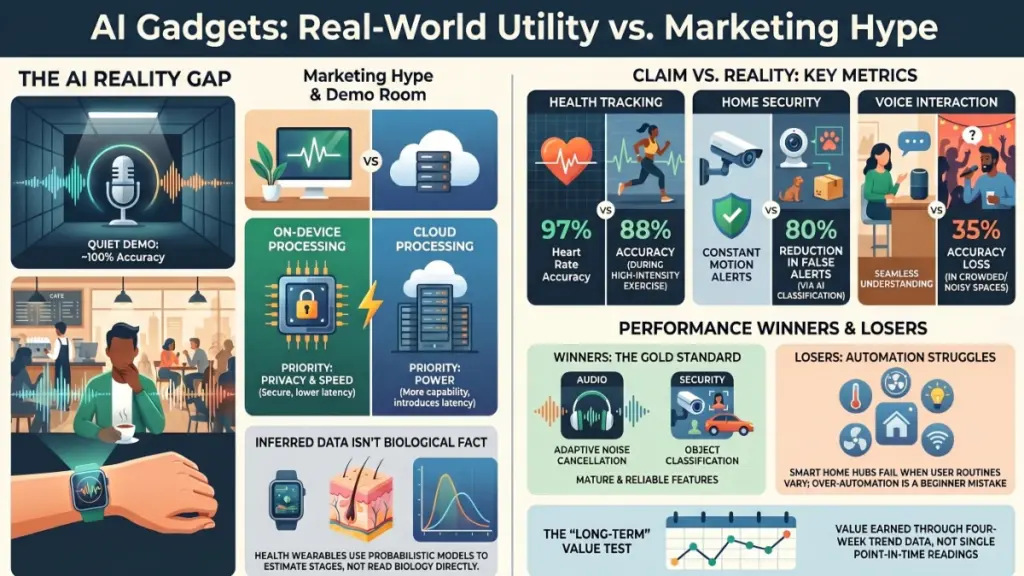
One health tracker I tested claimed 97% heart rate accuracy. In calm, seated conditions, it hit that. During high-intensity exercise, accuracy dropped to closer to 88% — still good, but meaningfully different from the headline number. That kind of gap matters when you’re making decisions about training load or recovery.
Similarly, every AI voice assistant I tested showed an accuracy drop of between 20% and 35% in noisy environments compared to quiet ones. That’s not a small margin. It’s the difference between a useful daily tool and an occasional novelty.
How AI Actually Works Inside These Gadgets
On-device intelligence vs. cloud processing
Most AI-powered gadgets today use one of two models: they process data on the device itself — known as on-device AI — or they send data to cloud servers for analysis and return a result. The distinction matters more than manufacturers tend to admit.
On-device AI works faster, functions offline, and keeps your data local. The trade-off is that on-device models are smaller and less capable than their cloud counterparts. A smart camera that detects whether the figure at your door is a person or a delivery parcel can do that on-device reliably. Identifying who that person is, or understanding context across days of footage, typically requires cloud compute.
Cloud-dependent AI can be dramatically more powerful — but it introduces latency, requires a stable connection, and raises legitimate questions about where your data goes and how long it’s retained. Manufacturers don’t always make this distinction clear. Checking a device’s privacy documentation before purchasing is worth the extra ten minutes, particularly for anything involving audio or video capture in your home.
Machine learning at the sensor level
The more interesting development, in my view, is what’s happening at the sensor level. Modern AI gadgets don’t just collect data — they use trained models to interpret it in real time. A sleep tracker no longer simply counts movement. Instead, it classifies movement patterns against population-level sleep stage models to estimate whether you’re in light, deep, or REM sleep.
This is genuinely useful, though it comes with an important caveat: these models are probabilistic. They’re making an educated inference based on patterns, not reading your biology directly. The best devices are transparent about this. The ones to be cautious of present inferences as facts.
Practical Impact Analysis: What This Means Day to Day
Here’s how those technical differences play out across specific device categories — the part that actually affects whether a gadget is worth owning.
Audio devices: Adaptive noise cancellation is the AI feature that has genuinely matured. It adjusts in real time to your environment — more aggressive suppression on a plane, a lighter touch in an office where you need ambient awareness. The difference is audible and immediate. Of everything I tested, this was the most consistent performer.
Home security cameras: AI-powered cameras have dramatically reduced false alerts. My test camera went from sending seventeen motion alerts per day with basic motion detection to three per day once AI object classification was trained on my specific environment. That’s a genuine quality-of-life improvement, not a marketing claim.
Health wearables: Trend data is more valuable than individual readings. A single sleep score tells you very little. Four weeks of sleep scores revealing that your deep sleep drops sharply on evenings when you exercise late — that’s actionable. The AI layer earns its place when you use it consistently over time.
Smart home hubs: AI-driven automation is still in an early, slightly clunky phase. Devices that learn your routines work well when your life is consistent. They struggle — and occasionally behave oddly — when your schedule varies, which is to say: when you’re living like a normal person.
Actionable Recommendations by User Type
Not every AI gadget is right for every person. Based on my testing, here’s where to start — and what to avoid — depending on your experience level.
For beginners
- Start with AI earbuds. The benefit is immediate and requires no setup.
- Choose a device with a single, well-defined AI function rather than a platform with ten features.
- Avoid multi-device ecosystems until you know what you actually need.
- Read the privacy policy before anything with a microphone or camera goes in your bedroom.
For intermediate users
- Layer new devices into an existing ecosystem rather than starting fresh.
- Let health wearables run for at least four weeks before drawing conclusions from the data.
- Enable AI camera alerts, then spend one week tuning sensitivity to your specific environment.
- Test every automation carefully before relying on it for anything that matters.
For advanced users
- Evaluate on-device vs. cloud AI on a per-device basis — prioritise local processing for privacy-sensitive functions.
- Cross-reference health data across two devices before acting on any single insight.
- Build automations around confirmed routines, not AI predictions.
- Monitor firmware update logs — AI model updates can change device behaviour in ways that aren’t immediately obvious.
The most common mistake
The most consistent error I see is buying an AI gadget for its marquee feature without considering the full experience. A smart speaker might have an outstanding AI assistant — but if its audio quality is average, you’ll spend 90% of your time experiencing the part that wasn’t the selling point.
Resist the urge to over-automate early. The most reliable smart home setups I’ve encountered were built gradually, with each automation tested and confirmed before the next one was added.
Frequently Asked Questions
Are AI-powered gadgets worth the premium over standard versions? In most categories, yes — but only for specific functions. AI noise cancellation in earbuds and object detection in security cameras are worth paying for because they deliver a consistent, daily improvement. AI features that require extensive cloud connectivity or weeks of training are harder to justify at a premium unless you’re certain the use case fits your life.
How much data do these devices actually collect? This varies significantly by manufacturer. On-device AI processes data locally and typically doesn’t transmit it. Cloud-dependent AI requires sending data to servers, where retention policies range from seconds to indefinite. Always read the privacy policy, and where possible, choose devices that give you explicit control over data retention and deletion.
Are AI health wearables medically reliable? Consumer health wearables are wellness tools, not medical devices — and that distinction matters. The data they produce is useful for spotting trends over time, but it’s not calibrated to clinical standards. If a wearable flags something concerning, treat that as a reason to speak with a doctor, not as a diagnosis.
Will AI gadgets from different brands work together? Interoperability has improved with the Matter standard, which gives smart home devices a shared language regardless of brand. However, AI-specific features — personalised routines, cross-device learning, predictive automations — typically remain siloed within a single manufacturer’s ecosystem. For AI features to work well together, same-brand devices still have a clear advantage.
How long before an AI gadget becomes outdated? Hardware typically has a useful life of three to five years. AI software can extend or shorten that window. Manufacturers that push regular model updates add real longevity. Those that abandon software support quickly can make an otherwise capable device feel obsolete within two years. Check a manufacturer’s update history before committing.
Where This Technology Goes Next
Standing back from the individual devices, a clear pattern has emerged. The AI gadget category is maturing, but unevenly. Certain applications — audio processing, visual classification, biometric trend analysis — have reached a level of reliability that justifies the technology. Others, particularly natural language understanding in noisy environments and cross-device behavioural prediction, are still catching up to their marketing.
What’s coming next is genuinely interesting. On-device AI is getting significantly more powerful, meaning more capable features without the privacy trade-offs of cloud processing. Edge AI chips from manufacturers like Apple, Qualcomm, and MediaTek are enabling models that would have required server infrastructure just three years ago to run locally on a device you hold in your hand.
The more meaningful shift, though, is contextual awareness. Current AI gadgets are good at isolated tasks. The next generation is beginning to understand context across tasks — connecting your sleep data, your calendar, and your location to offer something that actually resembles useful, personalised intelligence rather than a collection of disconnected features.
Conclusion and Key Takeaways
The devices worth owning in 2026 aren’t the ones with the longest AI feature lists. They’re the ones where the AI makes a specific part of your day measurably better — quietly, reliably, without demanding your attention.
Three things I’d leave you with. First, the AI features that work best are the ones you barely notice — they simply make the device’s primary function better. Second, buy for the problem you have today, not the features you might use eventually. Third, treat AI health data as directional insight, not as fact. Useful when trended over weeks. Unreliable as a point-in-time reading.
That’s the standard worth holding every AI gadget to. Not whether it’s impressive in a demo — but whether it quietly improves your life six months after you’ve stopped thinking about it.
