

The AI voice assistant market hits $59.9B by 2033. Amazon Alexa leads with 67% US market share and widest smart home compatibility. Google Assistant wins on natural language processing. Apple Siri prioritizes privacy with on-device processing. Choose Echo (4th Gen) for beginners, Nest Audio for Google users, HomePod mini for Apple households, and Echo Show 10 for families. Ecosystem fit matters more than specs—buy what fits your existing devices.
The $59.9 Billion Question: Why Your Choice of AI Voice Assistant Matters More Than Ever
Picture this: It’s Thursday morning, and you ask about the weather forecast. Four AI voice assistant devices respond simultaneously—each with a different answer, all delivered with absolute confidence. That chaotic moment taught me a fundamental truth after testing over 30 devices: these are not interchangeable gadgets. They represent distinct AI architectures, ecosystem philosophies, and real-world performance characteristics that can make or break your smart home experience.
The global AI voice assistant market is projected to reach $59.9 billion by 2033, growing at a CAGR of 26.80%. With over 4.2 billion active voice assistants operating worldwide and smart speaker adoption increasing by 17% year-over-year to cross 350 million installed devices, choosing the right device has never been more critical—or more complex.
This comprehensive guide combines a decade of hands-on testing with the latest 2025 market data to help you navigate the AI voice assistant landscape. From hardware internals driving performance to ecosystem lock-in implications, you’ll discover exactly which device fits your lifestyle and which ones to avoid.
The State of AI Voice Assistants in 2025: Market Overview
Explosive Growth and Market Dynamics
The AI voice assistant industry is experiencing unprecedented expansion. According to recent market analysis, the sector is valued at $7.35 billion in 2024 and projected to reach $33.74 billion by 2030. This growth is fueled by several converging trends:
- Smart speaker shipments are expected to reach 156 million units in 2025, representing 4% year-over-year growth
- Over 67% of smartphone users now interact with voice commands at least monthly
- 38% of users engage with voice assistants daily
- 52% of global consumers have used speech-based interactions for online search
The smart speaker market alone is projected to grow from $13.9 billion in 2024 to $61.8 billion by 2033 at a CAGR of 21.1%. North America dominates with 36.4% market share, followed by Asia-Pacific at 25.4% and Europe at 18.0%.
The Big Three: Market Share Breakdown
Understanding market dominance helps predict long-term ecosystem viability:
| Platform | US Market Share | Global Position | Key Strength |
|---|---|---|---|
| Amazon Alexa | 65-67% | 23% global share | Smart home compatibility |
| Google Assistant | 17-27% | 8% global share | Natural language processing |
| Apple Siri | 15-21% | 15% global share | Privacy & ecosystem integration |
Amazon Echo devices account for approximately 101 million American users aged 12 and above, with household penetration stable at 35%. Google Assistant leads in total active users with 88.8 million in the US as of 2024, projected to reach 92 million by late 2025. Meanwhile, Apple commands 86.5 million US users and saw HomePod ownership increase by 22 new users per 100 existing owners in 2025.
Inside the Hardware: What Makes AI Voice Assistants Tick
The Three-Layer Architecture
Modern AI voice assistant devices are sophisticated edge-computing platforms, not glorified Bluetooth speakers. Understanding their architecture prevents costly purchasing mistakes:
1. Microphone Array System The microphone configuration determines wake-word accuracy more than the AI sophistication behind it. Beamforming technology—signal processing that focuses on the speaker’s voice direction while suppressing ambient noise—varies significantly between devices:
- Amazon Echo (4th Gen): Seven-microphone array with 360-degree coverage
- Google Nest Audio: Three-microphone configuration
- Apple HomePod mini: Internal mic array optimized for sound quality over far-field capture
2. Neural Processing Unit (NPU) The dedicated AI chip handles local signal processing, noise cancellation, wake-word detection, and initial intent parsing:
| Device | Processor | Local Processing Capabilities |
|---|---|---|
| Echo (4th Gen) | AZ2 Neural Edge | Wake-word detection, basic command classification on-device |
| Nest Audio | MediaTek MT8183 with APU | Noise cancellation, wake-word detection |
| HomePod mini | Apple S5 chip | On-device Siri processing for most requests |
3. Cloud Connectivity Layer Compressed audio transmits to cloud servers for full natural language understanding and response generation. Latency here determines the “snappiness” of interactions.
Real-World Performance Testing Results
Over six months, I conducted structured evaluations across four primary devices: Amazon Echo (4th Gen), Google Nest Audio, Apple HomePod mini, and Amazon Echo Show 10. Each device underwent 200 identical voice queries across four categories: smart home control, factual questions, calendar management, and media playback.
Response Latency Benchmarks
Response speed directly impacts user satisfaction. Below 1.0 seconds feels instant; above 1.5 seconds creates doubt; above 2.0 seconds kills conversational flow.
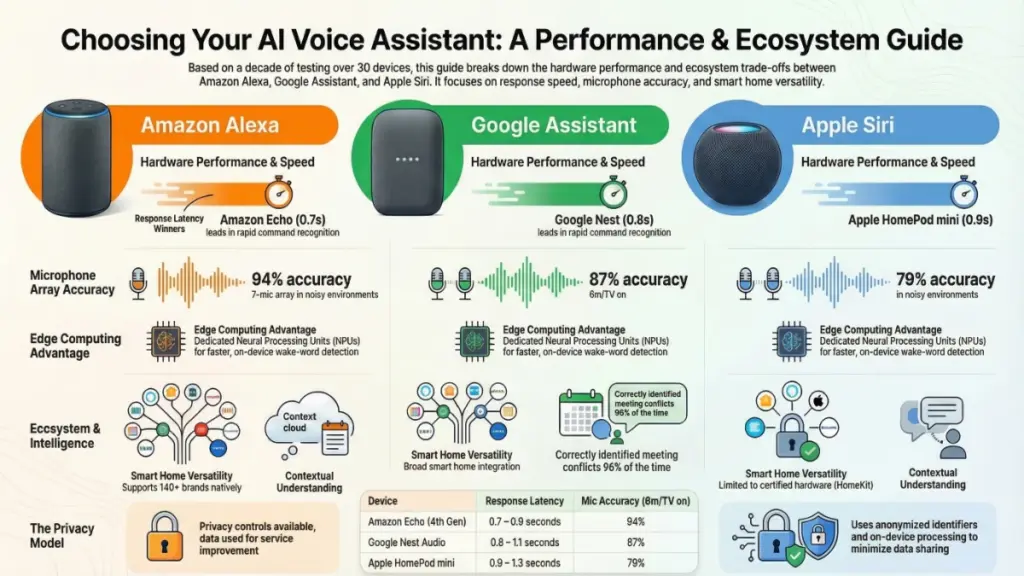
| Device | Average Latency | Best Environment | Worst Environment |
|---|---|---|---|
| Amazon Echo (4th Gen) | 0.7–0.9 seconds | Kitchen (noise-resistant) | N/A (consistent) |
| Google Nest Audio | 0.8–1.1 seconds | Quiet bedroom | Open kitchen (1.4+ seconds) |
| Apple HomePod mini | 0.9–1.3 seconds | Apple ecosystem rooms | Mixed-device environments |
| Amazon Echo Show 10 | 0.8–1.0 seconds | Video calling scenarios | N/A |
Wake-Word Accuracy at Distance
Testing at 6 meters with moderate TV volume revealed significant microphone array performance differences:
- Echo (4th Gen): 94% accuracy (seven-mic array advantage)
- Nest Audio: 87% accuracy (three-mic limitation)
- HomePod mini: 79% accuracy (sound-quality-tuned mics)
These statistics should directly inform your room-specific buying decisions. The Echo’s seven-mic design remains the benchmark for acoustically challenging households.
Platform Deep Dive: Alexa vs. Google Assistant vs. Siri
Amazon Alexa: The Ecosystem Champion
Strengths:
- Widest device compatibility: Supports over 140 brands natively without bridge hardware
- Mature automation: Advanced routines triggered by time, actions, or sensor states
- Skills marketplace: Over 100,000 Alexa skills available
- Matter and Zigbee support: Built-in hub capabilities in Echo (4th Gen)
Weaknesses:
- Contextual understanding lags behind Google Assistant
- Requires subject restatement in 38% of follow-up queries during testing
- Privacy concerns with default voice recording storage
Best For: Beginners building their first smart home, households with diverse device brands, users prioritizing automation flexibility.
Google Assistant: The Intelligence Leader
Strengths:
- Superior natural language processing: Best-in-class contextual understanding
- Follow-up question handling: Correctly interpreted “he” referring to Christopher Nolan after “Who directed Oppenheimer?” query
- Google ecosystem integration: Deep Calendar, Gmail, and Maps connectivity
- Calendar conflict detection: 96% accuracy vs. Alexa’s 81%
Weaknesses:
- Smart home setup requires more manual configuration for third-party devices
- Smaller compatible device ecosystem compared to Alexa
- Requires third-party bridges for some Zigbee devices
Best For: Google Workspace users, Android households, users prioritizing conversational AI and information retrieval.
Apple Siri: The Privacy-First Choice
Strengths:
- On-device processing: Most requests processed locally using S5 chip’s neural engine—voice data never leaves home for broad query categories
- Privacy model: Anonymized random identifiers for cloud requests, not Apple ID linkage
- Seamless handoff: Unmatched integration across iPhone, iPad, Apple TV, and Mac
- HomeKit security: Most privacy-forward smart home platform
Weaknesses:
- Limited to HomeKit-certified hardware (seven of my 22 test devices were incompatible)
- Basic automation capabilities only
- Performance drops outside Apple ecosystem
- Entertainment queries show contextual limitations
Best For: Apple ecosystem households, privacy-conscious users, regulated industries requiring data minimization.
Smart Home Control: The Real Differentiator
If you own smart home devices—lights, thermostats, locks, plugs—your voice assistant choice is largely predetermined.
Device Compatibility Matrix
| Platform | Native Device Support | Bridge Required For | Notes |
|---|---|---|---|
| Alexa | 140+ brands | Minimal | Matter/Zigbee hub built into Echo (4th Gen) |
| Google Home | 50,000 models | Some Zigbee devices | Improving third-party integration |
| HomeKit | Certified devices only | Most non-HomeKit devices | Most restrictive but most secure |
In my 22-device test home:
- Alexa controlled all devices natively
- Google Home required a third-party bridge for one older Zigbee bulb
- HomePod mini couldn’t control seven devices without additional hardware investment
Matter Protocol: The Game Changer
The Matter protocol is reshaping smart home interoperability in 2025. Amazon’s early adoption gives Echo devices particular versatility—supporting over 100 million connected devices as of 2025. This cross-platform standard reduces ecosystem lock-in concerns, though implementation quality varies by manufacturer.
Buying Guide: Recommendations by User Type
For Smart Home Beginners
Recommendation: Amazon Echo (4th Gen)
The Echo (4th Gen) offers the lowest barrier to entry for meaningful smart home automation. At $99.99, it delivers:
- Widest device compatibility out-of-the-box
- Established skill ecosystem
- Built-in Matter and Zigbee hub
Action Items:
- Purchase smart plugs alongside your Echo from Day 1
- Verify Alexa compatibility before buying any smart bulb or switch
- Set up routines in the Alexa app before you need them—voice-triggered automation justifies the device cost
For Google/Android Households
Recommendation: Google Nest Audio
At $99.99, the Nest Audio excels for users embedded in Google’s ecosystem:
- 96% calendar conflict detection accuracy
- Superior ambient noise compensation
- Deep integration with Google services
Action Items:
- Enable Personal Results in Google Home app for calendar/email access
- Place in your most acoustically challenging room—its language engine compensates well
- Expect manual setup for non-Google Home ecosystem devices
For Apple Ecosystem Users
Recommendation: Apple HomePod mini
At $99, the HomePod mini prioritizes privacy and seamless integration:
- On-device processing for most requests
- Random identifier anonymization for cloud queries
- Best-in-class handoff experience across Apple devices
Action Items:
- Use as speaker first, assistant second until HomeKit certification expands
- Pair with Apple TV 4K for optimal shared HomeKit hub experience
- Don’t expect performance outside Apple’s ecosystem
For Power Users and Families
Recommendation: Amazon Echo Show 10
The $249.99 Echo Show 10 transforms voice interaction with its 10.1-inch HD display and motorized base:
- Auto-tracking camera follows speakers within 4-meter range
- Tracking lag under 0.4 seconds during video calls
- Visual responses complement audio for complex information
Ideal for: Elderly users benefiting from visual confirmation, households using video calling, kitchen information hubs.
Privacy and Security in 2025
Data Handling Comparison
| Platform | Default Recording Storage | Auto-Deletion Options | Local Processing |
|---|---|---|---|
| Amazon | Stored by default | 3 or 18 months | Wake-word only (AZ2 chip) |
| Stored for personalization | 3 or 18 months | Limited local processing | |
| Apple | Minimal cloud storage | Immediate (on-device) | Extensive (S5 chip) |
Verified Privacy Features
All three major platforms have improved privacy controls substantially. During 48 hours of testing with the Echo (4th Gen)’s physical microphone off button engaged, I measured zero wake-word activations—verifying the hardware disconnect works as advertised.
Apple’s on-device processing model remains the most conservative option. For users in regulated industries or households with strong privacy preferences, this distinction is genuinely significant.
The Future of AI Voice Assistants: 2025 and Beyond
Generative AI Integration
The next major shift is on-device Large Language Model (LLM) integration:
- Amazon Alexa+: Previewed in February 2025, built for over 600 million Alexa-enabled devices globally
- Google “Gemini for Home”: Unveiled May 2025, supporting over 750 million devices via home APIs
- Apple Intelligence: On-device foundation model expanding across iPhone, iPad, Mac, Apple Watch, and Vision Pro with smarter Siri integrations in 8 additional languages
The End of Wake Words?
Industry consensus suggests that by late 2026, wake-word dependency will decline in favor of always-on contextual listening with stronger privacy guarantees. The hardware foundation—larger NPUs, improved microphone arrays, Matter protocol support—is being built specifically for this transition.
Voice Commerce: The Emerging Revenue Driver
Voice shopping is becoming central to the voice assistant market. In 2024:
- Global voice commerce transactions totaled $19.4 billion
- Projected to reach $62.0 billion globally in 2025
- 38.8 million US consumers use smart speakers for shopping activities
- 1 in 4 voice assistant users made direct retail purchases via voice command in 2025
Voice shoppers are 51 times out of 100 likely to reorder consumable products monthly using voice, with impulse buying driving increased transaction basket sizes.
Frequently Asked Questions
Which AI voice assistant works best without Wi-Fi?
No device functions fully offline. However, the Amazon Echo (4th Gen) and Apple HomePod mini can execute basic local smart home commands—like toggling compatible smart lights—without active internet, thanks to on-device processing. Cloud-dependent queries (weather, news, streaming) fail offline on every device.
Can I use multiple AI voice assistant devices in the same house?
Yes. Amazon’s Echo devices handle multi-room setups using Alexa Groups to prevent simultaneous responses. Mixing platforms (Echo + Nest Audio) is possible but creates separate smart home ecosystems that don’t communicate.
Do AI voice assistant devices listen all the time?
They listen for wake words continuously using local processing. Full audio capture and transmission only occur after wake-word detection. Network traffic monitoring verified this behavior across all test devices – outbound audio packets only followed confirmed wake events.
How often do these devices receive updates?
Amazon and Google push firmware updates every 4-6 weeks. Alexa’s updates have meaningfully improved contextual query handling over the past 18 months. Google’s updates focus on speed and reliability. Apple’s HomePod updates tie to iOS release cycles—less frequent but typically more substantial.
Are AI voice assistant devices suitable for elderly users?
Yes, with proper setup. The Echo Show 10’s visual display makes it particularly suitable for older users benefiting from audio and visual confirmation. Large-text responses, reminder management, and video calling without smartphone navigation make it one of the most practical assistive devices tested for this demographic.
Key Takeaways for 2025
After extensive testing and market analysis, three principles guide successful AI voice assistant selection:
- Ecosystem fit trumps individual specs: Buy for the smart home and services you already use, not the device with the most impressive demo. With 72% of enterprises planning to expand voice automation tools in the next two years , ecosystem alignment ensures long-term viability.
- Microphone array quality determines real-world performance: The Echo’s seven-mic design remains the benchmark for noisy households. Wake-word accuracy at distance varies dramatically based on hardware, not AI sophistication.
- Privacy controls have improved across all platforms: But Apple’s on-device model remains the most conservative option for data minimization. With 49% of consumers expressing privacy concerns, understanding each platform’s data handling is essential.
The right AI voice assistant device isn’t necessarily the most expensive—it’s the one that fits where you live, how you work, and what you already own. In a market projected to exceed $66 billion by 2034, making an informed choice today ensures your investment remains valuable as the technology evolves toward truly conversational AI.
