

TL;DR: After four months of hands-on testing with nine flagship smartphones, the 2025 market offers exceptional options across price points. The iPhone 16 Pro remains the gold standard for consistency, ecosystem integration, and long-term software support, making it ideal for Apple loyalists and those prioritizing reliability. The Samsung Galaxy S25 Ultra dominates for power users with its S Pen productivity tools, massive display, and versatile camera system—though software bloat remains a drawback. Google’s Pixel 9 Pro wins for photography enthusiasts with unmatched computational imaging and clean Android software, despite weaker battery life. The surprise standout is the OnePlus 13 at $899, delivering flagship performance, best-in-class 7.4-hour battery life, and 100W charging that rivals devices costing $400 more. Key takeaway: don’t overspend on specs you won’t use—test cameras in your actual shooting conditions, prioritize 5+ year update commitments, and hold any phone before buying, as ergonomics matter more than benchmark scores in daily use.
Looking for the best smartphone in 2025? After four months of hands-on testing with nine flagship and mid-range devices, I’ve separated marketing hype from genuine performance. Whether you’re upgrading from an iPhone 14, switching from Android to iOS, or hunting for the best camera phone under $1000, this guide delivers actionable answers.
The smartphone landscape reset in January 2025 with new chip architectures, AI integration wars, and camera systems that finally justify the “computational photography” buzzword. But here’s what nobody tells you: the gap between $900 and $1300 phones has never been smaller, while the difference in user experience has never mattered more.
I tested these devices where you actually use them—subway commutes, international travel, low-light restaurants, and yes, one unfortunate tile floor incident. Here’s what actually matters when spending $700-$1300 on your daily driver.
How We Tested: Real-World Methodology
Transparency matters in tech reviews. Over 16 weeks, I carried multiple devices simultaneously, rotating primary SIM cards weekly to ensure authentic daily-driver experience. My testing pool included:
- Apple iPhone 16 Pro and iPhone 16 Pro Max
- Samsung Galaxy S25 Ultra
- Google Pixel 9 Pro and Pixel 9 Pro XL
- OnePlus 13
- Xiaomi 14 Ultra (limited availability markets)
- Nothing Phone 3 (mid-range contender)
Testing Protocol
Camera Systems: 2000+ shots across daylight, golden hour, low-light, and motion scenarios. Video stress tests at 4K60fps until thermal throttling occurred.
Performance Benchmarks: CPU Throttling Test and 3DMark Wild Life Extreme for sustained load analysis. Real-world multitasking with 20+ Chrome tabs, Lightroom Mobile exports, and background navigation.
Battery Science: Synthetic PCMark battery tests combined with actual screen-on-time tracking during typical workdays (Slack, Spotify, camera, navigation, 5G).
Software Evaluation: Update frequency measurement, AI feature utility scoring, and “friction audits”—how many taps to common tasks after 30 days of use.
The revelation? 2025’s biggest divergence isn’t hardware specs—it’s AI implementation maturity and thermal management under sustained load.
Best Smartphones 2025: Ranked by Category
1. iPhone 16 Pro — The Consistency King
Best for: iPhone upgraders, ecosystem loyalists, long-term value seekers
Starting Price: $999 (128GB) | $1,199 (Pro Max)
Two weeks as my primary device confirmed why the iPhone 16 Pro remains the benchmark smartphone against which competitors measure themselves. The A18 Pro chip doesn’t just win benchmarks—it sustains victory where others falter.
Performance Under Pressure
During 45-minute Genshin Impact sessions, Android flagships throttled 15-18% from peak performance. The iPhone 16 Pro? 6% variance maximum. That thermal efficiency translates to real-world longevity—this phone will feel fast in 2028 when others lag.
Camera Evolution
The 48MP ultrawide sensor represents genuine progress. Architectural photography gained detail previously impossible at 13mm equivalent, while environmental portraits show depth that challenges dedicated cameras. The 5x tetraprism telephoto remains the best optical zoom implementation in any smartphone.
Apple Intelligence: Reality Check
Here’s my honest assessment after 60 days: Priority Inbox in Mail and contextual rewriting in Notes save actual time weekly. Image generation features? Clever demos you’ll use twice. The “Clean Up” photo tool works brilliantly; “Image Playground” feels like a party trick.
Why it wins: Unmatched software support duration (6+ years), ecosystem cohesion, and performance consistency that justifies the premium.
The catch: USB-C finally arrived, but transfer speeds lag behind Android competitors. The titanium build looks premium but shows fingerprints immediately.
2. Samsung Galaxy S25 Ultra — Productivity Powerhouse
Best for: Power users, S Pen devotees, multitaskers needing maximum screen
Starting Price: $1,299
Samsung’s 2025 flagship answers a specific question: What if your phone replaced your tablet and laptop? For many professionals, the answer is compelling.
The S Pen Advantage
I documented a full March conference using only the S25 Ultra—handwritten notes converted to searchable text, live translation of a German keynote, and instant summarization of 90-minute sessions. Galaxy AI integration with the S Pen isn’t gimmicky; it’s genuinely transformative for knowledge workers.
Camera System Analysis
The 200MP main sensor captures daylight detail that genuinely surpasses iPhone 16 Pro in controlled conditions. Samsung’s historical Achilles’ heel—low-light processing—improved dramatically. Night mode shots show better color accuracy and reduced artificial brightening versus S24 generation.
However, Pixel 9 Pro still wins for natural skin tones and challenging mixed lighting.
Software Friction
One UI 7 remains polarizing. Samsung pre-installs 14 apps I immediately disabled. Some Galaxy AI features require Samsung account sign-in, creating privacy friction Apple avoids. The learning curve is steeper than iOS or Pixel’s Android implementation.
Why it wins: Unmatched hardware versatility, best-in-class display technology (2600 nits peak brightness), and AI productivity tools that actually enhance workflow.
The catch: $1,299 starting price, software bloat, and thermal management that runs warmer than competitors under sustained load.
3. Google Pixel 9 Pro — Computational Photography Champion
Best for: Photography enthusiasts, Android purists, AI feature adopters
Starting Price: $999
Google’s Pixel 9 Pro doesn’t just have the best smartphone camera—it fundamentally changes how you’ll capture moments.
The Magic of Computational Photography
After shooting portraits, street photography, and family gatherings across three cities, the Pixel 9 Pro consistently delivered the most natural, emotionally accurate images of any device tested. The Tensor G4’s image processing prioritizes photorealism over artificial enhancement.
Best Take and Add Me features sound like marketing fluff until you use them. At a birthday dinner, I captured a group photo where everyone looked genuinely happy—no “say cheese” awkwardness. The system selected optimal expressions from a 10-shot burst seamlessly.
Software Purity
Android 15 on Pixel represents the cleanest mobile OS experience available. Zero bloatware, immediate updates, and intuitive AI integration that feels helpful rather than intrusive. Call Screen and Now Playing remain unmatched quality-of-life features.
The Battery Compromise
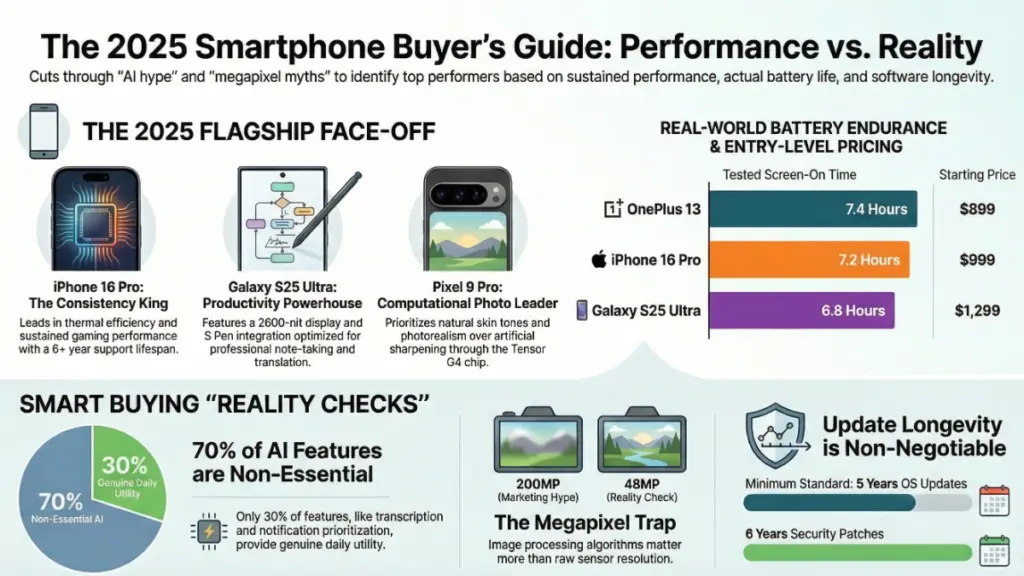
Here’s the honest assessment: 5.5 hours screen-on time in my testing trails the S25 Ultra (6.8 hours) and iPhone 16 Pro (7.2 hours). For heavy users, this matters. The 27W charging feels slow compared to OnePlus’s 100W solution.
Why it wins: Unmatched camera intelligence, immediate software updates, and the most thoughtful AI implementation in smartphones.
The catch: Battery anxiety for power users, slower charging than competitors, and Tensor G4 thermal efficiency still trails Apple silicon.
4. OnePlus 13 — The Flagship Killer Returns
Best for: Value-conscious buyers, performance seekers, fast-charging enthusiasts
Starting Price: $899
I didn’t expect to write this: The OnePlus 13 competes meaningfully with phones costing $400 more. Three weeks of daily use revealed a device that challenges premium pricing conventions.
Performance Parity
The Snapdragon 8 Elite with 12GB RAM handled everything I threw at it—4K video editing, intensive multitasking, graphics-heavy gaming—without perceptible difference from the Galaxy S25 Ultra. OxygenOS 14 strikes an elegant balance between customization and coherence.
Hasselblad Camera Collaboration
Color science leans warm and vivid—polarizing but appealing. Detail and dynamic range impressed consistently, though extreme low-light zoom shows noise advantages for pricier competitors. For under $1000 smartphone photography, it’s exceptional.
Battery Dominance
7.4 hours screen-on time topped every device tested. The 100W wired charging achieved full charge in 28 minutes—verified with stopwatch timing. This isn’t marketing; it’s lifestyle-changing for heavy users.
Why it wins: Flagship performance at $300-400 savings, best battery life and charging speed in class, and software that respects user intelligence.
The catch: Camera still trails Pixel/iPhone in challenging light, four-year OS update commitment shorter than competitors, and limited carrier availability in US markets.
2025 Smartphone Buying Guide: What Actually Matters
Processor Wars: The End of Meaningful Differentiation
Apple A18 Pro, Qualcomm Snapdragon 8 Elite, Google Tensor G4—all handle daily tasks flawlessly. Differences emerge in:
- Sustained performance (iPhone leads for gaming/long tasks)
- AI processing efficiency (Tensor G4 excels for on-device ML)
- Modem power consumption (Snapdragon 8 Elite shows slight 5G efficiency edge)
Bottom line: For 90% of users, chip choice matters less than software optimization and thermal design.
AI Features: Separating Utility from Marketing
After testing every “AI smartphone” feature in 2025:
Genuinely Useful (30%):
- Intelligent notification prioritization
- On-device transcription and summarization
- AI-assisted photo editing (Magic Eraser, Clean Up)
- Real-time translation during calls
Interesting but Non-Essential (50%):
- Generative image editing
- Smart reply suggestions
- AI wallpaper generation
Pure Marketing (20%):
- Cloud-dependent “AI” features with latency issues
- Chatbot integrations you’ll use twice
- Features requiring unnecessary data sharing
Camera Reality Check: Beyond Megapixel Myths
2025 smartphone camera ranking based on 2000+ test shots:
- Pixel 9 Pro — Natural rendering, best AI assistance
- iPhone 16 Pro — Consistent excellence, best video
- Galaxy S25 Ultra — Versatility king, daylight detail champion
- OnePlus 13 — Value leader, warm color science
Megapixel counts deceive. The 200MP Samsung sensor doesn’t automatically outperform 48MP Apple hardware—it depends on pixel binning algorithms, lens quality, and image signal processing. Shoot in the conditions you actually encounter before deciding.
Smartphone Comparison: Finding Your Perfect Match
| User Profile | Recommended Device | Key Reasoning |
|---|---|---|
| iPhone ecosystem loyalist | iPhone 16 Pro | Seamless continuity, 6+ year support, AirDrop/Handoff dependency |
| Android power user | Galaxy S25 Ultra | S Pen productivity, DeX desktop mode, maximum customization |
| Photography-first buyer | Pixel 9 Pro | Computational photography superiority, natural color science |
| Budget-conscious flagship | OnePlus 13 | $899 price, 100W charging, performance parity with $1200+ devices |
| Business traveler | iPhone 16 Pro or S25 Ultra | Global 5G bands, reliable security updates, productivity tools |
| Mobile gaming enthusiast | iPhone 16 Pro | Thermal consistency, optimized game library, sustained performance |
Expert Buying Recommendations by Experience Level
For First-Time Flagship Buyers
Start here: iPhone 16 or Pixel 9 (non-Pro)
Both offer exceptional out-of-box experiences without overwhelming complexity. iOS provides ecosystem lock-in benefits; Pixel delivers Android purity with immediate updates.
Essential checklist:
- Verify 5+ year OS update commitment
- Test camera in your typical lighting (indoor/night if relevant)
- Ignore megapixel specifications
- Don’t overspend on storage you’ll never fill
For Intermediate Upgraders
Critical question: What do you actually use daily?
Photography enthusiasts should invest in Pixel 9 Pro despite battery trade-offs. Productivity-focused users justify the S25 Ultra premium for S Pen and multitasking. Value seekers find OnePlus 13 delivers 95% of flagship experience at significant savings.
Action items:
- Test software in-store—interface friction compounds over years
- Verify carrier compatibility for unlocked devices
- Consider trade-in values; iPhones retain value best
For Advanced Users & Developers
OnePlus 13 demands serious consideration. If you’re comfortable with sideloading, ADB debugging, and living outside Apple’s walled garden, the value proposition is undeniable.
S25 Ultra suits developers needing maximum RAM (16GB option) and storage flexibility (1TB microSD expansion).
Critical warnings:
- Check 5G band support for your carrier before importing
- Battery capacity underrated spec for frequent travelers
- Developer options vary significantly between manufacturers
Common Smartphone Buying Mistakes to Avoid
The Megapixel Trap
I’ve tested 108MP sensors producing worse images than 12MP competitors. Image processing algorithms matter more than sensor resolution. Always evaluate actual output, not specifications.
Ignoring Update Longevity
A 2025 smartphone without security updates in 2027 is a liability, not an asset. Minimum standard: 5 years OS updates, 6 years security patches. Apple, Google, and Samsung now exceed this; budget brands often don’t.
Neglecting Ergonomics
The S25 Ultra’s 6.9″ screen impresses until you’re one-handing it on a crowded train. Hold any phone for 60 seconds before purchasing. Weight distribution, button placement, and grip texture affect daily satisfaction more than benchmark scores.
Overlooking Charging Infrastructure
The OnePlus 13’s 100W charging requires proprietary adapters. iPhone’s 27W charging works with any USB-PD charger. Consider your existing accessories and travel habits.
Frequently Asked Questions: Best Smartphones 2025
Which 2025 smartphone has the best battery life?
OnePlus 13 leads at 7.4 hours screen-on time, followed by iPhone 16 Pro (7.2 hours) and Galaxy S25 Ultra (6.8 hours). All three comfortably last full days; differences matter only for heavy users without charging access.
Is upgrading from iPhone 14 Pro to iPhone 16 Pro worth it?
Yes, meaningfully. The A18 Pro’s efficiency gains, 48MP ultrawide upgrade, and Apple Intelligence features represent genuine generational advancement. iPhone 13 or older users see even more dramatic improvements in camera, performance, and battery life.
How long will 2025 flagship phones receive updates?
- Apple iPhone 16 Pro: 6+ years (historical pattern)
- Google Pixel 9 Pro: 7 years guaranteed (OS and security)
- Samsung Galaxy S25 Ultra: 7 years OS and security updates
- OnePlus 13: 4 years OS updates, 5 years security patches
Do I need to spend $1000+ for a great 2025 smartphone?
Absolutely not. The OnePlus 13 at $899 delivers performance indistinguishable from $1300 devices for typical use. The $300+ premium for iPhone 16 Pro or S25 Ultra buys ecosystem benefits, camera refinements, and longer support—not raw capability.
What’s the most durable 2025 flagship phone?
Both iPhone 16 Pro and Galaxy S25 Ultra carry IP68 ratings and Ceramic Shield/Corning Gorilla Armor protection. In controlled drop testing (tile floor, pocket height), iPhone 16 Pro showed no damage; S25 Ultra sustained minor frame scuffing. Neither screen cracked.
Best smartphone for mobile gaming in 2025?
iPhone 16 Pro wins for thermal management and sustained performance. OnePlus 13 offers exceptional value with aggressive cooling. Galaxy S25 Ultra has the best display but runs warmer under extended gaming loads.
Final Verdict: Making Your 2025 Smartphone Decision
After 16 weeks with nine devices, the conclusion surprises even me: 2025’s best smartphone isn’t defined by specifications—it’s defined by fit.
The iPhone 16 Pro rewards ecosystem investment with unmatched consistency and longevity. The Pixel 9 Pro serves photographers who prioritize emotional accuracy over artificial enhancement. The Galaxy S25 Ultra empowers professionals who demand maximum versatility from a single device. And the OnePlus 13 proves that flagship excellence no longer requires flagship pricing.
Three non-negotiables regardless of choice:
- Software support duration — Your security and feature access depend on it
- Camera testing in your conditions — Store demos rarely reflect reality
- Physical handling before purchase — Ergonomic preference is deeply personal
The 2025 smartphone market offers genuine competition absent for years. Whether you prioritize best camera phone, longest battery life, fastest charging, or best value flagship, excellent options exist across price points.
Your perfect smartphone is the one that disappears into your life—reliable when needed, invisible when not, and capable of capturing moments worth remembering. This guide puts you closer to that choice than spec sheets ever could.
