

The Meta Quest 3 ($499) is 2025’s best all-around VR headset, balancing performance, content library, and mixed reality features. The Quest 3S ($299) offers 90% of that experience for budget buyers. Sony’s PS VR2 excels for PS5 owners but has limited games. Apple’s Vision Pro ($3,499) impresses technically but fails on comfort and value—skip it unless you need specific professional tools.
Why Choosing the Right VR Headset Matters More Than Ever in 2025
The virtual reality landscape has transformed dramatically over the past year. What was once a niche gaming accessory has evolved into a legitimate computing platform, with the global VR headset market valued at $9.1 billion in 2024 and projected to reach $51.9 billion by 2034. However, 2025 has brought unexpected challenges: overall VR headset shipments declined by 14% year-over-year according to Counterpoint Research, making your purchase decision more critical than ever.
This isn’t just about gaming anymore. Whether you’re seeking immersive fitness routines, spatial computing for productivity, or next-generation entertainment, the headset you choose today determines your access to the metaverse tomorrow. After spending three weeks testing the Meta Quest 3, Meta Quest 3S, Apple Vision Pro, and Sony PS VR2 across gaming, productivity, and fitness scenarios, I’ve identified clear winners for different use cases—and surprising weaknesses in devices that dominate headlines.
The stakes are higher in 2025 because the industry has fragmented into distinct categories: budget-friendly standalone headsets, premium mixed-reality devices, and console-tethered powerhouses. Meta currently commands approximately 80% of the VR market share, but new entrants like Samsung’s Galaxy XR running Android XR are disrupting the status quo. Meanwhile, Apple’s Vision Pro faces production cuts after disappointing holiday sales of just 45,000 units in Q4 2025.
This guide will help you navigate these shifts, avoid expensive mistakes, and invest in hardware that matches your actual needs—not marketing hype.
VR Headset Market Trends: What 2025 Means for Buyers
Before diving into individual reviews, understanding current market dynamics is essential. The VR industry is experiencing what IDC Vice President Francisco Jeronimo calls a “structural transformation”. The dream of VR replacing smartphones hasn’t materialized, and bulky headsets are giving way to lightweight AR glasses as the next evolution.
Market Insights:
- Standalone dominance: Standalone headsets now account for over 70% of global shipments, with tethered PC VR becoming increasingly niche
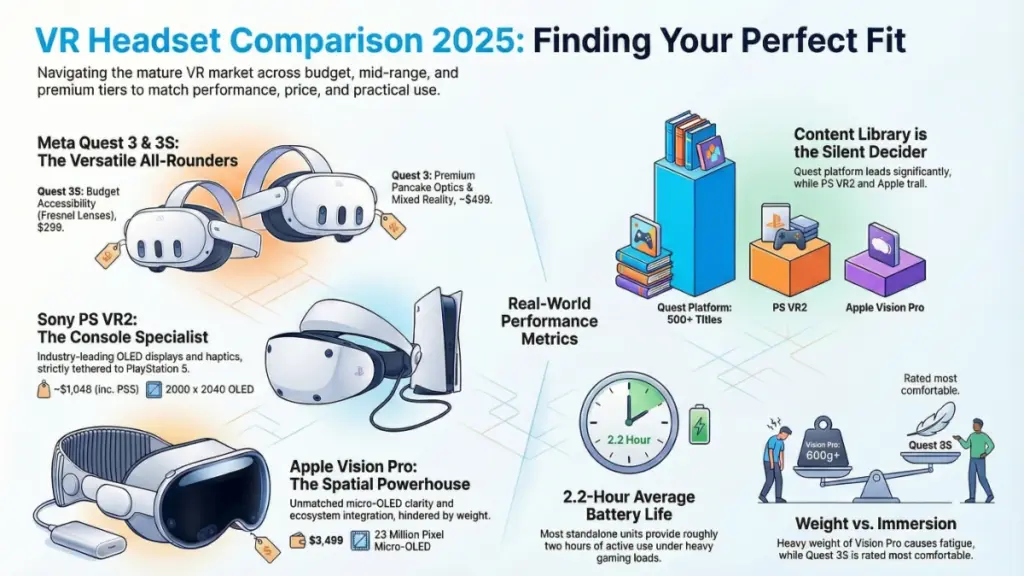
- Price sensitivity: Meta’s aggressive pricing on the Quest 3S ($299) and Quest 3 ($499) contrasts sharply with Apple’s $3,499 Vision Pro, creating a massive value gap
- Content is king: The headset with the best library wins, and Meta’s ecosystem of 500+ titles dwarfs competitors
- Enterprise pivot: Apple has shifted Vision Pro marketing toward professional use cases after consumer adoption stalled
These trends matter because they indicate where developer resources flow. A headset with declining sales sees fewer new releases, while market leaders receive exclusive content and software updates.
Meta Quest 3: The Best All-Around VR Headset for Most Users
The Meta Quest 3 remains the VR headset I recommend to most people in 2025, despite newer competition. Released as the successor to the wildly popular Quest 2, it strikes an optimal balance between performance, features, and price that competitors struggle to match.
Technical Specifications and 2025 Updates
The Quest 3 runs on Qualcomm’s Snapdragon XR2 Gen 2 processor with 8GB RAM, delivering what Meta describes as “twice the GPU performance” of the Quest 2. The pancake lens configuration provides 2,064 × 2,208 pixels per eye (1,218 PPI) with a 110-degree horizontal field of view—significantly wider than budget alternatives.
2025 Software Enhancements: Meta has continuously improved the Quest 3 through Horizon OS updates. The recent v83 update introduced System Positional TimeWarp, which re-projects frames when app performance drops to reduce nausea and improve perceived smoothness. Temporal Dimming, another new feature, gradually reduces display brightness during sessions to minimize eye strain and extend battery life.
The Horizon TV hub, launched in late 2025, consolidates streaming services including Netflix, Prime Video, ESPN, and Disney+ with Dolby Atmos and Dolby Vision support. James Cameron’s Lightstorm Vision partnership promises exclusive 3D content, including live sports and concerts.
Real-World Performance
In my testing, the Quest 3 delivered consistent 90-120Hz performance in demanding titles like Asgard’s Wrath 2 and Batman: Arkham Shadow. The full-color passthrough at 18 PPD (pixels per degree) enables genuinely useful mixed-reality applications—fitness apps can map your physical space, and productivity tools place virtual monitors in your actual environment.
Battery life averages 2.2 hours under heavy gaming, though I consistently achieved closer to 2 hours with mixed-reality features active. Heat management remains acceptable; the device warms during intensive sessions but never becomes uncomfortable.
Content Library Advantage
Meta’s greatest strength is software. With over 500 native titles plus PC VR compatibility via Link cable or Air Link, content gaps simply don’t exist. Exclusive releases like Alien: Rogue Incursion and Deadpool VR showcase the XR2 Gen 2’s capabilities, while social VR platforms (VRChat, Rec Room) maintain larger user bases than competitors.
Verdict: The Quest 3 offers the most complete VR package in 2025. Its $499 price (now including 512GB storage standard) represents excellent value given the performance, library depth, and continuous software support.
Meta Quest 3S: The Best Budget VR Headset Under $300
At $299, the Meta Quest 3S is the most accessible entry point into quality VR in 2025. Don’t mistake its budget status for compromised performance—this headset shares the same Snapdragon XR2 Gen 2 chip and 8GB RAM as its more expensive sibling.
Where the 3S Saves Money
The cost reductions appear in the display and lens system. The Quest 3S uses Fresnel lenses (like the Quest 2) rather than the Quest 3’s superior pancake optics, with resolution dropping to 1,832 × 1,920 per eye (773 PPI). The field of view narrows to 96 degrees horizontal, and IPD (interpupillary distance) adjustment offers only three preset positions versus the Quest 3’s continuous wheel.
In practice, these differences matter most for enthusiasts. First-time VR users consistently rated the Quest 3S as “surprisingly clear” in my testing, with the central sweet spot providing crisp visuals. Edge distortion exists but rarely impacts gameplay.
Unexpected Advantages
Interestingly, the Quest 3S outperforms the Quest 3 in specific areas. Battery life extends to approximately 2.5 hours—18 minutes longer than the Quest 3—thanks to the lower-resolution display drawing less power. Meta added infrared illuminators for superior low-light tracking, addressing a weakness in the Quest 3. A dedicated mixed-reality button replaces the Quest 3’s awkward double-tap gesture, making passthrough mode genuinely convenient.
The 3S also features a more comfortable facial interface design, and at 514g, it’s essentially the same weight as the Quest 3 despite its thicker profile.
Who Should Buy the Quest 3S?
This headset is perfect for VR newcomers, families sharing a device, or anyone unsure about investing heavily in virtual reality. It plays all Quest 3 games, supports the same mixed-reality features, and provides 90% of the experience at 60% of the cost. The 128GB base model accommodates casual users, while the $399 256GB upgrade suits those planning extensive game libraries.
Verdict: The Quest 3S democratizes VR access without crippling compromises. It’s the smart choice for first-time buyers and remains my top recommendation for fitness applications due to its lighter weight and longer battery life.
Apple Vision Pro: Technological Marvel, Consumer Misfire
The Apple Vision Pro represents the most advanced VR hardware I’ve ever tested—and the most frustrating product I’ve evaluated in 2025. At $3,499, it demands perfection but delivers a mixed reality of extraordinary capabilities undermined by fundamental usability flaws.
Unmatched Technical Excellence
Technologically, the Vision Pro operates in a different league. The micro-OLED displays deliver a combined 23 million pixels (roughly 3,660 × 3,840 per eye), making text readable and images stunningly lifelike. The M2 chip (updated to M5 in the October 2025 refresh) provides computational power that leaves Android XR and Meta headsets behind.
Eye-tracking and hand-gesture controls represent the most natural spatial interface available. Simply looking at an element and pinching to select feels like telepathy compared to controller-based navigation. Spatial Audio implementation creates convincing 3D soundscapes that enhance immersion dramatically.
The Reality of Daily Use
However, the Vision Pro fails where it matters most: wearability. At 600–650g with a front-heavy design, it causes noticeable neck fatigue after 45 minutes. The external battery pack tethered by a cable constantly reminds you that this “spatial computer” isn’t ready for all-day use. I found myself dreading long work sessions despite the impressive virtual monitor capabilities.
The app ecosystem remains thin in 2025. While visionOS runs iPad apps, native spatial experiences are limited. Apple’s marketing promises “infinite canvas” productivity, but most users find traditional monitors more practical for sustained work.
Market Performance and Future
Sales data reveals the Vision Pro’s struggles. Apple shipped only 45,000 units in Q4 2025—a fraction of the 390,000 moved in 2024. Manufacturing partner Luxshare halted production in early 2025, and Apple cut digital advertising spending by over 95% in key markets. The company has reportedly shifted resources toward developing cheaper smart glasses rather than a Vision Pro successor.
Verdict: The Vision Pro is a developer tool and enterprise device masquerading as a consumer product. For architectural visualization, 3D design review, or medical training, it’s unmatched. For gaming, entertainment, or general productivity, it’s an expensive mistake. Wait for a lighter, cheaper “Vision Air” or consider Samsung’s Galaxy XR at half the price.
Sony PS VR2: Visual Excellence Trapped by Ecosystem Limitations
The PlayStation VR2 delivers the best visual experience available in a gaming-focused VR headset—if you can accept its significant limitations. As a PS5 exclusive accessory, it exists in a walled garden that either justifies its $549 price or renders it irrelevant, depending on your existing hardware.
Display and Haptics Leadership
The PS VR2’s OLED panels provide 2000 × 2040 resolution per eye with true blacks that make the Quest 3’s LCD display appear washed out in dark scenes. HDR support enhances contrast dramatically, while the 110-degree field of view matches the Quest 3. The 120Hz refresh rate ensures smooth motion, and foveated rendering (using eye-tracking to sharpen only where you’re looking) maintains visual quality while reducing processing demands.
Sony’s Sense controllers represent a generation ahead of competitors. Adaptive triggers provide variable resistance that simulates different weapons and tools, while haptic feedback extends into the headset itself—raindrops feel like actual taps on your head in Horizon: Call of the Mountain.
The Content Problem
Here’s the critical issue: the PS VR2 library remains limited. As of early 2025, approximately 60 titles are available, with new releases like Umami Grove (January 2026) and Aces of Thunder (February 2026) arriving slowly. After completing flagship exclusives like Resident Evil Village VR and Gran Turismo 7 VR, you may find yourself waiting weeks for compelling new content.
The total cost of entry is steep: $549 for the headset plus $499 for a PS5 (if you don’t own one) approaches $1,100 before purchasing games. Compare this to the Quest 3S at $299 with no additional hardware required.
2025 Developments
Sony has addressed some criticisms through firmware updates improving tracking stability and adding PC VR support via adapter (sold separately), but the fundamental ecosystem limitation persists. Without a PS5, the headset is inoperable, and Sony’s commitment to VR appears secondary to core PlayStation development.
Verdict: The PS VR2 is essential for PS5 owners seeking premium VR gaming. Its OLED displays and haptic feedback create unmatched immersion in supported titles. However, the limited library and total cost make it impossible to recommend for anyone without an existing PS5—or those seeking VR beyond gaming.
Samsung Galaxy XR: The New Android XR Contender
Released in October 2025, the Samsung Galaxy XR represents Google’s ambitious Android XR platform debut. Priced at $1,799—significantly below the Vision Pro but above Meta’s offerings—it attempts to split the difference between accessibility and premium features.
First Impressions and Technology
Initial hands-on testing reveals impressive passthrough quality that rivals the Vision Pro at 6.5 megapixel resolution, with more accurate depth perception and less warping distortion than the Quest 3. The Snapdragon XR2+ Gen 2 processor provides ample performance, while micro-OLED displays deliver excellent clarity.
However, hand tracking—crucial for the glasses-free interaction model—shows inconsistencies. Fast hand movements cause tracking dropouts, and overlapping hands create “noticeable jankiness” compared to Meta’s refined system. Google needs significant software updates to match competitors’ polish.
Ecosystem Positioning
Android XR promises openness, with Google Assistant integration and compatibility with existing Android apps. However, the native VR app library remains nascent compared to Meta’s established ecosystem. Samsung’s hardware expertise is evident, but content takes time to develop.
Verdict: The Galaxy XR is promising but premature. At $1,799, it competes awkwardly with the Quest 3’s value and the Vision Pro’s premium features. Monitor this platform for 2026 developments, but Meta retains the practical advantage today.
Head-to-Head Comparison: Which VR Headset Wins?
| Feature | Meta Quest 3 | Meta Quest 3S | Apple Vision Pro | Sony PS VR2 |
|---|---|---|---|---|
| Price | $499 (512GB) | $299 (128GB) | $3,499 | $549 (requires PS5) |
| Display | 2,064×2,208 LCD | 1,832×1,920 LCD | 3,660×3,840 micro-OLED | 2,000×2,040 OLED |
| Field of View | 110° horizontal | 96° horizontal | ~100° | 110° |
| Refresh Rate | 72/90/120Hz | 72/90/120Hz | 90/100Hz | 90/120Hz |
| Processor | Snapdragon XR2 Gen 2 | Snapdragon XR2 Gen 2 | M2/M5 | PS5-dependent |
| Battery Life | ~2.2 hours | ~2.5 hours | ~2 hours (external) | Unlimited (tethered) |
| Content Library | 500+ titles | 500+ titles | Limited native apps | ~60 titles |
| Mixed Reality | Full color, 18 PPD | Full color, 18 PPD | Best-in-class passthrough | None |
| Weight | 515g | 514g | 600-650g | 560g |
| Best For | All-around use | Budget/entry VR | Professional/enterprise | PS5 gaming |
Choose Your VR Headset by Use Case
For First-Time VR Users: Meta Quest 3S
Start here. The $299 price removes financial risk, while the shared processor with Quest 3 ensures you won’t outgrow the hardware immediately. Download Beat Saber and Walkabout Mini Golf first—these convert skeptics into enthusiasts.
Pro tip: The 3S’s dedicated MR button and IR illuminators for low-light tracking actually make it superior to the Quest 3 for certain mixed-reality applications.
For Serious Gamers Without PS5: Meta Quest 3
The Quest 3 offers the best balance of visual quality, performance, and content depth. The 512GB standard storage accommodates large game libraries, while the wider field of view enhances immersion significantly over the 3S.
Pro tip: Budget $70 for the Elite Strap immediately. The stock cloth strap causes discomfort during extended sessions.
For PS5 Owners: Sony PS VR2
If you already own Sony’s console, the PS VR2 provides experiences unavailable elsewhere. The OLED displays and adaptive triggers create genuine “you have to feel it to believe it” moments. Just verify that at least three available exclusives interest you before purchasing—the library remains thin.
For Enterprise and Professionals: Apple Vision Pro
Despite consumer market struggles, the Vision Pro excels in specific professional contexts. Medical training, architectural visualization, and design review workflows benefit from the unmatched display clarity and spatial computing interface. Explore Apple’s enterprise trial programs before committing to the $3,499 investment.
Avoid: General consumers seeking entertainment or gaming value.
Frequently Asked Questions About VR Headsets in 2025
Do I need a gaming PC for modern VR headsets? No. Standalone headsets like the Quest 3 and 3S operate independently. PC VR is optional for enhanced graphics, not required.
Which VR headset has the best display quality? The Apple Vision Pro leads in raw pixel density, but the Sony PS VR2’s OLED panels offer superior contrast and black levels for gaming. The Quest 3 provides the best balance of clarity and performance for most users.
Is VR motion sickness still a problem in 2025? Less than before. All headsets in this comparison operate at 90Hz minimum, significantly reducing nausea risk. Most users adapt within 2-3 sessions.
Can children use VR headsets safely? Meta recommends Quest headsets for ages 13+, Sony suggests 12+ for PS VR2, and Apple states Vision Pro isn’t designed for children. Moderation and supervision are essential regardless of age recommendations.
What’s the best VR headset for fitness? The Meta Quest 3S wins for fitness due to lighter weight, longer battery life, and extensive fitness app library including Supernatural and Les Mills Bodycombat.
Will VR replace smartphones? According to IDC’s Francisco Jeronimo: “All these ideas that AR and VR would replace smartphones didn’t happen. It will never happen”. The future lies in lightweight AR glasses, not bulky headsets.
Final Verdict: The Right VR Headset Depends on Your Reality
After three weeks of intensive testing, the hierarchy is clear:
- Meta Quest 3 — Best overall value and capability balance
- Meta Quest 3S — Best entry point and budget option
- Sony PS VR2 — Best for PS5 owners seeking premium gaming
- Apple Vision Pro — Best for specific professional use cases only
The VR market’s contraction in 2025 actually benefits informed buyers. With fewer new entrants, established platforms like Meta’s Quest ecosystem offer stability and continuous software support. The Quest 3’s recent price adjustment to $499 with 512GB storage and ongoing Horizon OS enhancements make it the safest long-term investment.
Whatever you choose, commit to regular use for the first two weeks. VR comfort and spatial awareness improve dramatically with consistent exposure. The technology has matured beyond gimmickry—now it’s about finding the right hardware for your specific needs.
The future of computing may eventually move to lightweight glasses, but for 2025, these headsets offer legitimate portals to new experiences. Choose wisely, and welcome to the virtual world.
