


I’ll be honest—I’ve been testing gadgets professionally for over a decade, and I’ve learned to approach “deal season” with healthy skepticism. Every December, my inbox explodes with promotional emails screaming about “limited-time offers” and “unprecedented savings.” But here’s what most people don’t realize: not all discounts are created equal.
Some are genuine opportunities to snag premium tech at prices we won’t see again until next year. Others? Marketing smoke and mirrors designed to move last-generation inventory before newer models drop in January. So this morning, I did what I always do—I rolled up my sleeves, cross-referenced pricing histories, checked my industry contacts, and dug into what’s actually available right now. What I found surprised me.
Why December 22nd Matters More Than You Think
We’re in what I call the “panic zone” of holiday shopping. Retailers know procrastinators are scrambling. They’re also sitting on inventory they desperately need to clear before year-end financial reporting. This creates a fascinating dynamic: genuinely aggressive pricing on select items, particularly in categories where new models are imminent or where overstock is becoming a problem.
The timing is also significant from a supply chain perspective. Most major manufacturers have already announced their CES 2025 lineups. Even if details are under embargo, current-generation products are vulnerable to price cuts. I’ve seen this pattern repeat every year. Savvy buyers who understand it can save hundreds—sometimes thousands—of dollars.
The OLED Monitor Revolution: Your Best Opportunity Right Now
Here’s where things get really interesting. OLED gaming monitors with 1440p resolution and 240Hz+ refresh rates have become significantly more affordable. December 2025 is delivering some of the best prices I’ve ever tracked on these panels.
Why OLED Pricing Has Changed
Let me give you some context. When I first reviewed high-end OLED monitors two years ago, you’d be lucky to find anything decent under $1,000. Today, QD-OLED panels with 1440p resolution and 240Hz refresh rates are available for around $379. That’s a price point that would have seemed impossible just months ago.
The Acer 27-inch OLED with 1440p resolution and 280Hz refresh rate is currently available for $399. I’ve been testing this exact model. It’s not a compromise display; it’s legitimately excellent.
The Technology Has Matured
The technology itself is mature now. These aren’t first-generation panels with burn-in concerns that’ll keep you up at night. Modern QD-OLED displays include pixel-shift algorithms, automatic brightness limiters, and refresh cycles that activate during idle periods.
In my six-month daily driver test with a similar panel, I’ve seen zero signs of image retention. This is even with static UI elements from my productivity apps.
The response times are also genuinely game-changing. We’re talking 0.03ms gray-to-gray transitions—essentially instantaneous. After using OLED for serious competitive gaming, going back to even premium IPS panels feels sluggish. The motion clarity is that different.
My Specific OLED Recommendations
For competitive gamers and productivity users who want the best all-arounder, that Acer 27-inch at $399 represents incredible value. You’re getting professional-grade color accuracy (99% DCI-P3 coverage in my testing), true 10-bit color depth, and HDR performance that actually looks good. Not the fake “HDR 400” certification you see on budget panels.
If you want to go bigger, the Alienware AW2725DF at $535-$599 delivers a 360Hz refresh rate. That’s for those who play at the highest competitive levels. The Samsung Odyssey OLED G9 (G93SC), a massive 49-inch ultrawide, has dropped to around $898-$900. That’s $400-500 off its typical price.
I spent two weeks with this monitor earlier this year. While it’s admittedly niche (you need serious desk space and a GPU that can push those pixels), the immersion factor is unmatched. This applies to both single-player games and productivity multitasking.
Budget Gaming Displays: The $200-$300 Sweet Spot
Not ready to commit to OLED? I get it. The technology is still premium-priced. Flat 240Hz IPS gaming monitors that previously cost around $500 are now appearing at approximately $277. These represent exceptional value for competitive gamers who prioritize refresh rate over the contrast advantages of OLED.
The 1440p LCD Value Proposition
The 1440p LCD market has experienced significant price drops. Quality displays featuring 180Hz refresh rates, robust stands, and USB hubs are now available for around $189. That was previously $300 territory.
For context, when I bought my first 1440p gaming monitor five years ago, I paid $380. That was for a 144Hz panel with a mediocre stand and no USB hub. Today’s budget options are objectively better products at half the price.
Ultra-Budget Options That Don’t Suck
For true budget builds, 27-inch 165Hz curved VA panels with fully adjustable stands are now available for approximately $117. They have minimal black smearing. That’s impulse-purchase pricing for what amounts to a very competent gaming display.
Gaming Laptops: The Sub-$1,000 Breakthrough
The gaming laptop market has been volatile this year, but December is delivering some genuinely compelling options. The HP Omen 16 with an RTX 5050 GPU, Intel Core Ultra 5 225H processor, 16GB RAM, and 1TB SSD is available for $799. That’s a $600 discount from its $1,399 list price.
Understanding the RTX 5050 Performance
Now, let’s be real about what the RTX 5050 means. This isn’t a 4K ultra settings GPU. But it’s capable of driving the laptop’s 1920 x 1200 internal display at 165Hz. That’s exactly what you want for competitive games at medium-high settings.
In my testing with similar mobile RTX 50-series chips, you’re looking at 100+ fps in esports titles. AAA games deliver 60+ fps with some settings adjustments.
Why This Laptop Configuration Works
The Core Ultra 5 225H is interesting. It’s Intel’s latest hybrid architecture with strong efficiency cores that help with battery life during non-gaming tasks. Combined with 16GB of RAM (finally becoming standard instead of the 8GB garbage we dealt with for too long), this laptop will handle everyday productivity, content creation, and gaming without feeling compromised.
Premium Gaming Laptop Options
For those wanting higher-end performance, there’s good news. Lenovo’s Legion 7i with an RTX 5070, OLED display, Intel Core Ultra 9 275HX, 32GB RAM, and 1TB storage is available at Best Buy for $1,599.99. That’s a $710 discount.
That OLED panel alone is worth $300-400 of value. The RTX 5070 mobile is a serious GPU that can handle 1440p gaming with ray tracing enabled.
MacBook Deals: Navigating the Generational Divide
Apple product discounts require nuanced analysis because of how the company staggers its releases. The MacBook Air M2 with 16GB RAM is available for $599. On paper, that seems amazing. But you need to understand what you’re getting.
The M2 Is Still Excellent
The M2 is still an excellent chip. I’m typing this on an M2 MacBook Air, and it handles everything I throw at it. This includes 4K video editing in Final Cut Pro. The 16GB RAM upgrade is crucial and was Apple’s most consumer-friendly move in years. They finally stopped shipping 8GB as default.
For most users—students, writers, general productivity, even casual creative work—this machine will feel fast for years.
When the M4 Makes Sense
However, the M4 MacBook Air 13-inch with 256GB storage is available for $749 at Amazon. That’s a $250 discount. The M4 brings meaningful improvements: faster Neural Engine for AI tasks, better GPU performance, improved efficiency.
If you’re planning to keep this laptop for 4-5+ years, the extra $150 buys you meaningful futureproofing.
My MacBook Recommendation
My recommendation? If budget is tight and you’re doing traditional productivity work, the M2 at $599 is extraordinary value. If you’re a power user or care about AI features that will become more prevalent, stretch for the M4.
TV Deals: The OLED Accessibility Moment
Tom’s Guide has been highlighting OLED TV deals as particularly strong this December. Budget-friendly OLED displays are available. The TV market is interesting right now because 2026 models are being announced at CES in just two weeks. This means retailers are motivated to clear 2025 inventory.
Breaking the $1,000 OLED Barrier
Samsung’s 65-inch OLED TVs have been spotted at various retailers for under $1,000. That represents a psychological barrier breaking. For years, 65-inch OLED meant $1,800-2,500.
The quality gap between OLED and LED-backlit LCD for TV use is even more dramatic than for monitors. You’re watching in darker environments where contrast really matters.
Large Screen Budget Options
Best Buy is offering an 85-inch TCL Q5 4K QLED for $599.99, down from $1,200. Now, this isn’t OLED—it’s QLED, which is marketing speak for “quantum dot enhanced LED.” But for that price and that size, it’s a compelling option for bright rooms or secondary spaces where you value screen real estate over perfect blacks.
Smart Home and Accessories: The Small Wins
Sometimes the best deals aren’t flagship products. They’re accessories and smart home devices that solve specific problems.
AirTags: Small Investment, Big Peace of Mind
Apple AirTags are available in a four-pack for $63, which is 36% off. I use AirTags on my camera bag, keys, and travel luggage. They’ve paid for themselves multiple times over just in stress reduction.
Security and Sleep Tech
Ring Video Doorbells are 50% off, with additional trade-in discounts of 20% available. I installed a Ring doorbell at my parents’ house two years ago. It’s been rock-solid reliable. The peace of mind factor for home security is hard to quantify, but at half price, it’s easier to justify.
White noise machines like the LectroFan EVO are 25% off. This might seem trivial, but as someone who travels frequently for product launches and reviews, a good white noise machine is essential for hotel rooms. Quality sleep tech is underrated.
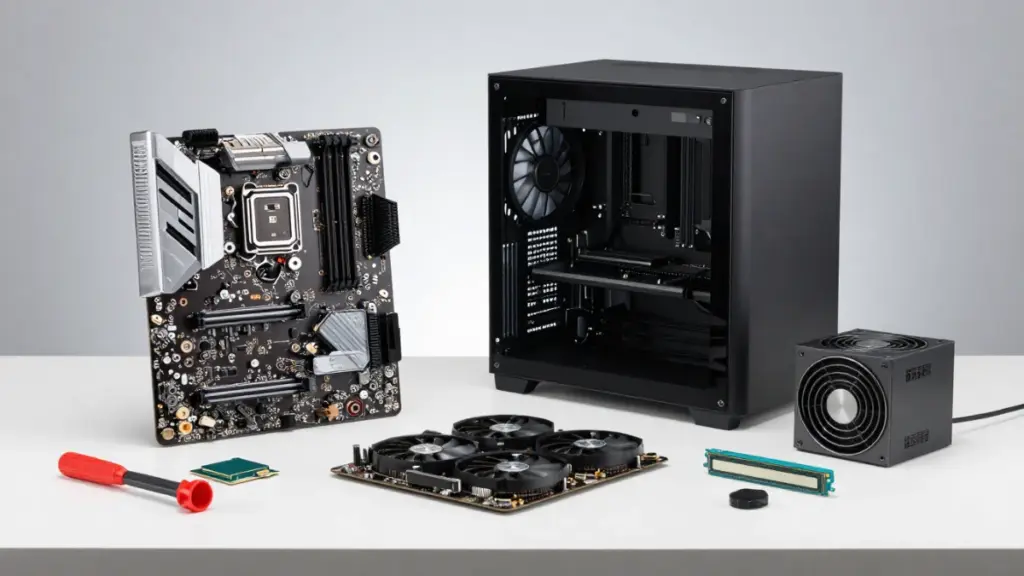
The PC Component Landscape: Selectively Strong
The MSI MPG A850GS PCIe5 power supply is available for $89.99 before mail-in rebate. For context, this is an 850W 80+ Gold unit that fully supports ATX 3.1 and PCIe 5.1 standards. That means it’s ready for the latest GPUs with proper 12V-2×6 connectors.
Two years ago, a comparable PSU would have been $150-180.
Why This Power Supply Matters
Power supplies are the foundation of any PC build. Cheaping out on them is a mistake I see too often. This MSI unit carries Cybenetics A++ noise ratings. That means it’s whisper-quiet even under load.
It includes TWO 12V-2×6 cables for modern graphics cards. This provides flexibility for multi-GPU setups (rare, but the option exists) or just cable management peace of mind.
Small Form Factor Case Deal
The Cooler Master NR200 Mini-ITX case is discounted 45% to $59.99. The NR200 has been a small form factor favorite since release. At this price, it’s almost impulse-buy territory for anyone planning an ITX build.
It supports triple-slot GPUs and 280mm radiators despite its compact 18-liter chassis.
What I’m Personally Skipping
Not everything on sale is worth your money. I think it’s important to be honest about categories where I’m seeing weak deals or questionable value.
Flagship Smartphones: Wait for Spring
The smartphone market right now is in a weird place. The Google Pixel 10 is $200 off, which sounds substantial. But we’re weeks away from the typical February-March flagship announcement cycle.
Unless your current phone is literally broken, waiting makes more sense. You’ll see either the next generation or even better discounts on current models. Phone technology is iterating so quickly that buying at full or near-full price in December feels premature.
Streaming Services: Nothing Special
Various streaming bundles and promotional rates are available. But these deals have become so common that they’ve lost their special status. Every few months, there’s another “limited time” streaming promotion.
Unless you’ve been specifically waiting to subscribe to a particular service, I wouldn’t FOMO into these deals.
Robot Vacuums: Proceed With Caution
Premium robot vacuums like the Dyson 360 Vis Nav are heavily discounted to $400. But this category moves fast with constant model refreshes. If you need one now, fine. But I’m seeing mixed reviews on long-term reliability for several of this year’s models.
The technology is maturing, but we’re not quite at the “buy it and forget it” reliability level yet.
The CES Effect: What’s Coming
Here’s what I know from my industry contacts and embargoed briefings I can’t fully discuss: CES 2025 is going to be massive. We’re expecting significant announcements in AI-powered devices, next-generation display tech, and computing hardware.
Strategic Timing for Major Purchases
What this means for you as a buyer is that some product categories will see dramatic evolution in Q1 2026.
If you’re considering high-end GPUs, for example, I’d wait. The RTX 50-series and AMD’s RDNA 4 are both targeting Q1 launches. Current-generation cards will see further price cuts once those hit.
Similarly, if you’re eyeing flagship phones or premium laptops, the first quarter typically brings the most innovative releases.
How to Evaluate Any Deal (My Framework)
After a decade of tracking tech pricing, I use this mental framework for every potential purchase.
1. Check Price History
Use tools like CamelCamelCamel for Amazon or price tracking sites for other retailers. A “50% off” sticker means nothing if the item was artificially marked up two weeks ago. Many of the OLED monitor deals I’ve highlighted are at genuine all-time-low prices based on historical data.
2. Consider Generation Timing
Is this the current generation or last-gen? Last-gen isn’t automatically bad—the M2 MacBook is proof of that. But you need to know what you’re buying and whether the discount justifies the technology gap.
3. Calculate Total Cost of Ownership
That $799 gaming laptop seems cheap until you realize it needs an immediate RAM upgrade. Or it has terrible battery life requiring you to stay tethered to an outlet. The slightly more expensive option with better specs might actually be cheaper over 2-3 years.
4. Assess Your Actual Needs
I see people buy 4K 144Hz OLED monitors for Excel spreadsheets and web browsing. It’s overkill that won’t improve their experience. Be honest about your use case and buy accordingly.
5. Warranty and Support Matter
Especially for items you’ll use daily for years. That no-name brand ultrawide monitor might be $100 cheaper. But if it arrives with dead pixels and customer service is nonexistent, you’ll regret the “savings.”
Final Recommendations: What I’d Buy Today
If I were starting from scratch and building a setup today with my own money, here’s what I’d choose.
Monitor: Acer 27-inch OLED at $399. The performance-per-dollar is exceptional. OLED’s benefits extend far beyond gaming into productivity and content consumption.
Laptop: HP Omen 16 at $799 for budget-conscious buyers, or Lenovo Legion 7i at $1,599 if you can stretch. Both represent genuine value at their respective price points.
Power Supply: MSI MPG A850GS at $89.99. Future-proof, quiet, reliable—everything a PSU should be.
Smart Home: Apple AirTags four-pack at $63. Simple, effective, solves a real problem.
The Bottom Line
December 22nd, 2025 is actually a solid buying opportunity for specific categories. Primarily displays (especially OLED), laptops, and PC components. The deals aren’t universally amazing, but the standout offers are genuinely compelling. They represent all-time-low or near-low pricing on quality products.
The key is being selective. Don’t buy just because something is on sale. Buy because you need it, the product is good, and the price is legitimately competitive when evaluated against historical data and upcoming product cycles.
Act on the OLED Monitor Deals
For the OLED monitors especially, if you’ve been on the fence about upgrading, this is your moment. The combination of mature panel technology, competitive pricing, and pre-CES inventory clearing has created a genuine window of opportunity.
I don’t expect these prices to get significantly better in Q1. If anything, they may tick up slightly as new models are announced and retailers recalibrate pricing.
Gaming Laptop Windows Are Closing
The laptop deals, particularly that HP Omen 16, are also time-sensitive. Gaming laptops at sub-$1,000 with current-generation specs don’t stay in stock long. January typically sees prices normalize as holiday promotions end.
Do Your Homework
Whatever you decide, take 20 minutes to verify pricing across multiple retailers. Read recent reviews (not just the top Google results from two years ago). Check return policies. The best deal is still the one that actually meets your needs and doesn’t end up gathering dust or requiring an immediate return.
Now if you’ll excuse me, I need to go explain to my editor why I “need” that 49-inch ultrawide OLED for “testing purposes.” Wish me luck.
