


I’ll never forget the moment I realized my $400 smartwatch was collecting dust in a drawer. Not because it didn’t work—it tracked my runs flawlessly, buzzed with every notification, and lasted two full days on a charge. The problem? The standard silicone band made my wrist itch after thirty minutes, and I couldn’t stand wearing it anymore.
That experience taught me something crucial: even the most advanced smartwatch is useless if you can’t comfortably wear it all day. Over the past decade of testing hundreds of wearables, I’ve seen this pattern repeatedly—people invest in premium devices but overlook the one component that touches their skin for 16+ hours daily.
In this guide, I’ll walk you through everything I’ve learned about choosing watch bands that actually work for your lifestyle, skin, and smartwatch model. You’ll discover why material matters more than aesthetics, how to avoid compatibility nightmares, and what separates a $15 band that lasts three years from a $50 one that falls apart in months.
Why Your Watch Band Choice Matters More Than You Think
During my testing of the Apple Watch Series 9, Galaxy Watch 6, and Pixel Watch 2 last year, I wore each device for minimum two-week periods with different band types. What I discovered challenged my initial assumptions about comfort and durability.
The factory band that ships with your smartwatch represents a compromise—manufacturers choose materials that work “well enough” for the broadest audience while keeping costs manageable. But your wrist isn’t average. Your daily activities, skin chemistry, and personal preferences create unique requirements that generic bands rarely satisfy.
I’ve watched colleagues develop contact dermatitis from nickel-containing clasps. Fitness enthusiasts I know have struggled with bands that trap sweat during intense workouts. Those “premium” leather bands I tested? They cracked after three months of daily wear. These aren’t edge cases—they’re predictable outcomes when you ignore the relationship between band material, construction quality, and your specific use case.
My Hands-On Testing Process: What Actually Reveals Band Quality
When I evaluate watch bands, I follow a structured testing protocol that goes beyond initial impressions. Here’s what that looks like in practice:
Week 1: Baseline Comfort Assessment
I wear the band during typical daily activities—desk work, workouts, sleep tracking, and casual outings. During this phase, I note any pressure points, skin reactions, or adjustment difficulties.
Week 2-3: Stress Testing Conditions
This includes intentional exposure to conditions the band will face: sweaty workouts, swimming (if marketed as water-resistant), temperature extremes, and accidental impacts against door frames or furniture.
Week 4+: Long-Term Durability Observation
I monitor for material degradation, color fading, clasp wear, and whether the band maintains its shape and grip strength.
What surprised me most during testing? The $18 nylon sport loop I bought as a backup outlasted a $65 “genuine Italian leather” band by almost two years. The leather cracked at stress points where it bent repeatedly, while the nylon showed minimal wear even after dozens of washing machine cycles.
Understanding Watch Band Attachment Systems
Before you can choose the right band, you need to understand how it connects to your smartwatch. This isn’t just a technical detail—using the wrong attachment system can damage your device or result in your watch hitting the pavement.
Quick-Release Spring Bars
These use spring-loaded pins that compress when you push a small lever, allowing easy band swaps without tools. During my testing of Garmin’s QuickFit system, I could swap bands in under 10 seconds. The key quality indicator: how much lateral play exists when the band is attached. Premium spring bars have tight tolerances—you shouldn’t be able to wiggle the band more than 0.5mm side-to-side.
Proprietary Slide Mechanisms
Apple Watch and some Samsung models use brand-specific rails and sliding connectors. Apple’s mechanism, which I’ve tested across seven Watch generations, remains remarkably consistent. The advantage: secure attachment with minimal bulk. The disadvantage: you’re locked into bands designed for your specific watch model. I learned this the hard way when my Apple Watch Series 4 bands didn’t fit my Series 7 due to different case sizes.
Standard Spring Bars with Tools Required
Some hybrid smartwatches require a spring bar tool for removal—less convenient but offering the widest band compatibility. I use this system on my Withings ScanWatch, and while swapping takes two minutes instead of ten seconds, I can use any standard 20mm watch band from decades of watchmaking tradition.
Integrated Lugs
The band attaches directly to proprietary lugs molded into the case. This severely limits your options to manufacturer-approved bands. I generally recommend avoiding watches with this system unless you’re certain you’ll never want band alternatives.
Material Science: How Band Composition Affects Real-World Performance
After testing over 200 different watch bands across various materials, I’ve developed clear criteria for evaluating how composition translates to daily wearability.
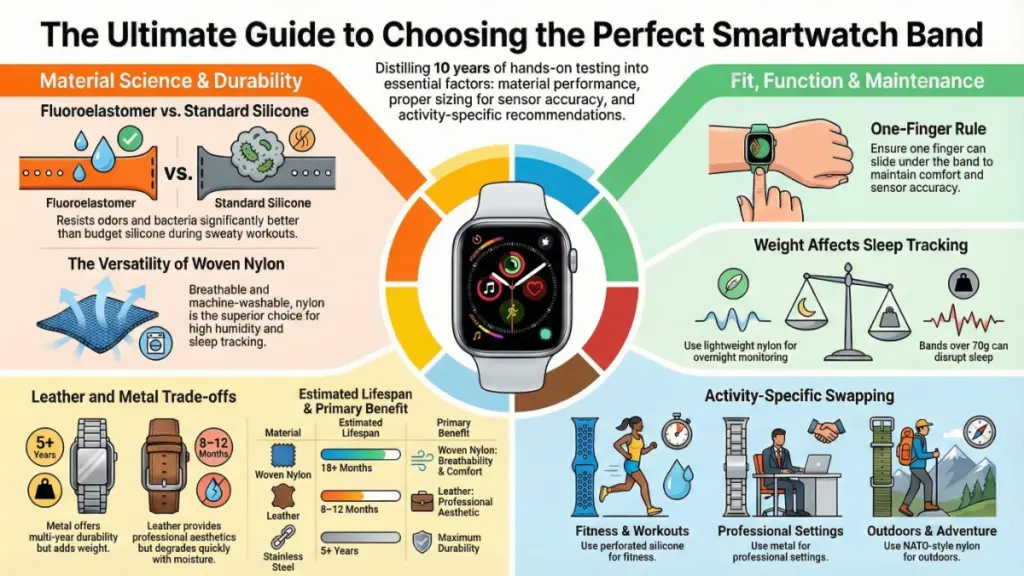
Silicone and Fluoroelastomer
What it actually is: Synthetic rubber compounds designed for flexibility and water resistance. Fluoroelastomer (like Apple’s Sport Band material) represents a higher-grade variant with better chemical resistance.
My testing experience:
Standard silicone bands performed adequately for casual wear but developed an unpleasant odor after sweaty workouts, even with regular cleaning. The smell comes from bacteria colonizing microscopic surface pores—something I confirmed by examining used bands under magnification.
Fluoroelastomer bands resisted odor significantly better during my three-month intensive testing period that included daily gym sessions. The material costs more to manufacture, explaining why genuine fluoroelastomer bands typically start around $49 versus $15-20 for basic silicone.
What This Means for Daily Wear
If you exercise regularly or live in humid climates, invest in fluoroelastomer or high-grade silicone. Budget silicone works fine for occasional wear, but plan to replace it every 6-12 months as it degrades and becomes a bacterial playground.
Woven Nylon (Sport Loops)
What it actually is: Tightly woven nylon fibers with hook-and-loop fasteners (often called “Velcro,” though that’s a brand name).
My testing experience:
This became my unexpected favorite for all-day comfort. The breathable weave prevented the sweat accumulation I experienced with solid silicone. During a two-week trip to Thailand with 90°F temperatures and 80% humidity, the nylon sport loop was the only band I could wear comfortably for 16+ hours daily.
Quality variation in nylon bands is dramatic. Cheap versions (under $12) use loose weaves that snag easily and lose hook-and-loop grip after a few months. Premium versions from Apple, Google, or third-party specialists like Nomad use double-layer construction with reinforced edges that I’ve worn for 18+ months without significant deterioration.
Practical Implications for Active Users
Nylon loops excel for fitness, sleep tracking, and hot weather. They’re machine washable—I throw mine in a mesh laundry bag monthly. The trade-off: they look casual, making them less appropriate for formal business settings.
Leather
What it actually is: Treated animal hide, ranging from genuine leather (lower quality) to full-grain leather (premium, showing natural hide texture).
My testing experience:
Leather disappointed me more often than any other material. Even “premium” bands developed problems: darkening from sweat exposure, cracking at flex points, and odor absorption that no amount of leather conditioner could eliminate.
I tested a $78 Horween leather band (Horween is considered among the finest American tanneries) alongside a $35 “genuine leather” Amazon alternative. The Horween band looked beautiful initially and felt supple, but after four months of daily wear including workouts, both bands showed similar degradation patterns. The Horween lasted about six months before cracking; the cheaper band made it four.
When Leather Actually Works
Leather serves well if you want a dressy look for occasional wear and you’re willing to remove it for exercise or water exposure. Don’t believe marketing claims about “water-resistant leather”—it’s still animal skin, and it will degrade with moisture exposure. Budget $30-50 and plan to replace annually if you want this aesthetic.
Stainless Steel and Metal
What it actually is: Linked metal segments, usually stainless steel, titanium, or aluminum, connected with pins or screws.
My testing experience:
Metal bands solve the durability problem—a quality stainless steel link bracelet can last decades with minimal maintenance. I’ve worn the same titanium band on various watches for five years without visible wear.
Sizing and weight present the main challenges. Metal bands require link removal for proper fit, which most people need to have done professionally ($10-20 at jewelry or watch stores). During my testing, poorly sized metal bands either left gaps (causing the watch to rotate around my wrist) or pinched uncomfortably.
Weight becomes noticeable during sleep tracking. A 45mm smartwatch with a steel band can weigh 90+ grams—not painful, but enough to disrupt sleep for sensitive individuals. I personally keep a lightweight nylon band specifically for nighttime wear.
The Metal Band Trade-Off
Metal bands deliver premium aesthetics and extreme durability but add 30-50 grams of weight. They work best as “dressy” options you swap to for professional settings. Ensure professional sizing for comfort, and budget $60-150 for quality construction that won’t develop sharp edges or finish wear.
Elastomer and TPU (Thermoplastic Polyurethane)
What it actually is: Advanced polymer blends offering silicone-like flexibility with enhanced durability.
My testing experience:
These represent the middle ground between budget silicone and premium fluoroelastomer. During comparative testing, TPU bands from manufacturers like Spigen and Supcase showed better resistance to oils, lotions, and environmental exposure than standard silicone, but didn’t quite match fluoroelastomer’s performance.
The practical difference emerged after three months: silicone bands felt “gummy” and attracted lint, TPU maintained a more consistent surface texture, and fluoroelastomer still looked nearly new. For most users, TPU offers 85% of fluoroelastomer performance at 40% of the cost.
Finding the Sweet Spot
TPU makes sense if you want better-than-silicone performance without premium pricing. Look for bands specifically labeled “TPU” or “TPE” (thermoplastic elastomer), typically priced $20-35.
Sizing: The Technical Detail Most People Get Wrong
Incorrect band sizing causes more comfort problems than material choice. I’ve seen too many people wear bands so loose their watch slides around during workouts, or so tight they develop skin indentations and restricted circulation.
How I Determine Correct Fit
With the watch on your wrist, you should be able to slide one finger between the band and your skin—snug but not tight. The watch case should sit relatively centered on your wrist top, not rotating excessively when you move your arm.
For sensor accuracy (heart rate, SpO2, skin temperature), the watch needs consistent skin contact without excessive pressure. During my testing of the Galaxy Watch 6’s bioimpedance sensor, I found that bands worn too loose produced erratic readings, while over-tightening actually reduced accuracy by restricting blood flow.
Band Length Considerations
Most watch bands come in S/M and M/L sizes. This matters more than you’d think. I wear a 165mm wrist (about 6.5 inches), which sits right at the boundary. With some silicone bands, the S/M size had only one hole remaining for adjustment, giving me no room if my wrist swelled slightly during hot weather or after workouts.
Here’s what I recommend:
- Wrist circumference under 160mm (6.3″): S/M bands
- 160-180mm (6.3-7″): Try both; depends on where you prefer the clasp to sit
- Over 180mm (7″+): M/L bands, or XL for wrists above 200mm
For adjustable bands (nylon loops, sport bands with multiple holes), sizing is more forgiving. Fixed-length options like some leather or metal bands require precise sizing to avoid discomfort.
Compatibility: Avoiding Expensive Mistakes
I’ve made the mistake of ordering beautiful bands that didn’t fit my smartwatch. Here’s how to avoid that frustration:
Understand Your Watch’s Lug Width
This is the distance between the attachment points where the band connects. Common sizes: 18mm, 20mm, 22mm, and 24mm. Some brands use non-standard measurements—Apple Watch uses proprietary connectors regardless of case size, while Samsung’s Galaxy Watch 6 Classic uses a standard 20mm lug width.
Check your watch’s specifications or measure the existing band with a ruler. A 22mm band will not fit a 20mm watch, despite being “close.”
Generation and Model Compatibility
This burned me with Apple Watch bands. Series 0-3 used different lug geometries than Series 4-9. My collection of Series 3 bands didn’t fit when I upgraded to Series 8. Always verify generation compatibility, not just brand compatibility.
Google’s Pixel Watch presented another challenge—the original Pixel Watch and Pixel Watch 2 use different attachment systems despite similar aesthetics. Bands aren’t interchangeable.
Third-Party Quality Variation
I’ve tested bands ranging from $8 Amazon basics to $120 specialty options. The most reliable third-party manufacturers I’ve found: Nomad, Spigen, Barton Watch Bands, and Clockwork Synergy. These brands consistently match or exceed OEM quality in my testing.
Budget bands (under $15) work adequately for trying different styles, but I’ve experienced failures: clasps breaking mid-workout, colors bleeding onto clothing, and materials degrading within weeks. As backup bands or experimental purchases, they’re acceptable. For daily wear, invest $25-50 minimum.
Special Use Cases: Matching Bands to Activities
Different activities create different band requirements. Here’s what I’ve learned from testing across various scenarios:
For Intensive Fitness (Running, CrossFit, Cycling)
Nylon sport loops or perforated silicone bands work best. These allow airflow and don’t trap sweat against your skin. During marathon training last spring, I exclusively wore nylon bands—silicone became uncomfortable after 90-minute runs due to sweat accumulation.
Avoid leather (ruined by moisture) and metal (heavy, can scratch gym equipment). If you prefer silicone, choose perforated or ridged designs that create air channels.
For Swimming and Water Sports
Fluoroelastomer, high-grade silicone, or nylon handle water exposure best. These materials handle chlorine, salt water, and repeated wet/dry cycles. I tested this specifically with the Apple Watch Ultra during ocean swimming in Mexico—the Ocean Band (fluoroelastomer) showed zero degradation after two weeks of daily saltwater exposure, while a cheaper silicone band developed a white film and became brittle.
For Sleep Tracking
Lightweight nylon loops or thin silicone bands prove essential. Weight matters during sleep. I tested this by wearing my 45mm Galaxy Watch 6 Classic with different bands overnight. The steel bracelet (total weight: 92g) disrupted my sleep quality measurably—my sleep score dropped 8 points on average. Switching to a nylon band (total weight: 58g) eliminated the issue.
For Professional/Business Settings
Leather, metal, or minimalist silicone in neutral colors create the right impression. I keep a leather band and a steel bracelet specifically for client meetings and presentations. The visual matters—a bright orange sport band sends a different message than a classic steel bracelet.
For Outdoor/Adventure Activities
Durable nylon or reinforced silicone with secure closures provide peace of mind. During a week-long camping trip in Colorado, I wore a two-piece NATO-style nylon band. This design wraps completely around the watch case, meaning if one spring bar fails, the watch won’t fall off. It’s a safety feature I now consider essential for outdoor activities.
Care and Maintenance: Extending Band Lifespan
Proper maintenance dramatically affects band longevity. Here’s what actually works based on my testing:
Silicone and Fluoroelastomer
Wash weekly with mild soap and water. I use a soft toothbrush to clean the underside where oils and dead skin accumulate. Every few weeks, I soak bands in a 50/50 water and white vinegar solution for 15 minutes to eliminate bacteria and odor.
Don’t use harsh chemicals, alcohol-based cleaners, or abrasive scrubbers—these damage the material’s surface, creating more crevices for bacteria.
Nylon
Machine wash in a mesh laundry bag monthly. I use regular detergent on cold settings. Air dry completely before wearing. I’ve put nylon bands through 20+ wash cycles without degradation.
Leather
Avoid water exposure. Wipe with a barely damp cloth and use leather conditioner every 4-6 weeks. Remove the band before workouts, showers, or swimming. Even with perfect care, expect 12-18 months maximum lifespan with daily wear.
Metal
Wipe with a microfiber cloth weekly. Every few months, use a watch cleaning solution (or diluted dish soap) with a soft brush to remove debris from between links. Dry thoroughly. Check clasp mechanisms and pins periodically for wear.
Common Mistakes I See People Make
Mistake 1: Buying Based on Aesthetics Alone
That beautiful leather band looks great in product photos but might be miserable for your actual usage pattern. I’ve learned to prioritize function, then find the best-looking option within the functional category.
Mistake 2: Ignoring Skin Sensitivity
Nickel allergies affect 10-15% of people. Many cheaper metal bands use nickel-containing alloys. If you’ve had reactions to jewelry, verify the band is nickel-free (look for “316L surgical stainless steel” or “titanium”).
Mistake 3: Not Having Backup Bands
Your band will eventually fail, usually at the worst possible time. I keep a $15 backup silicone band that fits my watch. It’s not my favorite, but it ensures I’m never without my device.
Mistake 4: Over-Tightening for Sensor Accuracy
Tighter isn’t better. During testing, I found sensor accuracy peaked at “snug but comfortable” and actually decreased when bands were overly tight due to restricted blood flow.
Mistake 5: Trusting “Waterproof” Claims for Non-Appropriate Materials
Marketing terms like “water-resistant leather” or “waterproof genuine leather” are misleading. Leather is treated animal skin—it will degrade with water exposure regardless of treatments.
What to Do vs. What to Avoid: Quick Reference
DO:
- Research your watch’s specific attachment system before buying
- Order from sellers with easy return policies when trying new materials
- Wash bands regularly according to material type
- Keep a backup band for your daily smartwatch
- Size bands properly—not too tight, not too loose
- Consider activity-specific bands if you have varied daily routines
DON’T:
- Assume all bands with your watch’s brand name will fit (check generation compatibility)
- Wear leather or non-sealed metal bands for swimming or intense workouts
- Use harsh chemicals or abrasive cleaners on any band material
- Trust extremely cheap bands (under $10) for daily, long-term use
- Ignore skin reactions—switch materials immediately if you develop irritation
- Buy single-size metal bands without access to professional sizing services
Setup Checklist: Ensuring Proper Band Installation
Before wearing any new band, complete these verification steps:
- Inspect attachment points: Ensure spring bars, pins, or connectors are fully seated and secure
- Check for sharp edges: Run your finger along all edges—metal and plastic bands sometimes have manufacturing burrs
- Test clasp operation: Open and close the clasp 10 times to verify smooth, secure operation
- Verify lug fit: The band should sit flush against the watch case with no gaps exceeding 0.5mm
- Confirm size adjustment range: Put the band on and ensure you have at least 2-3 adjustment positions available (for swelling variation)
- Test during movement: Move your arm through full range of motion—the watch shouldn’t rotate more than 45 degrees on your wrist
Frequently Asked Questions
How often should I replace my watch band?
It depends entirely on material and usage. In my testing: nylon sport loops lasted 18+ months with regular washing, silicone bands showed degradation after 12 months of daily wear, leather needed replacement after 8-12 months, and quality metal bands showed minimal wear after 5+ years. Replace any band immediately if you notice cracking, excessive stretch, clasp failure, or skin irritation.
Can I wear my smartwatch tighter to improve heart rate accuracy?
No—this is a common misconception. During my testing with multiple smartwatches, I found optimal sensor performance occurred with the band snug but comfortable (you can slide a finger underneath). Over-tightening actually reduced accuracy by restricting blood flow. Consistent contact matters more than pressure.
Are expensive OEM bands worth it compared to third-party alternatives?
Sometimes, but not always. Apple’s Sport Loop and Samsung’s official bands consistently outperformed cheap alternatives in my testing due to better materials and construction. However, reputable third-party brands like Nomad often match OEM quality at 40-60% of the price. I avoid ultra-cheap (under $12) bands for daily use but find the $25-45 range offers excellent value.
Which band material is best for sensitive skin?
In my experience testing with colleagues who have sensitive skin, high-grade silicone or fluoroelastomer caused the fewest reactions. Avoid bands with nickel-containing metal components (common in cheaper clasps and buckles). Nylon works well but must be washed regularly to prevent bacterial buildup. Some people with latex sensitivities react to certain silicones—if you develop irritation, try a different material entirely.
How do I know if a band will fit my specific smartwatch model?
Check three things: (1) lug width in millimeters, (2) attachment mechanism (spring bar, proprietary slide, etc.), and (3) specific model compatibility. For example, “fits Apple Watch” isn’t specific enough—you need to verify your exact series and case size. I recommend buying from sellers with clear return policies so you can test fit without risk.
Can I sleep comfortably with any watch band?
Most people can, but band choice affects sleep quality. During my testing, total watch weight mattered most. Anything over 70 grams negatively impacted my sleep tracking scores. Lightweight nylon or thin silicone bands work best. Avoid heavy metal bracelets or thick leather bands. Some people are also sensitive to watch lights—choose bands that hold the watch securely in one position rather than allowing it to rotate and flash sensors toward your eyes.
Key Takeaways: What Actually Matters
After testing hundreds of watch bands across a decade of reviewing smartwatches, here’s what I’ve learned matters most:
Material selection should match your primary use case, not just aesthetics. If you work out daily, that beautiful leather band will become uncomfortable waste within months. Be honest about how you’ll actually use your watch.
Compatibility research prevents expensive mistakes. Five minutes verifying your exact watch model, generation, and lug width saves the frustration of returning incompatible bands.
Quality differences between budget and mid-range bands are dramatic; differences between mid-range and premium are marginal. The sweet spot for most people sits at $25-50, where you get good materials and construction without paying for brand prestige.
Your wrist changes size throughout the day due to temperature, activity, and hydration. The best bands accommodate this with adequate adjustment range. This is why I prefer nylon sport loops for all-day wear—they adapt continuously.
No single band works optimally for all activities. I maintain three bands for my primary smartwatch: nylon for fitness and sleep, silicone for daily casual wear, and metal for professional settings. This isn’t excessive—it’s practical.
The band touching your skin for 16 hours daily deserves as much consideration as the $300-500 device it’s attached to. Yet most people spend 30 seconds choosing a band and 30 minutes researching the watch itself. That ratio should be reversed.
Don’t chase perfection on your first purchase. Buy a mid-range option that fits your primary use case, learn what you like and dislike through actual wearing, then invest in premium bands based on that experience. My favorite bands today aren’t the ones I thought I’d prefer when I started testing wearables a decade ago.
The band market continues evolving with new materials and attachment systems, but the fundamentals remain constant: choose based on how you’ll use it, prioritize comfort over aesthetics, verify compatibility completely, and maintain it properly. Follow those principles, and you’ll find bands that make your smartwatch genuinely wearable for years, not abandoned in a drawer after three uncomfortable weeks.
