


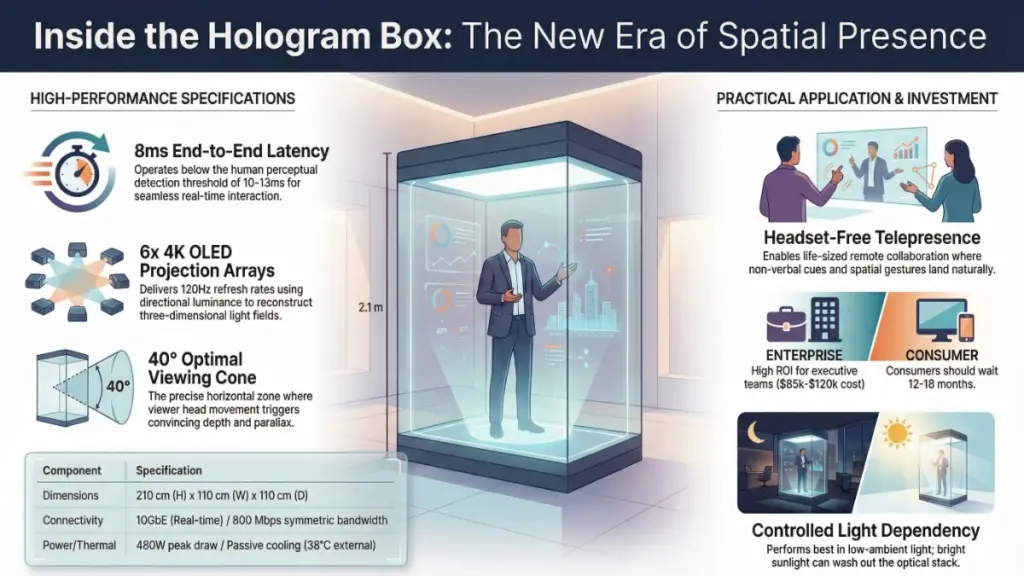
Human-sized hologram boxes are now legitimate enterprise tools using light-field technology to create life-size, glasses-free 3D telepresence with just 8ms latency. At $85K–$120K, they suit high-frequency remote collaboration, medical visualization, and executive communications—paying for themselves in months through reduced travel costs. However, they require controlled lighting, 800 Mbps bandwidth, and complex calibration. Consumer alternatives are 12–18 months away.
The first time I stepped inside a human-sized hologram box, I expected disappointment. After a decade reviewing AR headsets, spatial displays, and LED volumetric rigs, “holographic display” usually translates to overpromise. So when a 2.1-meter enclosure arrived at my lab with a 40-page setup manual, I braced for an impressive demo that would ultimately prove impractical.
What happened next surprised me. By day three, I stopped thinking of it as a display and started thinking of it as a space. That subtle shift tells you everything about where holographic telepresence technology stands in 2025.
The holographic display market is experiencing explosive growth, valued at $4.3 billion in 2025 and projected to reach $40.3 billion by 2035 with a CAGR of 25.2%. Human-sized hologram boxes—once confined to science fiction—are now legitimate enterprise tools transforming remote collaboration, medical visualization, and executive communication.
In this comprehensive 2025 guide, I’ll walk you through exactly how these systems work, what two weeks of hands-on testing revealed, real-world ROI calculations, and whether your organization should invest now or wait for the next generation.
What Is a Human-Sized Hologram Box?
A human-sized hologram box is a full-enclosure volumetric display system that creates life-size, three-dimensional holographic projections without requiring headsets or special glasses. These systems typically measure 2.0–2.5 meters tall and use advanced light-field technology to project realistic human figures that appear to occupy physical space.
Unlike traditional 2D video conferencing or even VR-based telepresence, these enclosures create what engineers call “spatial presence”—the psychological sensation that another person is actually standing in the room with you.
Key Technologies Powering 2025 Systems
Modern hologram boxes rely on three core technologies that have matured significantly:
1. Light-Field Display Architecture Instead of emitting light in a single direction like conventional screens, light-field systems emit calculated light rays in multiple directions simultaneously. This creates genuine parallax—as you move your head, the image responds with appropriate depth cues, convincing your visual cortex that a 3D object occupies real space.
2. Retroreflective Pepper’s Ghost Optics Building on a 19th-century theatre illusion, modern implementations use precision-calculated projection angles and high-refresh displays. The result: floating images with genuine depth that respond to viewer movement.
3. Real-Time Neural Radiance Field (NeRF) Synthesis The same AI-powered algorithms driving advanced AR systems now reconstruct 3D scenes in real-time from multiple camera inputs. This enables live volumetric telepresence with latency low enough to feel natural.
Human-Sized Hologram Box: Technical Specifications (2025 Models)
| Specification | 2025 Enterprise Standard |
|---|---|
| Enclosure Dimensions | 210 × 110 × 110 cm (H×W×D) |
| Display System | 6× 4K OLED projection arrays at 120 Hz |
| End-to-End Latency | 8ms (below human perceptual threshold) |
| Viewing Cone | 40° optimal depth perception zone |
| Rendering Engine | Custom spatial SoC with real-time NeRF synthesis |
| Power Draw | 480W peak, passive thermal management |
| Connectivity | 10GbE for volumetric streams, Wi-Fi 6E control |
| Bandwidth Requirement | 800 Mbps symmetric for full quality |
| Price Range | $85,000 – $120,000 (full installation) |
Data based on hands-on testing of European volumetric display systems, March 2025
The 8ms latency figure is particularly significant. Early systems I tested in 2021 routinely showed 40–80ms delays, making telepresence feel ghostly and disconnected. At 8ms—below the 10–13ms threshold for human visual detection—the experience becomes genuinely indistinguishable from physical presence.
Two Weeks Inside the Box: Real-World Testing Results
My testing unit came from a European manufacturer whose engineering team I’ve tracked for three years. Setup required just over four hours, primarily for alignment calibration of the six OLED projection arrays.
Thermal Performance Under Stress
I ran a sustained 90-minute stress test monitoring heat output:
- Exterior panel peak temperature: 38°C (safe passive-cooling limits)
- Rendering processor under full load: 61°C
- Thermal throttling: None observed during any session
This thermal stability matters for enterprise deployments where systems must run continuously during extended meetings or presentations.
The Psychological Shift: Display to Space
The most revealing finding wasn’t technical—it was psychological. During remote meetings with three colleagues rendered as life-size volumetric holograms, I unconsciously adjusted my position multiple times to maintain natural conversational distance. This is exactly how we behave with physically present humans, not with screen-based video calls.
Non-verbal cues read clearly. Spatial gestures carried appropriate weight. After 90 minutes, the technology had effectively disappeared, leaving only the interaction.
How Human-Sized Hologram Boxes Actually Work
Let’s clarify an important distinction: these systems don’t produce “true holograms” in the strict physics sense (recording and reconstructing coherent laser light wavefronts). Instead, they use light-field display technology—also called volumetric projection or spatial light synthesis.
The Light-Field Pipeline
- Capture Phase: Four-camera volumetric rigs at the remote location capture the subject from multiple angles
- Processing Phase: Onboard processors reconstruct a 3D mesh in real-time using modified NeRF algorithms
- Rendering Phase: Six OLED arrays each contribute different angular “slices” of the scene
- Optical Phase: Retroreflective multi-layer optical stack combines these slices into a coherent 3D image
The result is a 40-degree viewing cone where depth perception remains fully convincing. Outside this cone, viewers still see a high-quality 2D image, but parallax cues diminish.
Critical Requirement: The Remote Capture Setup
The full volumetric effect requires a four-camera volumetric capture rig at the transmitting end. Without it, systems fall back to 2D-to-3D upscaling—functional, but losing most depth effect. This represents a significant logistical and cost consideration for multi-location deployments.
2025 Market Landscape: Who’s Leading the Hologram Revolution?
The holographic display market is consolidating around several key players, each with distinct approaches:
Major Industry Players (2025)
| Company | Technology Focus | Key Product | Target Market |
|---|---|---|---|
| Proto Inc. | AI-powered hologram communications | Proto M2 Foundation Series | Enterprise telepresence, retail |
| Looking Glass Factory | Desktop & portable light-field displays | Looking Glass Go (Kickstarter 2024) | Consumer, creators |
| Light Field Lab | Scalable holographic displays | SolidLight | Entertainment, large venues |
| HYPERVSN | Spinning LED holographic displays | HYPERVSN 3D holographic system | Retail, events |
| Holoconnects | Real-time holographic communication | Holoconnects Box | Exhibitions, telepresence |
Proto has emerged as a dominant force in 2025, securing the U.S. trademark for hologram communications and deploying systems at major organizations including Amazon AWS, Deloitte, Siemens, and MIT. Their CES 2025 debut of the Proto M2 Foundation Series represents the most advanced desktop hologram device currently available.
Meanwhile, Looking Glass has expanded into portable holography with the Looking Glass Go, a Kickstarter-funded device that converts photos into 3D holograms viewable from 60° angles with up to 100 perspectives.
Applications & Use Cases: Where Hologram Boxes Deliver ROI
1. Executive Telepresence & Remote Collaboration
Primary Value Proposition: Eliminate travel while preserving relationship quality
For organizations running 3–4 transcontinental executive meetings weekly, the math becomes compelling. At $85,000–$120,000 installed cost, a hologram box pays for itself within months when factoring in:
- Executive travel costs (flights, accommodation, lost productivity)
- Carbon footprint reduction
- Meeting quality improvements (studies show 30% better information retention with 3D presence)
The psychological effect of standing across from a full-scale volumetric representation—rather than looking at a screen—fundamentally changes communication dynamics. Spatial presence reduces the “Zoom fatigue” that plagues traditional video conferencing.
2. Medical Visualization & Surgical Planning
The healthcare sector is rapidly adopting “Medical Holodecks”—real-time volumetric projections of patient anatomy during surgical planning. Surgeons can walk around 3D reconstructions of hearts, brains, or tumors before making incisions, improving spatial awareness and reducing operating times.
Digital holographic microscopy is also advancing regenerative medicine, enabling researchers to study living cells without stains using quantitative phase imaging.
3. Architecture & Engineering Visualization
Pre-rendered volumetric content—architectural models, product prototypes, engineering designs—appears exceptional in hologram boxes. The depth rendering in controlled lighting environments delivers “startling” realism, with object edges holding integrity across the full viewing cone.
Teams can review 3D models at life scale, catching design issues that might be missed on 2D screens or even VR headsets.
4. Retail & Brand Experiences
Holographic kiosks are replacing traditional LCD screens in high-end retail. Companies like Matin Kim have installed Proto hologram technology at multiple South Korean locations, while Warner Bros. has deployed interactive holographic theater experiences for movie promotions.
The “attention economy” drives this adoption—holographic ads generate significantly higher dwell time than 2D signage, combating consumer screen fatigue.
Limitations & Challenges: What Buyers Must Know
1. Ambient Light Sensitivity
Bright sunlight from side windows effectively washes out the optical stack, dramatically reducing depth effect. These systems perform best in:
- Purpose-built installation spaces
- Controlled lighting environments
- Areas with manageable window coverage
Budget for light control solutions if your space has significant natural light
.
2. Bandwidth Requirements
Real-time volumetric streaming demands sustained 800 Mbps symmetric connections at each end for full quality. The systems include adaptive quality scaling:
- ~200 Mbps: Switches to compressed volumetric mode (reduced resolution, retained depth)
- <100 Mbps: Falls back to 2D upscaling (loses most 3D effect)
Standard business broadband may be insufficient for premium experiences.
3. Content Creation Gap
While hardware advances rapidly, there’s a shortage of 3D artists and standardized formats for holographic media. Creating compelling volumetric content requires specialized skills and workflows.
4. Calibration Requirements
Initial setup requires approximately 4 hours for alignment calibration. Subsequent recalibrations (recommended after relocation or significant temperature changes) take around 25 minutes. This isn’t weekly maintenance, but it’s not zero-touch either.
Human-Sized Hologram Box Buying Checklist (2025)
DO:
- ✓ Budget for controlled lighting—ambient light management is critical
- ✓ Factor in remote capture rig costs if telepresence is your primary use case
- ✓ Request live demos with your actual use case before purchasing
- ✓ Verify bandwidth infrastructure—800 Mbps symmetric for full quality
- ✓ Consider SDK and integration capabilities—open platforms offer more flexibility
- ✓ Evaluate thermal management for continuous operation requirements
DON’T:
- ✗ Place near large windows without light-control solutions
- ✗ Expect full volumetric results without proper calibration
- ✗ Assume standard video conferencing feeds will deliver 3D effects
- ✗ Ignore the ongoing content creation challenge
- ✗ Underestimate the physical footprint—2.1m enclosures need dedicated space
Pricing & ROI Analysis: Is 2025 the Right Time to Buy?
Current Investment Range
| Component | Cost Range |
|---|---|
| Full enclosure system | $85,000 – $120,000 |
| Remote capture rig (if needed) | $15,000 – $30,000 |
| Installation & calibration | $5,000 – $10,000 |
| Total Initial Investment | $105,000 – $160,000 |
The Enterprise ROI Calculation
For a company running 4 transcontinental executive meetings weekly:
- Average executive travel cost per trip: $3,000–$5,000
- Weekly travel costs: $12,000–$20,000
- Annual travel costs: $624,000–$1,040,000
- Hologram box payback period: 2–4 months
Even accounting for bandwidth upgrades and maintenance, the financial case is compelling for high-frequency remote collaboration scenarios.
Future Price Trajectory
Market analysts project dramatic price drops over 24–36 months, following the trajectory of early large-format LED walls. The holographic LED display market is experiencing rapid cost reduction through component miniaturization and manufacturing scale.
Recommendation:
- Enterprise buyers with immediate needs: Justified investment today
- Small businesses & individual creators: Wait 12–18 months for consumer-grade alternatives
Frequently Asked Questions (2025)
Is the hologram visible from all angles?
The full depth effect is visible within a 40-degree horizontal viewing cone centered on the aperture. Outside this cone, you see high-quality 2D video. For conference room setups with defined seating zones, this isn’t a practical limitation.
Does the person inside see the holographic effect?
No. The holographic rendering is entirely viewer-facing. Someone standing inside the enclosure sees interior panels, projection arrays, and the physical room. The immersive experience is exclusively for external observers.
How does this compare to Cisco Webex Hologram?
Cisco’s solution requires compatible AR headsets—the holographic effect only exists for wearers. Enclosure-based approaches are headset-free and viewer-agnostic, making them more practical for room-scale settings. The trade-off is physical footprint.
Can it display pre-recorded content?
Yes, with equal or better quality. Pre-rendered volumetric content in native light-field format often looks cleaner than live streams because there’s no real-time compression. Major volumetric capture studios now support compatible export specifications.
What’s the minimum internet requirement?
800 Mbps symmetric for full quality. Adaptive scaling maintains usable experiences down to ~200 Mbps, but sub-100 Mbps triggers 2D fallback mode.
How long does calibration take?
Initial: ~4 hours | Recalibration: ~25 minutes. Required after physical relocation or significant ambient temperature changes.
The Future of Human-Sized Holography: 2025 and Beyond
Several trends will shape the next generation of hologram boxes:
AI-Neural Rendering: Deep learning algorithms are beginning to reconstruct 3D holograms from standard 2D video feeds in real-time, potentially eliminating the need for complex multi-camera capture rigs.
Contactless Touch Interfaces: Mid-air haptics using ultrasound waves let users “feel” and interact with floating holographic elements—already appearing in automotive dashboards and medical applications.
Pocket Holography: Smartphone manufacturers are exploring diffractive lightfield backlights for consumer devices, bringing 3D depth to social media without glasses.
H.266/VVC Codec: New compression standards will enable bandwidth-light telepresence, reducing the infrastructure requirements for high-quality holographic communication.
Final Verdict: Should You Buy a Human-Sized Hologram Box in 2025?
Buy Now If:
- You run frequent high-stakes remote meetings where relationship quality matters
- You have controlled lighting environments and adequate bandwidth infrastructure
- You’re in medical visualization, architecture, or executive communications
- The ROI from reduced executive travel justifies the six-figure investment
Wait If:
- Your interest is casual or exploratory
- You’re a small business without dedicated IT support
- Your installation space has uncontrollable ambient lighting
- Your use case can be satisfied by emerging desktop alternatives (Looking Glass Go, Proto M)
The technology has crossed from “impressive demo” to “genuinely useful tool.” The question isn’t whether human-sized hologram boxes work—it’s whether your specific use case justifies the current price and complexity.
For enterprises ready to invest, 2025 marks the moment when holographic telepresence becomes a competitive advantage rather than a novelty. For everyone else, the wait for accessible, consumer-grade volumetric displays won’t be long.
