

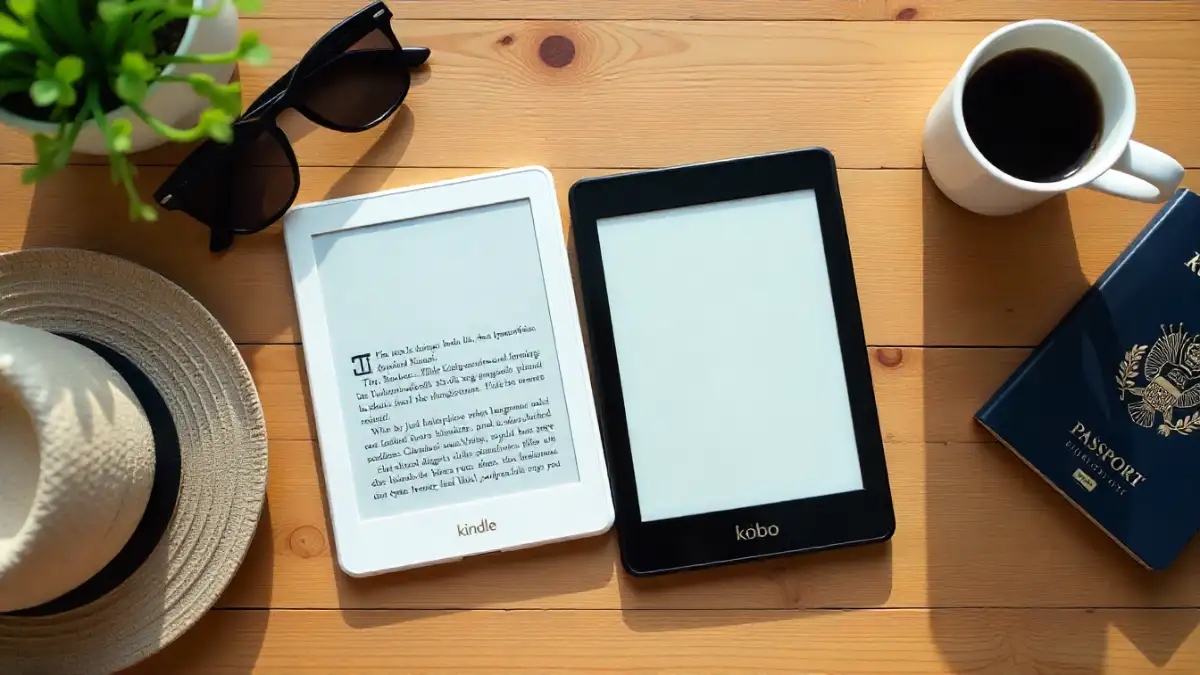
I’ll admit it—I used to be that person who insisted on dragging physical books through airports, somehow convincing myself that three hardcovers wouldn’t make my carry-on feel like I was smuggling bricks. Then I spent a month testing e-readers across six countries, and let me tell you, that romantic notion died somewhere over the Atlantic when my shoulder started protesting.
The question isn’t whether you need an e-reader for travel anymore. It’s which one actually delivers when you’re dealing with glaring Mediterranean sun, a dying phone battery, and that crucial plot twist at 35,000 feet. After putting both the Kindle Paperwhite (11th generation) and the Kobo Clara 2E through their paces—from beach loungers in Portugal to cramped train compartments in Switzerland—I’ve got some strong opinions about which device earns its spot in your travel tech arsenal.
The Setup: What We’re Actually Comparing
Before we dive in, let’s establish what we’re working with. The Kindle Paperwhite I tested is Amazon’s latest iteration, sporting a 6.8-inch display with 300 PPI resolution, adjustable warm light, and IPX8 waterproofing. It retails for $139.99 in the base configuration, though you’ll want to spring for the ad-free version unless you enjoy staring at skincare promotions before your thriller kicks in.
The Kobo Clara 2E matches that 300 PPI sharpness on a slightly smaller 6-inch screen, adds the same warm light and waterproofing credentials, but throws in something unexpected: it’s made from over 85% recycled plastic. At $129.99, it undercuts Amazon’s offering while championing sustainability. On paper, they’re remarkably similar. In practice? That’s where things get interesting.
Screen Real Estate: Size Actually Matters When You’re Squinting
Here’s something I didn’t expect to care about as much as I did: that extra 0.8 inches on the Paperwhite makes a legitimate difference during long reading sessions. When I was reading in a cramped middle seat on a transatlantic flight, the larger display meant I could bump up the font size without feeling like I was flipping pages every thirty seconds. Over a six-hour flight, I turned pages roughly 200 fewer times with the Paperwhite at my preferred font size compared to the Clara 2E—and yes, I’m the kind of nerd who tracks this stuff.
But here’s the trade-off: the Clara 2E slipped into my jacket pocket with room to spare, while the Paperwhite always felt just slightly too large for truly casual portability. During a weekend in Barcelona, I found myself grabbing the Kobo for quick café stops because it didn’t create that telltale rectangular bulge that screams “tourist with expensive electronics.” The Paperwhite lived in my bag, which meant I reached for it less spontaneously.
The Reading Experience: Where the Real Differences Emerge
Both devices deliver that crucial e-ink experience that makes digital reading feel remarkably close to paper. In direct Mediterranean sunlight—where my phone became basically useless—both screens remained perfectly readable without cranking brightness to battery-draining levels. The 300 PPI resolution means text is crisp enough that you’d be hard-pressed to spot pixelation even if you held either device uncomfortably close to your face.
What surprised me was how differently they handle page turns. The Paperwhite’s page refresh feels marginally faster, but the Clara 2E’s implementation is smoother—less of that characteristic e-ink flash that can be distracting. During a particular night of insomnia in a Berlin hotel, I noticed the Kobo’s smoother transitions were easier on my eyes at 2 AM. It’s subtle, but over hundreds of pages, subtle adds up.
The warm light feature on both devices proved essential for evening reading. I tested both against each other with identical brightness and warmth settings, and honestly, they’re nearly indistinguishable. The Paperwhite offers 24 levels of adjustment versus Kobo’s similar granular control, but in practical terms, both let you dial in the perfect tone for any lighting condition.
The Ecosystem Battle: Amazon’s Grip vs. Kobo’s Freedom
This is where your decision might already be made for you, and it has nothing to do with hardware. If you’ve accumulated a substantial Kindle library over the years, the Paperwhite integrates seamlessly with your existing collection. Whispersync means you can switch between devices mid-chapter without losing your place. The recommendation engine, while occasionally pushy, has gotten genuinely good at suggesting books I actually want to read.
But here’s where the Kobo Clara 2E won me over during testing: its open approach to file formats. I loaded EPUB files from my local library, dragged over DRM-free purchases from independent bookstores, and even transferred some PDF travel guides. The Paperwhite? You’re converting files or using Amazon’s Send to Kindle service, which works but adds friction. For a two-week trip through Eastern Europe where I wanted local guidebooks and indie travel narratives, the Kobo’s flexibility was genuinely liberating.
The Clara 2E also plays nicely with public library systems through OverDrive integration. I borrowed three books during my testing period without leaving the device, and the process was smoother than the Kindle’s library approach. If you’re a library power user, this alone might tip the scales.
Battery Life: The Number That Actually Matters on the Road
Amazon claims six weeks for the Paperwhite; Kobo suggests “weeks” for the Clara 2E. In real-world travel conditions—reading 90 minutes daily with Wi-Fi off most of the time and brightness at 40-50%—I got remarkably similar performance from both. The Paperwhite lasted 26 days before demanding a charge. The Clara 2E made it 24 days.
What matters more for travel: both devices easily survive a two-week trip without needing to compete for outlet space with your phone, tablet, and laptop. I used both across multiple countries without once worrying about battery anxiety. The USB-C charging on both models means you’re carrying one less cable type, though I wish Amazon had finally abandoned micro-USB earlier than they did on previous generations.
Water Resistance: Actually Tested (So You Don’t Have To)
Both devices claim IPX8 waterproofing, rated for submersion up to two meters for 60 minutes. I wasn’t about to intentionally drown either device, but I did test them in more realistic scenarios: reading by a pool in Lisbon with splashing kids nearby, getting caught in an unexpected downpour in Amsterdam, and yes, that one time I knocked over a water bottle directly onto the Paperwhite.
Both shrugged off everything I threw at them. The touchscreens remained responsive even with water droplets, though both became slightly finicky when actually wet—you’ll need to wipe them down for precise navigation. Neither showed any performance degradation after drying. For beach and poolside reading, either device delivers confidence that a surprise wave won’t brick your library.
Build Quality: Sustainability Meets Practicality
The Paperwhite feels premium. Its soft-touch backing is pleasant to hold, and the overall construction suggests it’ll survive getting tossed in a bag repeatedly. After a month of travel abuse, it looked essentially new save for some minor scuffing on the back.
The Kobo Clara 2E’s recycled plastic construction initially worried me—would eco-friendly mean fragile? Not at all. It actually survived better than I expected, though the texture is slightly more prone to showing fingerprints. What won me over was knowing that my reading habit wasn’t contributing to new plastic production. It’s a small thing, but for a device that could last five to seven years, that environmental consideration stuck with me.
Both devices feature physical bezels rather than edge-to-edge displays, which initially felt dated but proved practical. During turbulent flights, those bezels meant I could grip the devices without accidentally triggering page turns. Modern isn’t always better when you’re reading one-handed while hanging onto a subway pole.
The Verdict: It Actually Depends (But Here’s How to Decide)
After testing both devices across dozens of flights, train rides, and hotel rooms, I can’t declare a universal winner because the right choice depends entirely on how you read and what you value.
Choose the Kindle Paperwhite if:
- You’re already deep in Amazon’s ecosystem with a substantial Kindle library
- The larger screen appeals to you for longer reading sessions or larger fonts
- You value slightly faster page turns and Amazon’s recommendation engine
- You read primarily mainstream bestsellers and Amazon-sourced books
Choose the Kobo Clara 2E if:
- You want maximum file format flexibility and library system integration
- Smaller size and better pocket portability matter for your travel style
- You prefer supporting an open ecosystem over proprietary lock-in
- Environmental considerations factor into your purchasing decisions
- You read from multiple sources including public libraries and independent bookstores
In my own travel bag? I kept reaching for the Clara 2E. Its combination of portability, format freedom, and environmental consciousness aligned better with how I actually read while traveling. But I completely understand why the Paperwhite wins for people already invested in Amazon’s ecosystem—that integration and larger screen create real value.
The truth is, both devices are excellent e-readers that will serve you well through countless trips. You really can’t make a wrong choice here. What matters most is picking the one that fits your existing reading habits and library setup. Either way, you’ll wonder how you ever traveled with physical books, and your shoulders will thank you somewhere over the Atlantic.
