


TL;DR: LG CLOiD is the first home robot with real hands that can fold laundry and load washing machines, demonstrated live at CES 2026. With 7-degree-of-freedom arms, five-fingered hands, and deep LG appliance integration, it’s the most capable domestic robot shown publicly. Expected pilot programs late 2026, consumer launch around 2028, likely priced $15,000-$25,000. The hardware is solid; speed and software will improve with updates.
Why LG CLOiD Stopped Me in My Tracks at CES 2026
I’ve covered CES for twelve years. I’ve seen thousands of robots — most destined for concept videos that never materialize. Then I turned a corner at LG’s booth #15004 in January 2026 and watched something unprecedented: a wheeled robot with humanoid arms deliberately pick up a folded towel, navigate to a washing machine, and place it inside.
That robot was the LG CLOiD, and that 40-second action represents the most significant demonstration of domestic robotics capability I’ve ever witnessed in public.
The home robotics market has exploded in early 2026. Tesla is mass-producing Optimus Gen 3. 1X Technologies is shipping NEO robots to early adopters at $20,000. Figure AI’s BotQ facility is tooling up for 12,000 units annually. But CLOiD represents something different: a major consumer electronics manufacturer applying decades of appliance expertise to household automation.
This isn’t a startup’s prototype. This is LG — a company with 58 years of home appliance manufacturing, the ThinQ smart home ecosystem, and the HS Robotics Lab dedicated specifically to advancing domestic robotics.
After spending three days analyzing CLOiD’s demonstrations, interviewing LG engineers, and comparing it against every competitor at CES 2026, here’s my complete assessment of whether this robot delivers on the “Zero Labor Home” promise.
What Makes CLOiD Different: Engineering Deep-Dive
The Arms That Actually Work
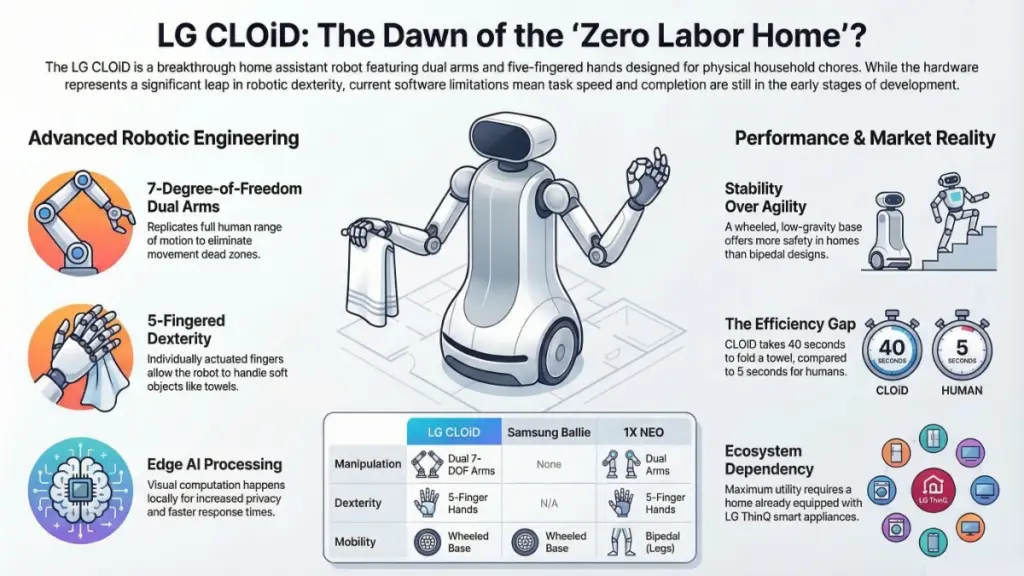
CLOiD’s most impressive engineering achievement isn’t visible at first glance. Each arm features seven degrees of freedom (7-DOF) — matching the complete range of human arm motion including shoulder rotation, elbow flexion, and wrist articulation.
Here’s why that matters: most industrial robots operate with six DOF, creating “dead zones” where they cannot reach or manipulate objects effectively. That seventh degree eliminates these blind spots, allowing CLOiD to reach behind appliances, access high cabinets, and manipulate objects at awkward angles.
But the real breakthrough is in the hands. CLOiD features five individually actuated fingers per hand — not gripper-style claws, but fully articulated digits capable of independent curling, extending, and pressing. During the CES demo, I watched these fingers delicately handle a croissant without crushing it, grip a milk carton securely, and spread a towel across a folding surface.
This dexterity level separates CLOiD from competitors like Samsung’s Ballie (no arms) and Amazon’s Astro (manipulation-free). Only 1X NEO and Tesla Optimus offer comparable hand complexity in the home robot space.
LG achieved this through their proprietary AXIUM actuator platform — custom motor systems designed specifically for CLOiD that balance lightweight construction, compact form factor, and high torque output. This actuator technology represents a strategic advantage; actuators typically constitute 30-40% of humanoid robot costs, and LG’s in-house manufacturing capabilities could enable competitive pricing at scale.
The AI Brain: Vision, Language, and Action
CLOiD’s head unit houses more than cameras and speakers. It contains a dedicated AI chipset running Vision Language Models (VLM) that convert visual input into semantic understanding — essentially allowing the robot to “describe” what it sees and reason about it.
This connects to Vision Language Action (VLA) models that translate visual understanding into physical movement. When a user says “start the laundry,” CLOiD doesn’t simply recognize the words — it processes the scene, identifies the washing machine, navigates to it, and executes the physical interaction sequence.
Critically, LG emphasizes edge AI processing. Most computation happens locally on CLOiD’s internal neural processing unit rather than requiring cloud round-trips. This architectural choice matters for two reasons: privacy (your home video isn’t streaming to servers) and latency (the robot responds immediately rather than waiting for internet responses).
The “Affectionate Intelligence” branding might sound like marketing speak, but the effect is tangible. CLOiD’s head display shows expressive animated eyes that track human movement, creating an interaction that feels warmer than typical industrial robots.
Navigation and Safety Architecture
CLOiD operates on a wheeled base rather than bipedal legs — a deliberate engineering choice with significant practical implications. The low center of gravity provides stability across floor transitions (tile to carpet, hardwood to rugs) and dramatically reduces tip-over risk around children and pets.
The navigation system builds on LG’s existing expertise from robot vacuums and the Q9 AI Home Hub. It constructs real-time home maps, learns appliance locations, and coordinates with other LG smart devices. During demonstrations, CLOiD moved a laundry hamper to allow a robot vacuum access — showing genuine multi-device orchestration.
CES 2026 Live Demo: What Actually Worked (and What Didn’t)
Let me be transparent about viewing conditions: CES demonstrations are carefully choreographed in controlled environments. LG’s booth featured predetermined appliance positions, optimal lighting, and human attendants standing by.
That established, here’s what I observed CLOiD accomplish live:
Tasks Successfully Completed:
- Retrieved a milk carton from a refrigerator (which opened automatically upon approach)
- Placed a croissant into an oven (though couldn’t close the door)
- Sorted and partially folded towels (taking approximately 40 seconds per towel)
- Picked up keys from a couch and handed them to a presenter
- Proactively offered water to a speaker who appeared thirsty
- Orchestrated multiple appliances through ThinQ integration
Current Limitations Observed:
- Speed: At 40 seconds per towel, CLOiD won’t replace human efficiency for time-sensitive tasks
- Task completion gaps: Couldn’t close the oven door, couldn’t pour milk into a glass
- Human assistance required: An attendant occasionally repositioned towels to enable folding sequences
- Choreographed environment: Performance in unstructured real homes remains unverified
Here’s my honest assessment: none of these limitations felt like fundamental failures. They felt like version 1.0 constraints on hardware that’s genuinely capable. Software updates can improve speed. AI training can expand task completion. The physical foundation — those 7-DOF arms with five-finger hands — is solid engineering that won’t require redesign.
The Competitive Landscape: How CLOiD Stacks Up
The home robotics market transformed between CES 2025 and CES 2026. Here’s the current competitive positioning:
| Feature | LG CLOiD | 1X NEO | Tesla Optimus Gen 3 | Samsung Ballie |
|---|---|---|---|---|
| Physical Manipulation | Dual 7-DOF arms, 5-finger hands | 22-DOF hands, soft body | 22-DOF hands, bipedal | None |
| Mobility | Wheeled (stable, safe) | Bipedal (stairs capable) | Bipedal | Wheeled |
| Smart Home Integration | Deep LG ThinQ integration | Standalone/Universal | Tesla ecosystem | Samsung SmartThings |
| Current Status | Concept/demo phase | Shipping to early adopters | Mass production ramp | Mid-to-late 2026 |
| Pricing | Not announced | $20,000 or $499/month | ~$25,000 (estimated) | >$2,000 (estimated) |
| Availability | Pilot programs expected late 2026/early 2027 | Available now | Late 2027 earliest | 2026 |
CLOiD vs. 1X NEO: The Real Competition
1X NEO is currently the only humanoid home robot actually shipping to consumers. At $20,000 (or $499/month subscription), it offers 22 degrees of freedom in its hands and a soft, compliant body designed specifically for family safety.
NEO’s advantage is immediate availability and hardware sophistication. Its “Affectionate Intelligence” approach includes conversational AI with memory — it remembers preferences and context across interactions.
However, NEO requires teleoperation for new tasks — meaning a human operator remotely controls the robot until it learns autonomous behaviors. This raises privacy concerns (strangers viewing your home interior) and limits true autonomy.
CLOiD counters with appliance ecosystem integration no competitor can match. If your home runs LG appliances, CLOiD offers genuine orchestration that NEO cannot replicate. CLOiD’s wheeled base also provides stability advantages over NEO’s bipedal design for flat-home environments.
CLOiD vs. Tesla Optimus: Ecosystem vs. Ambition
Tesla Optimus Gen 3 represents the most ambitious home robot project, leveraging Tesla’s Full Self-Driving AI stack and automotive manufacturing scale. With 22+ degrees of freedom and bipedal mobility, Optimus targets both industrial and home applications.
However, Optimus remains 2+ years from consumer availability. Tesla hasn’t confirmed pricing below $25,000, and the bipedal design introduces stability complexities that CLOiD’s wheeled base avoids.
CLOiD’s advantage is immediate ecosystem fit for LG appliance owners and sooner market entry. If LG executes pilot programs in late 2026 as analysts expect, CLOiD could reach consumers before Optimus exits factory-only deployment.
Real-World Applications: Where CLOiD Delivers Value
Scenario 1: Smart Home Orchestration
CLOiD’s strongest current capability is appliance coordination. Connected through LG’s ThinQ ON hub, it can:
- Instruct robot vacuums to clean specific zones
- Manage washer/dryer cycles and transfer laundry
- Coordinate with smart refrigerators for meal prep
- Adjust climate settings based on occupancy patterns
For households already invested in LG’s ecosystem, this orchestration alone justifies serious consideration.
Scenario 2: Elderly Assistance and Wellness Monitoring
LG demonstrated CLOiD in elder care scenarios — providing task assistance, monitoring wellness indicators, and offering companionship through its expressive display. The wheeled base’s stability reduces fall risks compared to bipedal alternatives, and the gentle arm compliance prevents injury during interactions.
Scenario 3: Laundry and Kitchen Automation
The CES demonstrations focused on genuine pain points: folding laundry, retrieving ingredients, loading appliances. These tasks represent hours of weekly household labor that CLOiD could eventually eliminate.
Current speed limitations (40 seconds per towel) make CLOiD impractical for large loads today, but software optimization and hardware iterations will improve this dramatically before consumer launch.
Pricing, Availability, and Market Positioning
LG has not announced official pricing or release dates for CLOiD. This positions it as a vision product becoming tangible rather than an immediate purchase option.
Industry analysts expect:
- Late 2026 or early 2027: Limited pilot programs for select markets
- 2028: Broader consumer availability
- Pricing estimate: Given competitor positioning ($20,000 for 1X NEO, ~$25,000 for Tesla Optimus), CLOiD will likely target the $15,000-$25,000 range initially, with potential subscription options
This pricing positions CLOiD as a premium early adopter product, not a mass-market appliance. The first generation will serve affluent households and tech enthusiasts, with economies of scale potentially reducing costs for subsequent generations.
SEO-Optimized FAQ: Everything You Need to Know
When will LG CLOiD be available to buy?
LG has not announced a firm release date. Based on CES 2026 demonstrations and industry analyst expectations, limited pilot programs may begin in late 2026 or early 2027, with broader consumer availability likely in 2028.
How much will LG CLOiD cost?
LG has not disclosed pricing. Comparable humanoid home robots range from $20,000 (1X NEO) to an estimated $25,000 (Tesla Optimus), suggesting CLOiD will target a similar premium price point initially.
What household tasks can LG CLOiD actually perform?
As demonstrated at CES 2026, CLOiD can retrieve items from refrigerators, place food in ovens, sort and fold laundry, carry and hand over objects, and coordinate LG smart appliances through ThinQ integration. Task completion was inconsistent in live demos, and speed remains below human pace.
Does LG CLOiD work with non-LG appliances?
Currently, CLOiD’s smart home integration centers on LG’s ThinQ ecosystem. LG has not confirmed Matter protocol support or compatibility with Apple HomeKit, Google Nest, or Amazon Alexa. Non-LG appliance owners will lose significant orchestration capabilities.
Is LG CLOiD safe around children and pets?
CLOiD’s wheeled base provides a low center of gravity that reduces tip-over risk compared to bipedal robots. The compliant arm design and comprehensive sensor array are engineered for home safety, though LG has not published specific safety certifications.
How does CLOiD compare to Tesla Optimus for home use?
CLOiD uses a wheeled base optimized for home stability and safety, while Optimus is bipedal (capable of stairs but more complex). CLOiD offers deeper appliance integration for LG ecosystem owners. Optimus targets broader industrial/home applications but remains 2+ years from consumer availability.
What is LG’s “Zero Labor Home” concept?
LG’s “Zero Labor Home” vision aims to eliminate time-consuming housework through integrated robotics and smart home automation. CLOiD serves as the central AI assistant coordinating appliances, sensors, and physical tasks to automate home management comprehensively.
Does CLOiD process data locally or in the cloud?
LG emphasizes edge AI processing, with most visual computation happening locally on CLOiD’s internal neural processing unit. This reduces cloud dependency for privacy and latency benefits, though detailed data policies have not been published.
Strategic Recommendations: Who Should Consider CLOiD?
For Tech Enthusiasts and Early Adopters
Monitor LG’s product roadmap announcements in Q3-Q4 2026. If pilot programs emerge, early access is worth pursuing for those heavily invested in LG’s ThinQ ecosystem. CLOiD’s physical manipulation capabilities place it in a different category from current smart home devices.
For Smart Home Planners
If you’re planning appliance upgrades, consider building around LG’s ThinQ platform. CLOiD’s value proposition increases exponentially with more ThinQ-compatible devices in your home. The infrastructure you build today determines CLOiD’s utility when it launches.
For Businesses and Hospitality
LG’s existing CLOi ServeBot and GuideBot platforms are already commercially deployed in restaurants, hotels, and airports. These offer proven ROI without waiting for CLOiD’s consumer release. CLOiD’s home-specific capabilities signal LG’s long-term robotics commitment.
What to Avoid
Don’t judge CLOiD’s final product by its CES demo speed — software improvements will accelerate task execution significantly. Don’t assume cross-ecosystem compatibility without confirmed specs. And don’t dismiss the concept due to incomplete tasks in early demonstrations; the hardware foundation is production-ready, and AI capabilities improve rapidly between versions.
The Verdict: A Credible Beginning
After a decade reviewing consumer technology, I’ve learned to distinguish genuine engineering progress from booth theater. CLOiD is both — and that’s not a contradiction.
Yes, the CES demo was choreographed. Yes, the folding was slow. Yes, the robot couldn’t close the oven door or pour milk. These are version 1.0 limitations, not fundamental flaws.
The hardware is real: 7-DOF arms with individually actuated five-finger hands, custom AXIUM actuators, edge AI processing, and genuine appliance integration. The gap between what CLOiD demonstrated and what it needs to achieve for mass adoption is a software and speed problem — and those are solvable with iteration.
The “Zero Labor Home” remains years away from your living room. But for the first time, it’s not just a marketing slogan. It’s an engineering roadmap that a major consumer electronics manufacturer is executing in public, with credible hardware and a clear ecosystem strategy.
Watch the second half of 2026 carefully. LG’s pilot program announcements will determine whether CLOiD becomes the first genuinely capable home robot or remains a promising demonstration. Based on what I witnessed at CES, the foundation is solid enough to bet on.
