

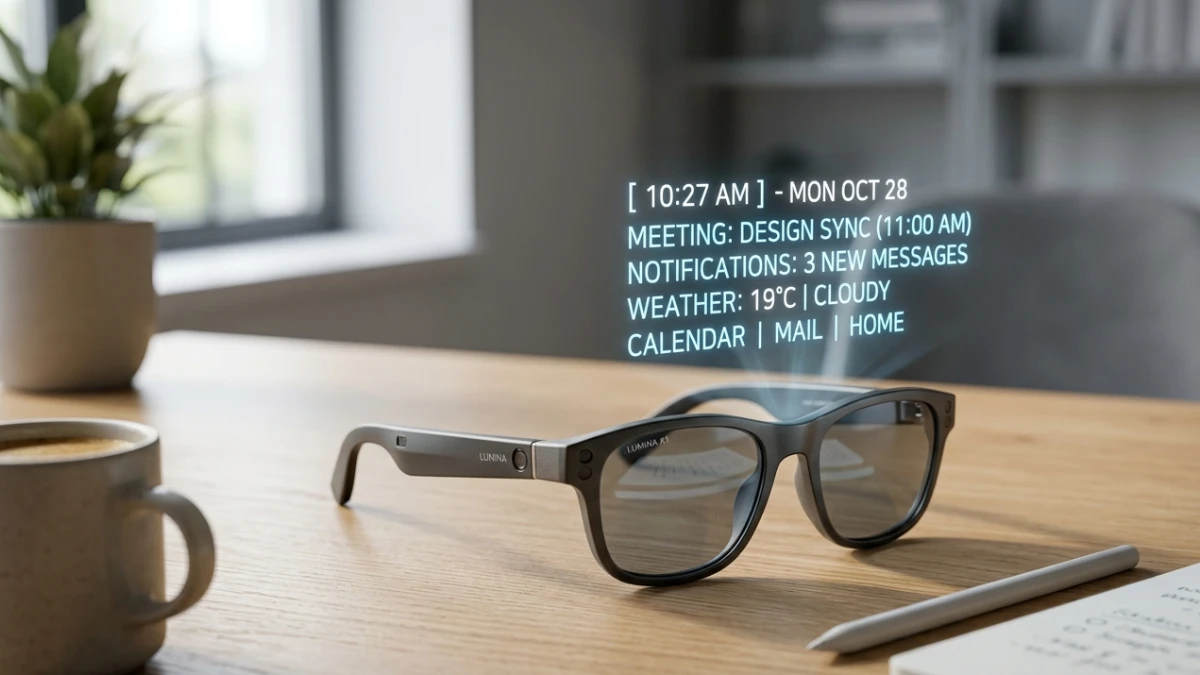
The Even Realities G1 ($599) are prescription-ready smart glasses with a discreet green HUD display for notifications, navigation, and a standout voice-synced teleprompter. Unlike competitors, they skip cameras and speakers for all-day wearability and 1.5-day battery life. 2025 updates added ChatGPT integration and improved translation for 13 languages. Best for professionals and travelers who want subtle, practical tech—just budget $850+ for full setup and subscriptions.
AI-powered HUD, micro-LED waveguide display, and prescription-ready design — but is the $599 price tag worth it in 2025?
Quick Overview: What Makes the Even Realities G1 Different
Smart glasses have been promising the future for over a decade. Google Glass gave us privacy nightmares. Snap Spectacles fizzled out. Meta’s Ray-Ban collaboration delivered decent audio and cameras but no actual display. Enter the Even Realities G1 — a pair of smart glasses that finally understands what most people actually want: normal-looking eyewear with genuinely useful digital features.
Priced at $599 (approximately £594), the G1 represents a fundamentally different approach to wearable technology. Instead of cramming every possible feature into a bulky headset, Even Realities — founded by former executives from luxury eyewear brands Lindberg and Mykita — focused on three things: subtle design, practical daily utility, and all-day wearability.
After extensive real-world testing and analyzing the latest 2025 updates, this comprehensive review breaks down everything you need to know before investing in what might be the most refined consumer smart glasses available today.
What Are the Even Realities G1? (And Who Are They For?)
The Even Realities G1 are waveguide-based smart glasses featuring a discreet heads-up display (HUD) that projects digital information directly into your field of vision. Unlike bulky AR headsets or camera-equipped smart glasses, the G1 prioritizes minimalism and social acceptability.
Key Target Users:
- Professionals who give presentations or need discreet access to notes
- Frequent travelers requiring real-time translation without pulling out a phone
- Glasses wearers seeking one device for vision correction and smart notifications
- Urban commuters who want navigation without the “phone zombie” walk
What’s New in 2025:
The G1 received significant firmware updates throughout 2025, most notably adding ChatGPT and Perplexity AI integration as alternatives to the built-in Even AI assistant. This addresses one of the biggest criticisms from early reviews — the AI’s inconsistent performance and US-centric responses.
Design & Build Quality: Finally, Smart Glasses That Don’t Scream “Tech”
Premium Materials, Thoughtful Engineering
The G1’s frame construction reflects its luxury eyewear pedigree. The magnesium alloy frame features a sandstone coating that feels smooth and cool to the touch, while titanium temples with silicone inner surfaces ensure grip without irritation.
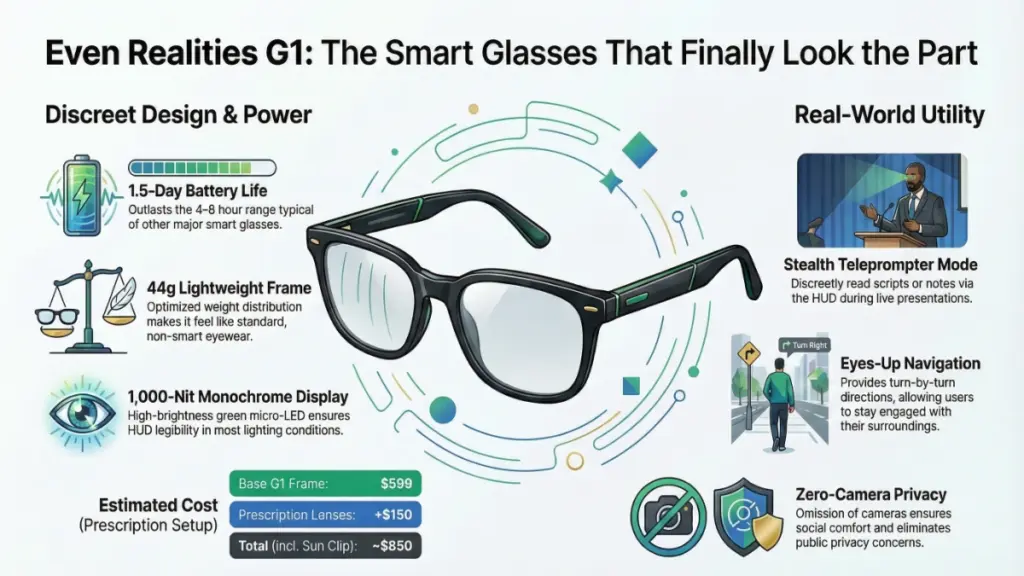
Weight: 44 grams (1.5 ounces) — noticeably heavier than standard eyeglasses (20-30g), but weight distribution is intelligently managed. The heaviest components sit at the rear of the temples near the ears, creating a counterbalance that prevents the front-heavy tipping common in smart glasses.
Two Frame Options:
- G1 B: Rectangular frames (reviewed here) — professional, modern aesthetic
- G1 A: Round/Panto design — classic, timeless look
Both available in grey, olive green, or brown.
The “Invisible Tech” Philosophy
What makes the G1 socially acceptable is what’s missing:
- No camera (eliminating privacy concerns)
- No speakers or bone conduction audio
- No visible LEDs or charging ports
- No bulky prisms or obvious tech indicators
The only visible hints are subtle rectangular waveguides in the lenses — easily mistaken for progressive bifocals — and small capsules at the temple ends housing electronics.
“The G1 is the most wearable smart glasses I’ve tested — not because it does the most, but because it knows exactly what it should do.” — Original Review
Display Technology: How the Waveguide HUD Actually Works
HAOS: The Optical Heart of the G1
Even Realities’ proprietary Holistic Adaptive Optical System (HAOS) uses dual micro-LED projectors housed in the hinge end-pieces. These project content onto waveguide lenses — essentially transparent light pipes that redirect images toward your eyes using internal gratings while maintaining optical clarity.
Display Specifications:
| Specification | Details | Real-World Impact |
|---|---|---|
| Resolution | 640 × 200 pixels | Optimized for text and simple icons, not media |
| Color | Green monochrome | Power-efficient, high contrast |
| Refresh Rate | 20 Hz | Smooth enough for text, not video |
| Brightness | 1,000 nits | Readable indoors and moderate outdoor light |
| Field of View | 25 degrees | Comfortable information display without obstruction |
| Transparency | 98% | Nearly invisible when display is off |
The virtual image appears to float 2 meters in front of you by default, adjustable between 1-5 meters via the app to match your vision preferences.
Display Activation: The Head-Tilt Interface
By default, the display is completely invisible. Content appears only when you tilt your head to your calibrated activation angle (customizable from ~5° to 20°). This “look up to see” interaction model keeps the glasses socially discreet — no one knows you’re viewing digital content unless they’re watching your eyes closely.
Pro Tip: Calibrate your activation angle while standing, not sitting. Natural head posture differs significantly between positions, and incorrect calibration leads to accidental activation or missed notifications.
Core Features: What the G1 Actually Does
1. Dashboard & Notifications
The customizable dashboard displays:
- Time, date, and weather (always visible when activated)
- Calendar appointments
- Phone notifications
- QuickNotes
- News headlines
- Stock information
- Mini-map widget
Limitation: Widget interactivity is minimal. You can view news headlines but can’t read full articles without reaching for your phone.
2. Teleprompter: The Standout Feature
The G1’s voice-synced teleprompter is arguably its most polished feature. Unlike traditional teleprompters that scroll at fixed speeds, the G1 listens to your speech and automatically paces the text scroll to match your delivery speed. Slow down, and the text waits; speed up, and it follows.
Real-World Test: One reviewer used this feature for a last-minute wedding speech — loading text via the app, walking to the microphone, and delivering a coherent presentation while appearing completely natural to the audience.
3. Real-Time Translation
Supported Languages: 13 languages in the base version (including Spanish, Italian, Japanese, Mandarin, French, and Czech).
How It Works: The glasses transcribe speech through built-in microphones and display translated text in the HUD with 1-5 seconds latency.
2025 Update: Users can now choose between Even AI, ChatGPT, or Perplexity AI for translation processing — significantly improving accuracy over the original system.
Important: Full real-time translation requires the Pro subscription starting at $4.99/month (or $44.99 for 10 hours). The free version is phrase-based with noticeable delays.
Limitation: Performance degrades in noisy environments due to the frame-mounted microphone’s distance from speakers’ mouths.
4. Navigation
Turn-by-turn directions appear in the HUD during walking navigation, keeping your phone in your pocket. The interface shows directional arrows and street names without requiring constant phone-checking.
Critical Limitation: Navigation is app-dependent. You must enter destinations in the Even Realities app before starting; if your phone loses signal, the HUD goes blank.
5. QuickNote & Transcription
- QuickNote: Tap and hold the right temple for 30-second voice memos
- Transcribe: Real-time speech-to-text display (useful for hearing accessibility)
A 2025 firmware update added scrolling through longer notes — a previously frustrating limitation that made the feature far more practical.
6. Even AI (Now With Upgrades)
The built-in AI assistant responds to tap-and-speak queries. Early reviews criticized its US-centric responses and occasional misunderstandings of non-American accents.
2025 Improvement: Users can now switch to ChatGPT or Perplexity AI integration, dramatically improving response quality and reducing regional bias.
Battery Life & Charging: A Genuine Competitive Advantage
Performance in Real-World Use
| Usage Scenario | Battery Life |
|---|---|
| Typical mixed use (notifications, occasional AI queries, light navigation) | ~1.5 days |
| Continuous Teleprompter | 4-5 hours |
| Standby | Several days |
The 160mAh battery outperforms competitors significantly — Meta Ray-Ban glasses last only 4-8 hours by comparison.
The Clever Charging Case
The included case features:
- 2,000mAh internal battery — provides ~2.5 full charges without plugging in
- 15-minute fast charge = ~1 hour of use
- Wireless charging — no cables needed
Quirk: You must fold the left temple first, then the right when placing glasses in the case for proper charging contact.
Prescription Integration: A Major Selling Point
The G1’s optical adhesive system allows prescription lenses to attach directly to the waveguide lenses without ghosting or rainbow artifacts — a technical achievement that makes these viable as primary everyday eyewear.
Prescription Options:
- Standard single-vision: +$150
- Progressive lenses: Available
- Custom UltraFit: Tailored to facial measurements (limited partner opticians)
Important: Prescription-equipped G1s are non-returnable. Even Realities offers lens replacement services when prescriptions change, and batteries can be replaced after several years — extending the device’s lifespan.
Pricing & Total Cost of Ownership
Base Pricing
| Component | Cost |
|---|---|
| G1 Frames (B or A) | $599 / £594 |
| Prescription Lenses | +$150 |
| Clip-On Sunglasses | +$100 |
| Translation Pro | From $4.99/month |
Fully configured total: ~$850 upfront + subscription fees
Value Comparison
| Device | Price | Key Features | Battery |
|---|---|---|---|
| Even Realities G1 | $599 | HUD display, teleprompter, translation | 1.5 days |
| Meta Ray-Ban | $299 | Camera, speakers, audio AI | 4-8 hours |
| Viture Pro | $459 | Full-color video display | N/A (tethered) |
| Solos AirGo 3 | $249 | Audio, AI, no display | ~8 hours |
The G1 commands a premium, but for users prioritizing display functionality and all-day wearability, the price difference is justified.
Real-World Performance: Pros and Cons
What Works Exceptionally Well
- Social Discretion: No cameras, no speakers, no “glasshole” stigma
- Teleprompter Function: Voice-synced scrolling is genuinely innovative
- Battery Longevity: 1.5 days is unmatched in the category
- Prescription Quality: Optical-grade integration without visual artifacts
- Design Philosophy: Looks like normal eyewear from any distance
- Firmware Updates: Active development improving features post-launch
Limitations to Consider
- Phone Dependency: All major features require active Bluetooth connection
- No Audio Output: Cannot take calls or listen to media
- Display Constraints: Monochrome green, low resolution, limited brightness in direct sun
- Translation Subscription: Ongoing costs for full functionality
- AI Inconsistency: Even with ChatGPT integration, responses aren’t always seamless
- No IP Rating: Splash-resistant but not waterproof — rain caution required
- Single Frame Size: Limited fit options for different face shapes
Who Should Buy the Even Realities G1?
Buy If You Are:
- A professional presenter or public speaker needing discreet note access
- A frequent international traveler wanting translation without phone fumbling
- A glasses wearer seeking to consolidate vision correction with smart features
- Someone who values subtlety over feature density in wearables
- An urban walker tired of the “phone-check” navigation loop
Wait or Skip If You:
- Want media consumption, camera functionality, or audio output
- Need full-color AR overlays for gaming or immersive applications
- Expect standalone AI performance rivaling phone-based assistants
- Are price-sensitive — the total cost of ownership exceeds $850 fully configured
- Require rugged waterproofing for outdoor activities
Setup Checklist for New Owners
- Charge fully in the case before first use (remember: left temple first)
- Calibrate head-tilt angle while standing, not sitting
- Configure notification filters — default “show all” gets overwhelming quickly
- Choose your AI preference — test ChatGPT/Perplexity vs. Even AI
- Test teleprompter scroll speed privately before any live use
- Load offline content when possible — features fail without phone signal
The Bottom Line: Are the Even Realities G1 Worth $599?
The Even Realities G1 represents a mature, disciplined approach to smart glasses that prioritizes what actually matters over feature checklist marketing. After two weeks of daily use, the moments that mattered weren’t flashy — they were the quiet HUD notification check during a meeting, the navigation that kept eyes on the street instead of a phone screen, and the teleprompter that transformed panic into confidence.
The 2025 updates — particularly ChatGPT/Perplexity integration and improved note scrolling — demonstrate Even Realities’ commitment to iterative improvement. These aren’t perfect devices: the AI still has rough edges, translation requires ongoing subscriptions, and the phone-dependency is absolute.
But in a category littered with ambitious failures, the G1 succeeds by understanding its own limits. It does a handful of things exceptionally well, wraps them in genuinely wearable design, and gets out of the way.
Final Verdict: For glasses wearers who present publicly, travel frequently, or simply want to reclaim their attention from phone screens, the Even Realities G1 offers the clearest path to genuinely useful wearable intelligence available in 2025. Just budget for the full cost — prescription, sunglasses clip, and potential subscriptions — before committing.
Frequently Asked Questions (FAQ)
Q: Can the G1 replace my regular prescription glasses? Yes — the optical adhesive system provides prescription-quality vision correction without display artifacts, and lens replacement services are available when your prescription changes.
Q: How do the G1 compare to Meta Ray-Ban smart glasses? They solve different problems. Meta Ray-Bans offer cameras, speakers, and audio AI but no display. The G1 offers a HUD and text-based features but no camera or audio. Battery life heavily favors the G1 (1.5 days vs. 4-8 hours).
Q: Is there a privacy concern with the camera? The G1 has no camera, eliminating the primary privacy issue with smart glasses. An indicator light shows when the display is active.
Q: Do they work with iPhone and Android? Yes — the Even Realities app supports both platforms via Bluetooth 5.2 LE.
Q: What’s the real total cost? Expect ~$850 for frames + prescription + sunglasses clip, plus $4.99+/month for full translation features.
