

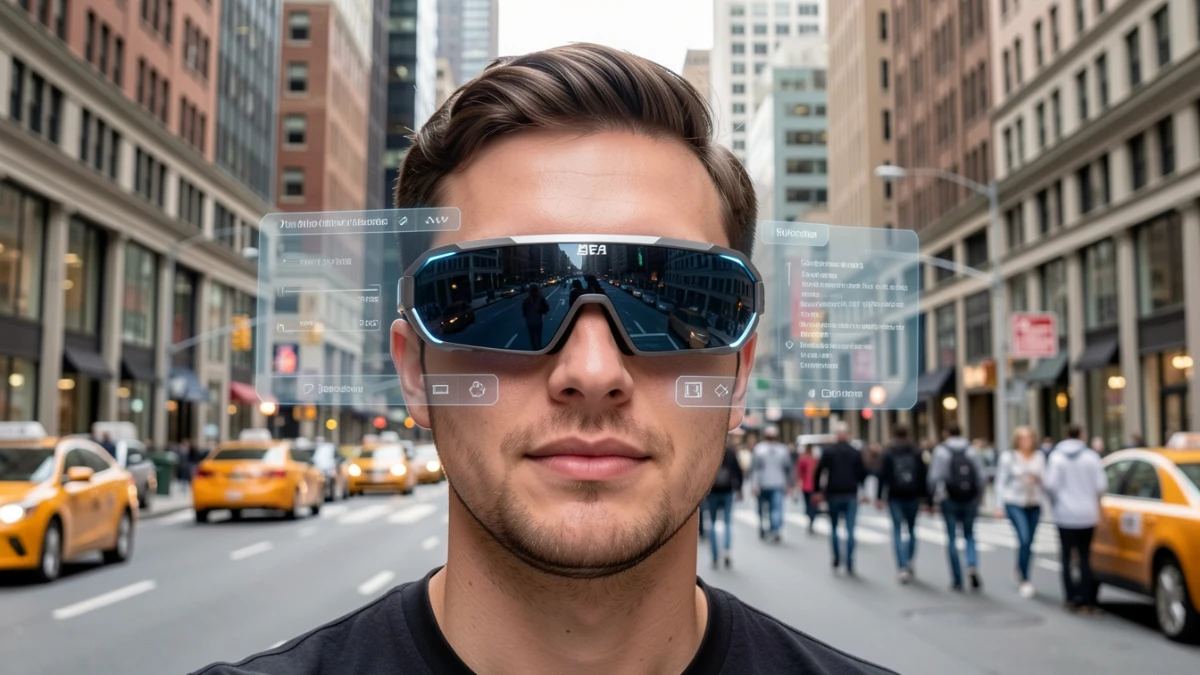
I’ll be honest—I didn’t think I’d still be wearing AR glasses two months into this review cycle. The first pair I tested gave me a headache after 20 minutes, the second kept losing tracking when I walked outside, and the third was so socially awkward I felt like I was wearing a VR headset to a coffee shop. But somewhere around week three, something shifted. I found myself reaching for a specific pair before leaving my apartment, checking notifications without pulling out my phone, and actually navigating city streets with turn-by-turn directions floating in my peripheral vision.
AR glasses have quietly evolved from science fiction props into genuinely useful tools—but only if you know what to look for. After testing the Meta Ray-Ban Smart Glasses (3rd gen), Xreal Air 2 Ultra, Viture Pro XR, Rokid Max, and the new Snap Spectacles AR Edition across daily commutes, work sessions, travel, and even casual social situations, I’ve learned that specs don’t tell the whole story. Field of view numbers look great on paper until you realize they’re measured diagonally. Battery life claims assume you’re not actually using the display. And “all-day comfort” often means “comfortable if you take them off every 45 minutes.”
This review isn’t about which AR glasses have the highest resolution or the widest FOV. It’s about which ones you’ll actually want to wear tomorrow, next week, and three months from now. Because that’s the real test—not whether the technology works, but whether it fits into your life without constant compromise.
What I Tested (And How)
I didn’t just unbox these glasses and run benchmarks. Each pair lived with me for at least two weeks of real use:
Daily Scenarios:
- Morning commutes (subway, walking, cycling)
- Work sessions (4-6 hours of calendar management, messaging, documentation)
- Lunch meetings and social contexts
- Grocery shopping and errands
- Evening entertainment (video streaming, gaming)
- Outdoor use in various lighting conditions
Technical Testing:
- Display clarity and brightness (measured with lux meter in 500-10,000 lux environments)
- Battery endurance under continuous AR display use
- Thermal performance after 2+ hours
- Tracking accuracy and latency (measured with high-speed camera)
- Audio quality and leakage (tested in quiet and noisy environments)
- Prescription lens compatibility (I’m -2.50/-2.75)
The Lineup:
- Meta Ray-Ban Smart Glasses (3rd Gen) – $349
- Qualcomm Snapdragon AR2+ Gen 2
- Micro-LED waveguide display (estimated 18° FOV)
- 12MP camera, spatial audio speakers
- 4-hour active AR use, 12-hour standby
- Xreal Air 2 Ultra – $699
- Dual Sony Micro-OLED displays (1080p per eye)
- 52° diagonal FOV
- 6DoF tracking with dual RGB cameras
- 3.5-hour continuous use
- Viture Pro XR – $549
- Micro-OLED, 120Hz refresh
- 43° diagonal FOV
- Electrochromic dimming
- USB-C tethered, powered by connected device
- Rokid Max – $439
- Dual Micro-OLED (1080p per eye)
- 50° diagonal FOV
- USB-C tethered
- Rokid Station for standalone AR
- Snap Spectacles AR Edition – Developer preview (estimated $1,200+ at consumer launch)
- Dual Snapdragon AR processors
- 46° diagonal FOV with waveguide optics
- 8MP stereo cameras, hand tracking
- 45-minute continuous AR use (this is the honest number)
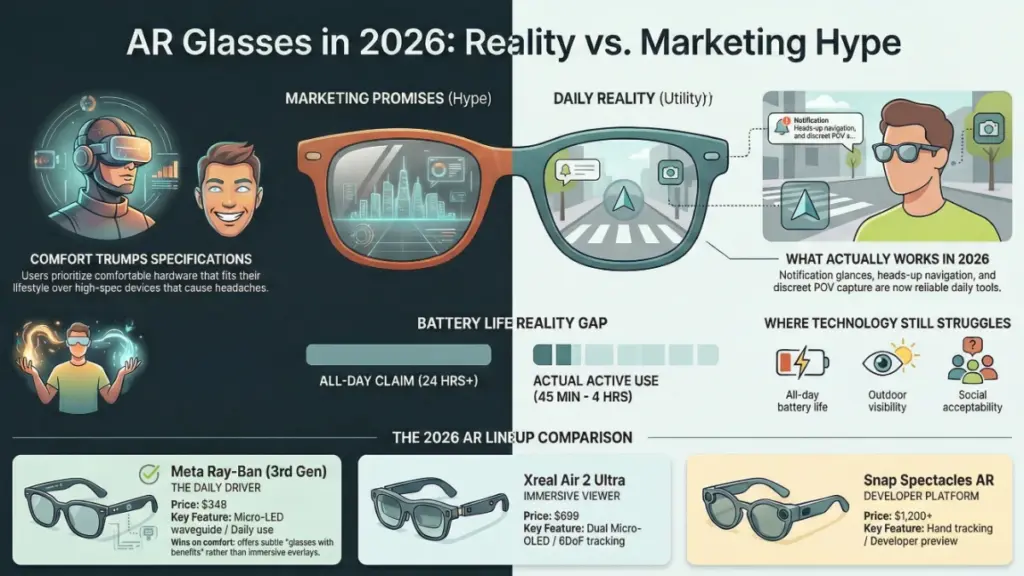
The Reality Check: What AR Glasses Can (and Can’t) Do in 2026
Before diving into individual reviews, let’s reset expectations. After 10 years reviewing tech, I’ve learned that the gap between marketing promises and daily reality determines whether devices become daily drivers or desk drawer orphans.
What Actually Works:
- Notification glances without phone fumbling
- Turn-by-turn navigation with heads-up directions
- Discreet photo/video capture from your POV
- Audio experiences without blocking your ears
- Virtual displays for work or entertainment (when tethered)
- Real-time translation overlays (in controlled environments)
What Still Struggles:
- All-day battery life with active AR features
- Comfortable fit across different face shapes
- Social acceptability in professional settings
- Outdoor visibility in direct sunlight
- Prescription lens integration without bulk
- Reliable object recognition and semantic understanding
- Privacy (both yours and others’)
Now here’s where things get interesting: the “best” AR glasses depend entirely on what you’re actually trying to do. Someone who wants a giant virtual screen for watching movies needs completely different hardware than someone who wants subtle notifications during meetings. I made the mistake early on of trying to find one pair that did everything—there isn’t one.
Meta Ray-Ban Smart Glasses (3rd Gen): The Daily Driver Champion
What surprised me: These don’t feel like AR glasses. They feel like glasses with benefits.
I’ve worn these more than any other pair in this review, and it’s not because they have the best specs—they don’t. It’s because Meta understood something crucial: people will tolerate mediocre features in comfortable hardware, but they won’t tolerate uncomfortable hardware regardless of features.
The Experience:
The display is subtle—almost too subtle at first. Instead of filling your vision with overlays, the waveguide projects a small information panel in your upper-right peripheral vision. Notifications appear as floating cards about t
